I’m pleased to announce that a metrological mystery has been solved. The “Ellifino”, which is intrinsically related to well known ancient units through geometry, as been identified as 1.8 of a Pied du Roi (French foot) of 1.067438159 ft that is far more ancient than it normally gets credit for.
1 Pied du Roi 1.067438159 ft x 1.8 = 1 Ellifino 1.921388686 ft
Many thanks to Geoff Bath for providing me with more information about the possible greater antiquity of the Pied du Roi, including its identification with the Hashimi Cubit.
This helps to also establish the legitimacy and antiquity of the Pied du Roi though its geometric relationships to other units, as well as helping to establish the legitimacy and antiquity of the “Ellifino”, which may have been used in the design of the interior of the Great Pyramid.
Many people might already be familiar with the Vesica Piscis scheme that relates a number of well known ancient units of measurement to one another via square root 2, square root 3, and square root 5.
This scheme seems to suggest that the Ancient Egyptians were aware of the Megalithic Yard, and indeed we can point to this being in apparent evidence at Giza, starting with the possibility that the fundamental unit of the Great Pyramid’s base is the Megalithic Yard and NOT the Royal Cubit.
Note that even Wikipedia concedes the possibility of the legitimacy of the Megalithic Yard through geometric relationships, before dismissing the possibility for lack of corresponding units in Megalithic architecture, even while corresponding units like the Remen and Royal Cubit (and other ancient units) ARE in evidence at Stonehenge and other Megalithic sites.
https://en.wikipedia.org/wiki/Megalithic_Yard
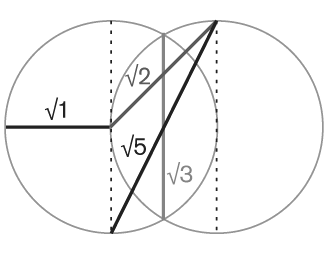
If square root 1 equals the Remen (approx. 1.216 ft), then square root 2 equals the Royal Cubit (approx. 1.72 feet), square root 3 equals the Palestian Cubit (approx. 2.107 ft), and square root 5 = the Megalithic Yard (approx. 2.72) feet.
The diagonal of a cube is also sqrt 3 in length if the length of the sides is 1.
The Megalithic Yard is a controversial unit credited to Professor Alexander Thom from his extensive work on Megalithic sites in the UK, but clearly the ancient Egyptians were in a position to know it quite well via this well known sacred geometry. We seem to be able to find them having made use of it at Giza and elsewhere in Egypt.
(The Palestinian Cubit is also the diagonal of a rectangle measuring 1 Remen by 1 Royal Cubit).
For the former “Ellifino”, it relates to the Royal Cubit (about 1.72 feet) and the Megalithic Yard (about 2.72 feet) thus
(1.72 / 2) x sqrt 5 = 1.923018461
(2.72 / 2) x sqrt 2 = 1.923330445
(2.72 x sqrt 3) = 1.177 x 4, by the way, so the Harris-Stockdale Megalithic Foot would also have a geometric relationship to the Megalithic Yard.
Ancient units can also be related to each other through circular geometry.
We’ve already seen a bit of that with the Aztec Sun Stone, so we know that if the circumference of a circle is 11.77245771 ft, the radius will be Flinders Petrie’s neglected Stonehenge Unit.
Imagine if you will a series of circles in which the circumference of one circle becomes the radius of the next circle.
Note that here I am more or less equating Carl Munck’s “Alternate Pi” 1.177245771 with the Harris-Stockdale Megalithic Foot of ~1.178 ft, and as usual am not paying a lot of attention to proper decimal placement – it really isn’t important here.
| Radial Value | x 2 Pi = | Circumferential Value |
| 1.789199019 = 1 / 5.589093161 = Aubrey 56 #1 | x 2 Pi = | 1.124186899 = Petrie Stonehenge Unit / 2 |
| 1.124186899 | x 2 Pi = | 7.063474605 = 6 x 1.177245771 = ~6 HSMF |
| 7.063474605 | x 2 Pi = | 4.438111985 = SRVS / 2 |
| 4.438111985 | x 2 Pi = | 2.788548002 = Vara? |
| 2.788548002 | x 2 Pi = | 1.752096383 |
| 1.752096383 | x 2 Pi = | 1.100874625 = Indus Ft |
| Radial Value | x 2 Pi = | Circumferential Value |
| sqrt 3.75 | x 2 Pi = | 12.16733603 (10 Remens) |
| 12.16733603 | x 2 Pi = | 76.44962696 (1/4 inner circumf. SH sarcen circle) |
| 76.44962696 | x 2 Pi = | 480.83471728 (Munck ht Cheops pyr. = 450 Pied du Rois) |
| 480.83471728 | x 2 Pi = | 3018.110298 (Munck perim. Cheops pyr. = 1800 x 1.676727943) |
| Radial Value | x 2 Pi = | Circumferential Value |
| 1 / 1.323891319 | x 2 Pi = | 4.745997815 1 / Palestinian Cubit = 1 / 2.107038475 |
| 4.745997815 | x 2 Pi = | 2.981998374 = 5 / 1.676727943 |
| 2.981998374 | x 2 Pi = | 1.873644837 Petrie Stonehenge Unit in feet |
| 1.873644837 | x 2 Pi = | 1.177245771 ~HSMF |
| 1.177245771 | x 2 Pi = | 7.396853331 Sqr, Munck Megalithic Yard |
| 7.396853331 | x 2 Pi = | 4.647580017 = sqrt 2160 |
| 4.647580017 | x 2 Pi = | 2.920160646 = 24 Remens |
| 2.920160646 | x 2 Pi = | 1.834791048 |
| 1.834791048 | x 2 Pi = | 1.152833215 = 108 Pied du Roi |
| Radial Value | x 2 Pi = | Circumferential Value |
| 2.719256444 Incidental MY | x 2 Pi = | 1.708559214 |
| 1.708559214 | x 2 Pi = | 1.073519415 |
| 1.073519415 | x 2 Pi = | 6.745121413 (Radian x 1.177245771 |
| 6.745121413 | x 2 Pi = | 4.238084776 = Radian x SMMY |
| 4.238084776 | x 2 Pi = | 2.662867199 |
| 2.662867199 | x 2 Pi = | 1.673128806 = historical unit of ~510 mm? |
| 1.673128806 | x 2 Pi = | 1.051257833 = 864 Remens |
| 1.051257833 | x 2 Pi = | 6.605247772 = 6 Indus Feet |
| Radial Value | x 2 Pi = | Circumferential Value |
| 1.789199019 = 1 / 5.589093161 = Aubrey 56 #1 | x 2 Pi = | 1.124186899 = Petrie Stonehenge Unit in inches / 2 |
| 1.124186899 | x 2 Pi = | 7.063474605 = 6 x 1.177245771 |
| 7.063474605 | x 2 Pi = | 4.438111985 = SRVS / 2 |
| 4.438111985 | x 2 Pi = | 2.788548002 = Vara? |
| 2.788548002 | x 2 Pi = | 1.752096383 |
| 1.752096383 | x 2 Pi = | 1.100874625 = Indus Ft |
| 1.100874625 | x 2 Pi = | 6.916999270 = 648 Pied du Roi |
| Radial Value | x 2 Pi = | Circumferential Value |
| 1 / 2.012073538 mean d SH sarcen circ. x 2 | x 2 Pi = | 3.122741385 |
| 3.122741385 | x 2 Pi = | 1.96207279 |
| 1.96207279 | x 2 Pi = | 1.232808885 = 2 / 1.622311470 |
| 1.232808885 | x 2 Pi = | 7.74966672 = sqrt 60 = ~Thom Mid Clythe Quantum |
| 7.74966672 | x 2 Pi = | 48.66934398 = 40 Remens |
| 48.66934398 | x 2 Pi = | 305.7985070 inner circumf. SH SC = (1 / 360) Indus Feet |
| 305.7985070 | x 2 Pi = | 1921.388686 = 180 Pied du Roi formerly “Ellifino” |
| 1921.388686 | x 2 Pi = | 12072.44116 |
| 12072.44116 | x 2 Pi = | 758.338493 = 360 x Palestinian Cubit 2.107038470 |
Note either type of geometry scheme may imply additional valid ancient units that may have yet to be recognized.
So if all these units are thus linked at the source like this, why did this diversification every take place?
Perhaps because of the value of a more diverse group of numbers as both mathematical probes, and as building blocks for creating the numbers that ancient architects wanted to express, such as numbers pertaining to astronomy (calendars) and geodesy.
Having worked a great deal with many of these numbers for a long time now, I hope that is safe to say.
–Luke Piwalker
 Luke Piwalker