It would seem odd that I can’t remember which were it not for the sheer number of structures I’ve looked at in the past year, but once before – ONCE – I found myself looking at ancient architecture and wondering if the numbers I work with are really enough to describe them.
I could also note that it’s not infrequently that I see suggestive hints in trigonometric functions which are usually ignored because they may not be able to support a premise of exactitude and so may simply be interesting coincidences. (A number of pyramid features like slope length or vertical edge length seem like they are almost square root functions of familiar numbers).
I’ll make a note of that in case anyone out there is interested in following up on it. At present, while we can see some of the ways they worked with approximations, there really is no absolute statement of the ancients’ opinions on dealing with the mathematically impossible.
We do know now that for example Stonehenge attempted the mathematically impossible – the particular combination of important numbers there inevitably gives rise to a fair amount of “almost” concerning them and their relationships, but whether the designers considered some of the resulting equations valid or not remains difficult to say.
When it comes to the ancient Greeks and their sacred architecture, even though they (like the Romans) seem to have been the probable inheritors of ancient Egyptian units of measure, thus far they seem to have some touches of their own and seem to me to have been mathematicians probably as formidable the ancient Egyptians themselves.
At any rate, I was looking at this again from Athanasios Angelopoulos, from the same page as the Kallichoron Frear
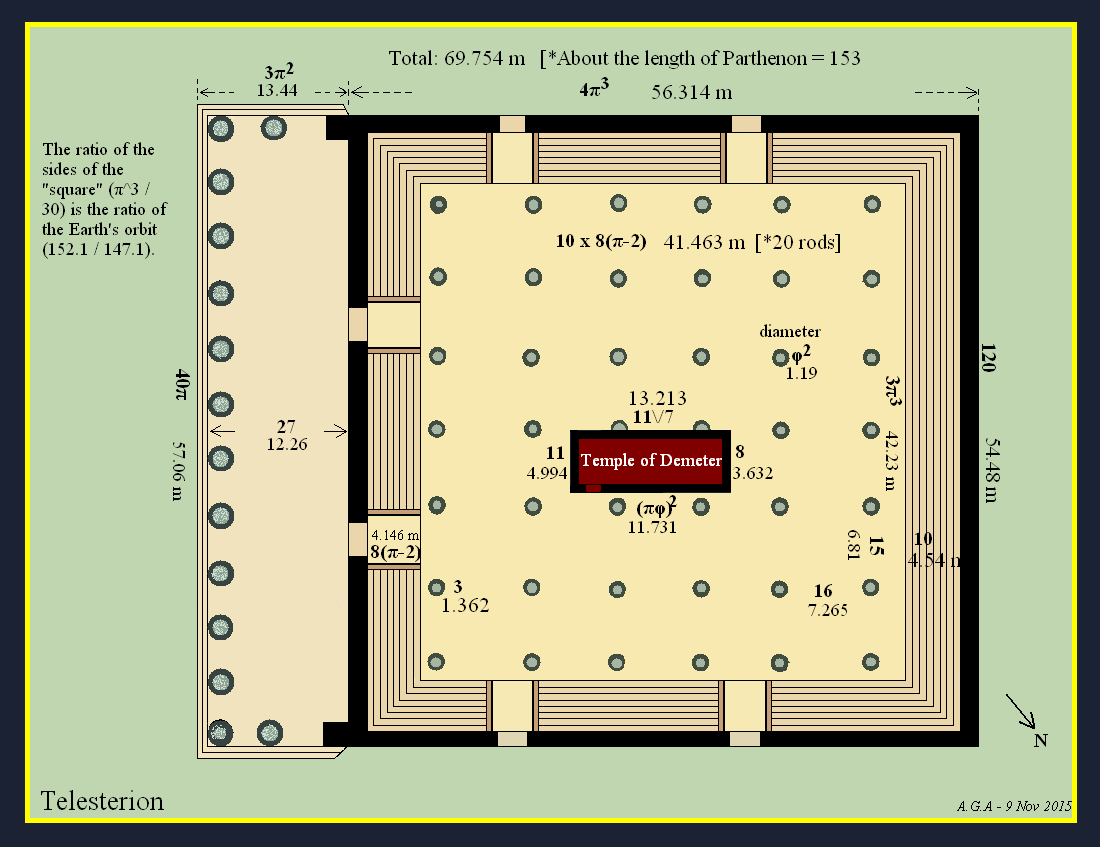
http://athang1504.blogspot.com/2016/08/ancient-eleusis.html
Let’s start by looking at the ratios 56.314 / 54.48 and 42.23 / 41.463.
56.314 / 54.48 = 1.033663730; 42.23 / 41.463 = 1.018498420.
Both are suggestive of several things. Respectively, either 10.33542556 or 10.31324031, and either 10.19328359 or 10.17140347. Note that the latter pair of figures has Lunar connotations = 10.31324031 is presumably the representation of Solar Year / Lunar Year (365 / 354 = 1.031073446) and 10.17140347 is 360 / Lunar Year.
The ratio between either pair of ratios is 10.33542556 / 10.19328359 = 10.31324031 / 10.17140347 = 1.013944699, which is the preferred Greek Foot in “modern Imperial” feet, as a ratio.
The Greek foot itself can be seen as the reconciliation of a 365 day year and a 360 day year: 365.0200808 / 360 = 1.013944699, which hints at the Greek Foot having great antiquity.
The ratio between subdivisions of the total length, 56.314 / 13.44 = 4.190029762, is suggestive of 16.76727943 / 4 = 4.19189858
The ratio between subdivisions of the maximum width is 57.06 / 54.48 = 1.047356828, very suggestive of (Pi / 3) = 1.047197551.
A relatively prodigious series can be formed by recombining 4.19189858 and 1.047356828 into equations of multiplication and divisions.
So far it would seem as if they are doing things according to the very same design principles seen everywhere else thus far in the ancient world.
The overall maximum length given would be 56.314 + 13.44 = 69.754 m = 228.851706 ft.
It’s possible that this is equal to (360 / Lunar Year) x Venus Orbital Period as 225 days.
(360 / 353.9334578) x 225 = 228.8565780.
It’s something that is still not understood well, but it seems to have been a popular gesture in ancient Greek architectural design to use a value that is apparently 225 Greek Feet — 225 x 1.013944669 = 228.1375505 ft, with the use of 224.8373808 as a possible alternative interpretation.
The overall maximum length / maximum length ratio would therefore be about 69.754 / 57.06 = 1.222467578. This may mean 1.223194031, a projected geodetic form of the Remen, normally 1.216733603 ft.
1223.194031 equals twice the slope length of the Great Pyramid and four times the inner perimeter of the Stonehenge sarcen circle. (To derive an equivalent Greek Foot at a ratio of 12:10 would give a Greek Foot of 1.223194031 / 1.2 = 1.019328359 ft).
To tell the truth, working with data from Angelopoulos is still an experimental work in progress in terms of how much liberty we should be taking with the data, yet clearly we are seeing in some form or another, the usual for ancient architecture.
I will try and “cut to the chase” then about what seems unusual here.
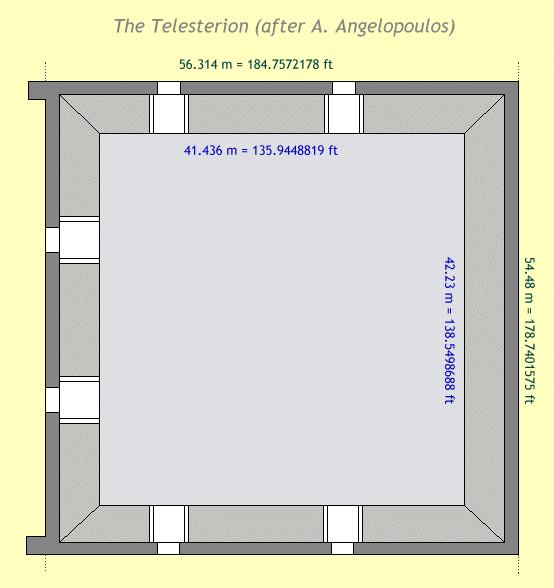
184.7572178 / 135.9448819 = 1.359049379. While the meaning of this isn’t clear, it does seem rather deliberate.
The lower base area would be approximately 178.7401575 x 184.7572178 = 33023.53421 square feet – this is presumably 66052.47771 / 2 = 33026.23885).
I don’t know whether it’s meaningful or intentional, but curiously, 33026.23885 / 10.33542556 = 3195.440638 = 178.7579574^2 / 10^n
The upper base area would be approximately 138.5598688 x 135.944819 = 18836.49628. This is reminiscent of a possible side length of the El Castillo pyramid at Chichen Itza.
This is approximately the square root of the Lunar Year x 10^n. The absolute meaning of a figure like this is otherwise still under consideration at Chichen Itza, although the favored scheme involves a symmetry between mulitiplication and division of 6 and Pi, suggesting that the intent was to represent the square root of the Lunar Leap Year. (60 Pi = 188.4955592)^2 = 355.3057584 x 10^n, with the other side representing (600 / Pi = 190.9859317, the square root of the Solar (calendar) year represented as 190.9859317^2 = 364.7562611 x 10^n. This is based on the data from Teobert Maler.
Another Lunar reference that might have been included here involves 56.314 m = 184.7572178. (sqrt (Saros Cycle / 10) = 6585.3211 / 10) x 360 x 2 = 18476.55395.
The diagonal of the upper platform would be sqrt ((138.5598688^2) + (135.9448819^2)) = 194.1129778 ft.
This is intriguing because such possible variations on the Assyrian Cubit were first noted in both Mayan and Greek architecture (see “Rio Bec Phi”).
The diagonal of the platform of the base would be sqrt ((178.7401575^2) + 184.7572178^2)) = 257.0666712.
257.0666712 is sqrt 66083.27343 and recall that earlier in the post we saw
“The lower base area would be approximately 178.7401575 x 184.7572178 = 33023.53421 square feet – this is presumably 66052.47771 / 2 = 33026.23885)”
It way or may not be of significance that 1/16th of the Full Moon Cycle would be
411.78443029 / 16 = 25.73652689

13.213 / 11.731 = 1.126331941 = 225.2663882 / 200. This is a slightly oversized estimate of the Venus Orbital Period – figures this high do not fit into formulas linking Venus Orbital Period to Half Venus Cycle – so the intended figure may have been slightly smaller, likely either 225 or 224.8373808.
4.994 / 3.632 = 1.375 = (687.5 / 100) x 2. The Mars Orbital Period is 686.971 days, and probably best represented as 2160 / Pi = 687.54993542.
Hence we may already see in this temple the conjunction of Venus and Mars through representation of half of their respective Orbital Periods, another apparent vote of confidence for Angelopoulos’ data.
It should also be noted that for 13.214 = 43.34973753 ft that this is very suggestive of the Jupiter Orbital Period of 4332.59 days.
(Also 43.34973753 x 16 = 6935.958005 / 100. The canonical Metonic Cycle value is 6936.892403 days. 43.34973753 x 8 = 3467.979002; the Eclipse Year value is 346.62 days, so this Jupiter Orbital Period value contains several references to Lunar Cycles).
For 11.731 m = 38.48753281, (38.48753281 / 2) x (Pi^2) = 189.9283616, highly suggestive of the B value for the Half Venus Cycle of 18997.72194. This approximation exceeds the canonical 18980 day value, but may be indicated by certain ancient variant formulas the same way that 819 was used by the Maya to represent Solar Year x Venus Year, even though it involves alteration of 365 to 364 for this purpose: 364 x 225 = 819 x 100; 365 x 225 = 821.25 x 100.
3.632 m = 11.91601050 ft could be another long-awaited occurrence of 117.7245771 / (Pi^2) = 11.92799350.
Note that 2 / 11.92799350 = 1.676727943, the often-discussed mysterious metrological unit that seems to have been used by the ancient Egyptians, ancient Maya, and now the ancient Greeks.
For now I think I will leave it at that – suffice it that it doesn’t seem difficult to see numerous references to “The Gods” – that is, the planets – in this example.
–Luke Piwalker
 Luke Piwalker