I’ve made a number of attempts at interpreting the Bent Pyramid at Dahshur in the past years, but although we have data from a trusted source – WMF Petrie – the endeavor remains problematic, and has thus far not reached definitive solutions.
Recently, DUNE at GHMB has been producing some very interesting interpretive work on the Bent Pyramid, which is not only very intriguing, but also reminds me that I still do not have a complete interpretation of this mysterious structure.
Largely, the “party line” seems to have been the change in slope angle at the top of the Bent Pyramid arises as a precautionary measure adopted during the construction of the pyramid against the risk of structural failure.
A few dissenting voices propose that the change in course angle was part of the original plan – thus there may be some mathematical or philosophical reason for the change in slope angle, such as the expression of duality, making it essentially “two pyramids in one”.
I highly recommend Keith Hamilton‘s examination of the subject in The Bent Pyramid, the curious case of the 60 degree pyramid and although I do not seem to be able to bring myself to agree with his metrological findings, John Legon‘s treatment of the subject is also recommended.
One reason I have difficulty agreeing is because Legon’s conclusions seem as they may actually be a poor match for Petrie’s data, even if there are unanswered questions about what Petrie reported. This also includes Legon’s rendering of the enclosure or “peribolos”.

Petrie’s description of the enclosure wall from A Season in Egypt
Notice the data for the W side of the peribolos enclosure particularly. Accepting it at face value, it reads as if the inner measure is in inverse Megalithic Feet, and the outer measure is in Megalithic Yards. I have explained often how both of these units can be seen as having been known to and used by the ancient Egyptians because of the intimate relationships between these two units and major units of ancient Egyptian measure such as the Royal Cubit and Remen.
11757 inches / 12 = 979.75 ft; 2.720174976 x 360 = 979.2629914.
One difficulty I have with embracing the idea of the Bent Pyramid as an expression of duality, is that like Legon’s interpretation, the actual reality may be not be quite so simple. What Petrie’s data describes for the Bent Pyramid is not a pyramid with a square base, but rather a pyramid whose base is slightly rectangular.
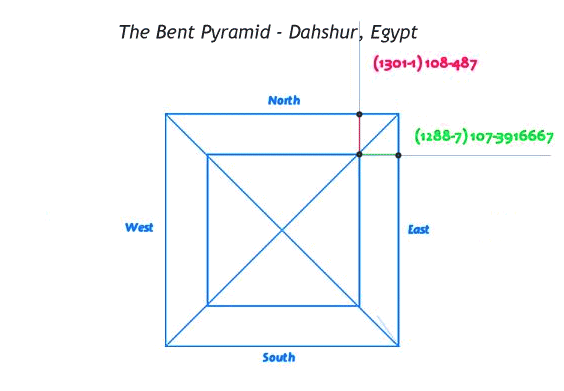
The Bent Pyramid’s base according to Petrie’s data. Is the Bent Pyramid pyramid several feet larger running North to South?
We seem to have something of a consensus among independent researchers that the general base length of the Bent Pyramid seems to represent 1/4 of the value of the Earth’s Circumference in “modern” miles, a remarkable fact that seems to be constantly overlooked by archaeology in spite of the earlier “craze” among independent Egyptological researchers for looking for the Earth’s proportions and the solar year in the Great Pyramid.
Nonetheless, to my reckoning, it is still one of the unanswered questions about the Bent Pyramid whether we are looking at the polar circumference, the mean circumference, or the equatorial circumference of the Earth in miles, or given the slightly rectangular shape, perhaps several of these, or all three.
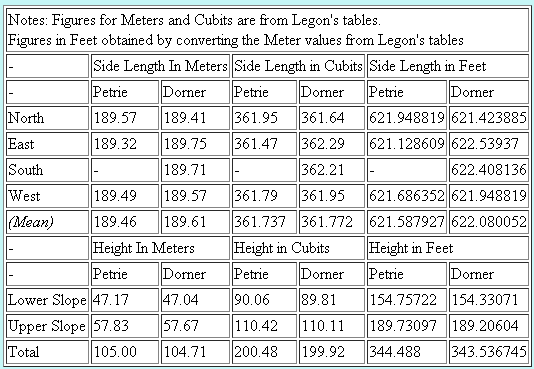
Data for the Bent Pyramid, after John Legon. Read “Lower and Upper sections” for “Upper Slope” and “Lower Slope” – the values here are the vertical heights, NOT the slope lengths.
Petrie’s mean 621.587927 x 4 = 24863.51708 / 10; polar circumference in miles ~24860; Dorner’s mean 622.080052 x 4 = 24883.313434, consensus mean value 24883.2.
We can propose that the short sides of the base of the Bent Pyramid represent the polar circumference, the long sides represent the equatorial circumference, and the average (mean) of the two represents the mean circumference of the earth, which may be a satisfactory solution mathematically, but there are further complications when it comes to attempting to reconcile the width at the base of the whole pyramid with the width of the upper pyramid section.
The general base width of the upper section is reminiscent of Phi / 4 x 10^n, another remarkable fact about the Bent Pyramid that seems to have been overlooked by one researcher or another whether orthodox or independent.
One recent proposal I’ve come up with is that given the reported rectangularity, the upper section may also aspire to express a set of values, with one possibility being a maximum of the Munck classic 1.622311470 x 10^n, a minimum of about (Apsidal Precession Cycle / 20) / = ~3233 / 20 = 161.65, with a mean of approximately 1.618829140, probably the second most Phi-like number to include in any pyramid, which would seem to make the Bent Pyramid rather reminiscent of Mexico’s amazing Pyramid of Niches in that respect.

The Pyramid of Niches, a remarkable study in deliberate irregularity.
Particularly with Petrie’s data, the upper vertical height much resembles 1/100 of the Half Venus Cycle / Calendar Round in feet, or perhaps 100 times ((360 / Calendar Round) x 10^n). The bottom height resembles 10 x (sqrt 240), a hugely important number that is the basis for the radius of the Stonehenge sarsen circle ((sqrt 240) x Pi ft) and the height of the Great Pyramid ((sqrt 240) x (Pi^3) ft) in Munck’s models (and mine).
If memory serves, Munck’s suggestion for the base of the Bent Pyramid was at one point, if not in perpetuity, 620.1255336 ft, which it might be following application of pavement. This begins to come close to the subject of paved vs unpaved models, since while at Giza I have proposed theoretical missing pavement to explain the difference in Munck’s Great Pyramid value, and more conventional figures for the Great Pyramid’s proportions, in Josef Dorner’s diagram for the Red Pyramid (Sneferu’s other pyramid at Dahshur) we are actually shown a pavement layer encroaching on the lowest casing stones.
This in an interesting concept because it implies that if such a layer of pavement were applied to the Bent Pyramid, it would be concealing these dramatic geodetic values describing the Earth’s proportions unless the same data is also contained in the Bent Pyramid so that it would remain accessible even after pavement (very similar to the apparent situation with my Great Pyramid model), since surely we weren’t intended to have to tear up the pavement to get at the stored data.
Speaking of Dorner, however, we are reminded of several other complications in attempting to unravel the original design of the Bent Pyramid. As Keith Hamilton explores, and as is seen in the data from Dorner repeated in John Romer’s The Pyramids, Dorner proposed the first plan for the Bent Pyramid involved a pyramid of slope angle 60* and a base of about 157 m (about 300 Royal Cubits).
I have very mixed feelings about this.
One the one hand, since we have been looking at slope angles in radian values lately, a slope of 60* or (Pi / 3) Radians (60 / 57.29577951 = Pi / 3) would be an abolutely wonderful complement to a pyramid whose base length in feet conveys the equatorial circumference in miles.
On the other hand a complication of working with Dorner’s data is what appears to be general lack of access to the article that Romer cites as source (the often-cited Form und Ausmasse der Knickpyramide MDAIK 47 pp 81-92), and another is that the data as presented by Dorner does not in fact describe a pyramid of slope angle of 60*, but at base of 156.99 m and height 123.43 m, of about 57.5252*.
I should very much like to know how Dorner arrived at these figures before inveting in his proposal.
If memory serves, Dorner has also been a problematic source when it comes to the Red Pyramid, and seems to have ignored the data from other sources in order to superimpose a 60* slope onto the Red Pyramid, as if purely to justify the rather questionable suggestion that the angles of a pyramid and its pyramidion should match.
This, even while the other Bent Pyramid data attributed to Dorner seems a very reasonable match for Petrie’s, suggesting that we may have to carefully take Dorner’s data on a case-by-case basis rather than on reputation as we are generally able to do with Petrie after inspecting the data.
There is another curious thing about the Bent Pyramid, which is the total height. Even if we agree that it appears to be 200 Royal Cubit, some of the proposals I’ve come up with make the figure about 344.5 feet, which would be about 200 of the so-called “Stecchini” or “Lepsius” Cubit, taken from Stecchini’s descriptions of several ancient measuring rods described by Lepsius.
Thus far there have been absolutely no certain departures from the use of the “Morton” Royal Cubit in ancient architecture whatsoever.
What is more, a number of equations seem to reinforce this view, suggesting that something unusual may have happened here that remains difficult to explain.
However, the appearance of Cubit-like values does not necessarily mean that these were the chosen units of design (see Giza), and I concede that the “Stecchini/Lepsius” cubit did manage to find its way into the table or metrological units organized as much as possible after John Neal’s schemes.
As I believe I may demonstrate on more or less a daily basis, there is more to metrology than is included Petrie’s “Inductive” approach which looks for whole numbers of unit values, no matter how many concessions we are able to make to “Inductive Metrology”.
Returning to the question of duality, as I have suggested herein, the rectangular shape asserted for the Bent Pyramid’s base by Petrie may already constitute duality; the two pyramids formed by the change in slope angle may represent something beyond duality – multiplicity.
Indeed, there are a number of geometric projects we can make from the data, any and all of which might have been intended with the possible exception of Dorner’s 300 Cubit / 60* slope proposal (Fig. E).
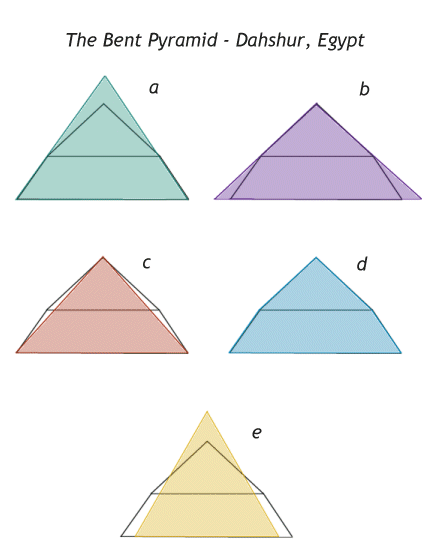
That is one of the things I admire about DUNE’s work is making the effort to try to see what the Bent Pyramid would have looked like had it not been “bent
On the subject of the slope lengths, in the model based on Petrie’s data showing the pyramid as it would be viewed from North or South, the projections give us ~188.3627686 ft for the lower base (and ~277.9168027 for the upper slope length). Here too there is some uncertainty as Petrie seems to refer to some slight convexity, which may have been used to achieve a particular mathematical or metrological target figure.
It may be something I’ve mentioned previously since for some time it’s been part of the considerations, but 188.3627686 greatly resembles a number that for a while was under consideration for the El Castillo calendar pyramid, but in the end the proposed symmetry formed from 6 and Pi seem to have won out. What was intended for the Bent Pyramid however may be another story and may remain an open question.
For the record, the number in question can be formed from the number that was proposed as one of the base proportions for El Castillo (data: Maler) – 60 Pi = 188.4955592.
188.4955592 / 1.000723277 = 1.177245771 x 160 = 188.3593232.
It’s (at least) nearly a Wonder Number in its own right – and you’ll notice that it does appear to be a value in proposed Megalithic Feet – yet it remains to be seen whether it serves the overall purposes of the Bent Pyramid. So far it seems to be difficult to get 188.3593232 to be a plausible value for the square root of the Lunar Year x 10^n, which is another reason that 60 Pi seems to have won out for the El Castillo pyramid.
I’m not terribly proud of (in fact, quite the contrary), but I must admit that I’m still perplexed by the meaning of the various perimeter/height ratios be can obtain from the Bent Pyramid (just as I remain concerning the upper/lower base ratios), even though perimeter/height ratios are obviously crucial with other Egyptian pyramids.
If only just for fun, we can try them again and hope that something serendipitous happens this time with more certainty.
24883.2 / lower height ~154.75 = ~1.607961228
24883.2 / upper height ~189.75 = ~1.311367589
24883.2 / total height ~344.5 = 7.22298984
I will note this time that 7.22298984 is reminiscent of 1/48th of the Eclipse Year (346.62 / 48 = 7.22125 and 346.5939351 / 48 = 7.220706982), but this still remains almost incomprehensible how it would serve the overall design.
I could also note that 1.311367589 appears to be about 48 times the Tropical or Sidereal Year, divided by 10^n, but I am not sure if either of thee observations is actually meaningful.
It’s unfortunate, but as Petrie’s data describes the Bent Pyramid, I have really never seen the lines of it – even after many adventures in pyramid interpretation, there seems to be very little in the way of established protocol to be applied here.
I will say this much – if a valid figure for the upper perimeter is supposed to 1622.311470 ft (mean value?), 1622.311470 / (16 x 1.067438159) = 18997.7219 / 10^n, so that is at least one important observation to come from the latest effort.
I always feel apologetic about how much 18997.7219 is in excess of the value it represents, nearly 18 additional dats added to the canonical Half Venus Cycle of 18980, and yet not only is such a figure the result of a viable formula, but it may have roots in, and receive support from, ancient calendar operations that are more classical in nature.
For example, it’s easy to think canonically of the Saros Cycle as representing 19 Eclipse Years: 19 x 346.62 = 6585.78, which is quite a remarkable representation of the textbook figure of 6585.3211 days for the Saros Cycle.
Yet if we are any more exacting, 6585.3211 / 346.62 = 18998.7607 / 10^n, so 18997.7219 may really be something ancient Americans and Egyptians dealt with – and had to deal with, in the course of working out ways to express their extremely complex calendar systems, in spite of some of the simplifications we have may seen them also use.
For whatever it’s worth, I have a few more odds and ends in my recent notes that might be of some interest.
These come from attempting to explore the possibility that the Bent Pyramid’s upper height is (360 / Calendar Round) x 10^n rather than Calendar Round / 10^n, and light of a possible ancient meter value (one which does appear as legitimate in my metrological tables)
In the notes, it comes to light that there is apparently a figure in meters which is reminiscent of some of the candidate measures in feet, i.e. Petrie’s height for the upper pyramid is about 189.75 feet, which could either be the Half Venus Cycle in feet, or (360 x 10^n) / Half Venus Cycle in feet, while 189.75 meters = 622.5393701 ft = 24901.5748 ft /4
We have seen numerous cases already where there is correlation between geodetic and astronomical figures, but this may be new to me.
If I use 2 (R^2) / 10^n as the meter = 3.282806350, which may have been used in some cases at Stonehenge (sarsen circle thickness),
24901.19742 / 3.282806350 = 189.6334627 (360 / (Half Venus Cycle A / 10^n)) / 4
24901.19742 / (3.282806350^2) = 5.776565612 = 115.5313122 / 2 / 10 = ~260 / 225 = 1.1555555555
5.776565612 = 15 / 259.6698628 = ~15 / 260
5.776565612 x 6 = 346.5939367, the best overall representation of the Eclipse Year
24901.19742 / 189.6334627 = 3.282806350 x 4 = 360 x 364.7562611
3.28280635 x 4 x 10^n = 5280 x 24869.4507
24858 / 819 = 364.2197802 x 12
500 Thoth Remens / 360 / 360 = 47.00886107, possible base number for emulation of Jim Wakefield’s Rollright Stones interpretation.
Notice how much 364.2197802 resembles some of the characters in our recent search for “364”.
It occurs to me that if there were conversation of the ratio of Solar to Lunar Year across an alternate set,
353.9334578 Lunar (calendar) Year x 1.031324031 = 365.0200808
Alt Calendar Year (?) 364.2365562 / 1.031324031 = 353.1737313, which is enough for call for a reconsideration of the effectiveness of the Harrris-Stockdale Megalithic Foot at representing the Lunar Year, since 1.177245771 = 300 = 353.1737313, whereas I’ve suggested to Peter Harris that perhaps a slightly longer version, 1.179778193 (also found in the Stonehenge trilithon circles) might have been reserved for that purpose to give a more accurate Lunar Year (1.179778193 x 300 = 353.9334578).
These equations might hint again at the possibility of the height of the upper part of the Bent Pyramid being (360 / Half Venus Cycle B) x 10^n (189.4964044) rather than the value (360 / Half Venus Cycle A) x 10^n (189.6334627) that was used in the notes.
Something that is enticing about this proposition is that apparently, 189.4964044 is able to perform a sert of geodetic Coup de Grace by linking the equatorial circumference in miles to what is presumed to be the mean circumference of earth in feet
24901.19742 / 189.4964044 = 131407229.1 / 10^n
Maybe there’s a clue in that somewhere?
This comes from notes on an experiment with data of unknown quality for a stone circle in Japan, of all things, but some of it may actually be topical here
Stone· Ring at Loh Ah Tsai, Lamma Island, Hong Kong (PDF)
1′. N. CHID, C. L. SO, and S. M. BARD Hong Kong University Archaeology Team
“Four stones are set outside the ring, in so regular a pattern that they appear to form a part of the whole design (only two appear in PI. I); they lie in pairs: the first pair 15 feet from the lower end of the ring and 4 ft. 3 in. apart, precisely bracketing the long axis of the ring; the second a further 15 feet away from the first and 2 ft. 2 in. apart, again precisely bracketing the long axis of the ring. These measurements are significant. The distances of 15 feet and the almost exact ratio of the distances separating each pair (4 ft. 3 in. and 2 ft. 2 in.) show that the position of these paired stones is not accidental.”
It seems like an odd remark – 4.25 ft / 2.1666666666 ft = about one of those Mayan Numbers I warn people about, (1 / 1.622311470) / Pi
= 1.962076285.
This is in fact the square root of (18997.72194 / (Pi^2)) x 2, something else I wasn’t aware had a valid square root.
“The ring is an artifact, comprising an oval of stones of varying sizes, with a slightly constricted waist, and at its widest parts measuring 9 feet by 14 1/2 feet; its long axis points west-south-west (PI. I inset) ;28 stones form the circumference and 4 more divide it across the waist, obviously a part of the design.”
15 / 2.166666666 = 24 / 346.62
(15 / 4.25) x 2 = 224.6893314 / Pi
4.25 / 12 = 354.1666666
In spite of all the experiments I’ve done with calendar numbers I am nonetheless amazed at just how quickly the Eclipse Year, the Venus Orbital Period, and the Lunar Year all popped out of that.
Lastly, several observations that happened because I’d started experimenting with the possibility that the minimum side length of the Bent Pyramid could be essentially 1/2 of the Apsidal Precession Cycle value, I thought I’d try 1.676727940, an still possibly unidentified unit of measure that draws legitimacy from both geometric relationships to established ancient units and also from a very significant amount of utility for adjusted astronomical calculations.
1 / (1.676727943 / Pi) = 18983.99126 Half Venus Cycle A / 10^n
(At present, 1.676727940, is strongly suspected of deriving directly from either the Sacred Cubit or the Indus Foot).
In fact, why don’t I make use of the occasion to point this out, that the Pi ratio links both 1.067438159 and 1.676727943 to the A value of the Half Venus Cycle (Calendar Round) in what is essentially almost the most direct manner possible
(1.067438159 / 2) x Pi = 1.676727943 / 10; 1.676727943 x Pi = (1 / 18983.99126) x 10^n
I hope readers can see there just a glimmer of why I have so much faith in these numbers.
In the course of trying to project the possible original height of the Bent Pyramid from the lower base angle, I’ve seen angles of both 54* and ~55* given. The later, which seems to have support from Petrie, is the figure I therefore have more faith in. This would give the projected design a slope length of approximately 541.931388913 feet, a figure I have not yet succeeded in identifying, but upon attempts at examination resembles about 128 / Ubaid Cubit in feet, which is somewhat curious because the Great Pyramid perimeter seems to be interpretable as 128 Ubaid Cubits of ~2.362 feet.
541.931388913 / 2.362 = 229.4375959 = (365.0200808 / 5) x Pi = 229.3488809
541.931388913 x 128 = 6936.721778 x 10; Metonic Cycle = 6939.688 days
541.931388913 / 1.676727943 = 3232.0777041 (Apsidal Precession ~3233 days).
So, at least if the Bent Pyramid is going to continue to confuse us (or me, at least), at least it’s still teaching us things. Perhaps soon someone will stumble across the combination of numbers that makes everything clear at last.
–Luke Piwalker
 Luke Piwalker