I may not have made a note of it in my blog posts (although I seem to remember mentioning it to the GHMB forum), but if we project a regular model of the El Castillo pyramid from Maler’s data, when we get to the perimeter it would be
(2 x long side 600 / Pi ft = 190.9859317 ft) + (2 x short side 60 Pi ft = 188.4955592 ft) = 758.9629819 ft.
This gives an average side of 758.9629819 / 4 = 189.7407455 ft, again the Mayan Calendar Round (Half Venus Cycle) having a canonical value of 189.80 x 100 days.
This may give us something of a quandry; on the one hand we have what very clearly suggests the intent to express a Calendar Round value constructed from the square roots of Solar and Lunar (Leap) Years, but on the other hand, the figure falls just short of experimental tolerances for actual mathematics.
Ideal figures here might be 758.5338512 ft or 759.3596503 ft, which (disregarding correct decimal point placement) are 4 times the “Half Venus Cycle A Builder” and 4 times the Half Venus Cycle A itself.
758.5338512 is 360 of the standard Palestinian Cubit of 758.5338512 / 360 = 2.107038476 ft. 758.5338512 / 4 = 189.6394628, the HVC A Builder. These “Builder Figures” are simply divided into 360 x (10^n) to produce the Half Venus Cycle: 36000 / 189.6394628 = 18983.99126 (HVC A) x 100.
2.107038476 combined with 360 can produce a short series of notable figures.
(2.107038476 / 360) x 10^n = 585.2884654 our new Wonder Number, the Codex-inspired oversized Venus Synodic Period
(2.107038476 / 360^2) x 10^n = 1.6252801293 (see height Great Pyramid missing apex section in Royal Cubits and possible link between certain forms of the Solar Year and Venus Orbital Period (365.25 / 224.7 = 1.625500668).
(2.107038476 x 360^2) = 27.30721864 x 10^n, which may be one of our best representations of the Tropical and/or Sidereal Month.
(There could also be an intended reference to a possible approximation of the Mayan Calendar number of 819 in this same series)
Yet if we wish to maintain the experimental “Giza Standard” of accuracy employed thus far, both of these enticing values fall short of the “Giza Standard” that is used when operations of geometry or trigonometry are involved, because they are generally damaging to the intended values (Giza Standard = .9995 = 99.95% accuracy or higher).
758.5338512 / Calculated value 758.9629819 = .9994345820
Calculated value 758.9629819 / 759.3596503= .9994776278
One of the things that would fit here while upholding the “Giza Standard” is the proposed Calendar Round approximation 2 x (Pi^8):
2 x (Pi^8) = 18977.06203; 189.7706203 = 759.0824813 / 4
Calculated value 758.9629819 / 759.0824813 = .9998425739
The quandry is that this value for the Calendar Round / Half Venus Cycle comes from the D column of values, and just when we’ve been contemplating lately closing the door on these numerous (possibly excessively so) values except the vital basic A, B, and C groups, here is El Castillo to seemingly try to hold the door open on them, because the very laws of mathematics don’t quite seem to want to let us “have our cake and eat it too” here.
Thus once again, while we can see very clearly what might have been generally intended (in this case a rather blatant Calendar Round reference), knowing what was intended exactly isn’t always quite as easy.
Note that remarkably, Maler’s data gives the horizontal distance from the edge of the temple platform to the edge of the pyramid base on all sides as 2000 cm. One might involve this data in an argument for the ancient American use of metric system measurements (indeed, I was quite surprised to learn that Le Plongeon’s idea of ancient American metric had carried forward into later academic work), but as with any particular unit, we would be hard pressed for evidence that they used any single unit exclusively.
Quite the contrary, as with ancient Egypt, what the data seems to show is a “plethora” of different units side by side. The diversity of different measures even from Andrews’ often incomplete and sketchy datasets may simply be too great for things to be otherwise.
For precedence, I should mention that a figure of ~6.56 ft (i.e. 2 meters) appeared repeatedly in Munck’s diagrams of the Tikal pyramid temples (typically the height of the temple platforms). This is taken from data from Maler and is corroborated by Andrews’ data. To my knowledge, Munck never explained what he thought these estimates meant but he did go out of his way to draw attention to the remarkable fact.
I can also mention again that I attempted to work with the idea of ancient American meters based on question in Dimitrios Dendrinos’ paper on Guachimontones whether ancient Americans could have been using the meter. For the particular scenario, a meter of 3.289868134 would have been called for, which along with 57.29577951^2 / 100 = 3.282806350 and other suggestions remains promising, even if matters are inconclusive. (The width of the Stonehenge sarsens was apparently intended as 3.282806350 according to calculation, which may have been intended at Stonehenge as an ancient meter).
I may never have posted both diagrams to this blog before since I can’t find any evidence of it, so I will correct the omission now. Here are both of the diagrams based on Maler’s plans:

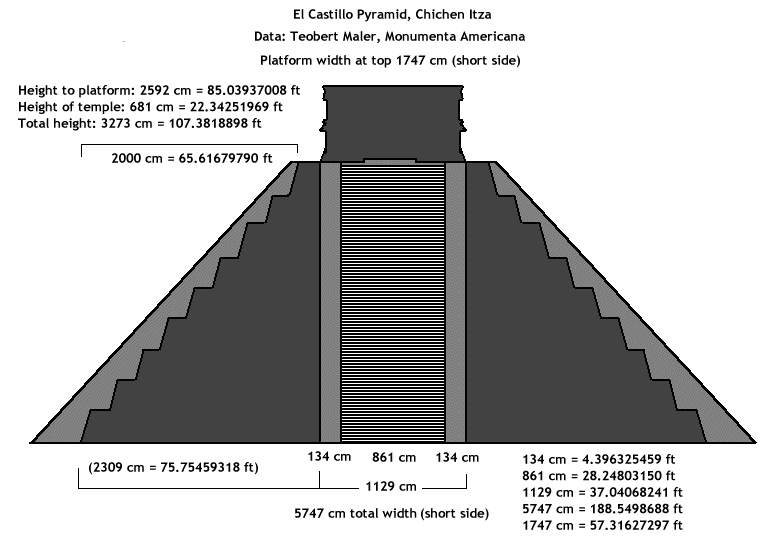
Of course, it’s one thing to find interesting numbers to match to raw data values, but eventually when dealing with structures comprised of individual parts, sometimes our best suggestions may not fit together satisfactorily. Such may be the case with El Castillo.
It’s certainly suspected that the width of the “adosadas” along the staircase on that side, 132 cm = 4.330708661 ft, refers to Jupiter’s 4332.59 day Orbital Period, and ideally probably the 4329.292929 approximation, and the 920 cm = 30.18372703 width of the stairs themselves easily conjures the idea of 30.18110298 ft (1/100th of Munck’s Great Pyramid base perimeter) = 18 of the still unidentified ancient unit of 1.676727943 ft, but if we wish to conserve the interpretation of 1184 cm = 38.84514436 as being the same number from atop Tikal Temple I, something may have to give here, and it may be the 30.18110298 suggestion, which is unfortunate because it’s very easy to obtain the A value for the Calendar Round from this number using only the Radian value of 57.29577951
57.29577951 / 30.18110298 = 18983.9399126 / 10^n = ~18980

Carl Munck’s drawing of Tikal Temple I labelled according to Maler’s data. For years I have successfully interpreted “38.812” ft as 38.81314681 without finding significant cause to reconsider.
There isn’t really any necessity that the value for El Castillo be the same as the mysterious value from Tikal, but if we attempt to interpret El Castillo as if we were at Tikal by throwing (Pi / 3) at it – and indeed there seems to be no sensible reason that Tikal or any other site should have a monopoly on (Pi /3) – we may find some interesting things.
I will also refer the reader here to my second diagram of El Castillo and the total width of the stairs as 1129 cm = 37.04068241, and the proposed base diagonal of this same model of 268.3798543 ft.
Normally I would be quick to interpret 37.04068241 ft as 5 Squared Munck Megalithic Yards: 5 x 7.396853331 = 36.98426666, which it could be; however there is a fairly impressive (Pi / 3) series that issues forth from 268.3798543 as follows (correct decimal placement ignored for convenience, as usual)
268.3798543 x ((Pi / 3)^1) = 281.0467262 = (224.8373808 / 8) x 10
268.3798543 x ((Pi / 3)^2) = 294.3114435 = 1177.245771 / 4
268.3798543 x ((Pi / 3)^3) = 308.2022222
268.3798543 x ((Pi / 3)^4) = 322.7486131 = (1 / sqrt 960) x 10^n
268.3798543 x ((Pi / 3)^5) = 337.9815573 = 1.216733603 / 360
268.3798543 x ((Pi / 3)^6) = 353.9334591 = Lunar Calendar Year
268.3798543 x ((Pi / 3)^7) = 370.6382517
268.3798543 x ((Pi / 3)^8) = 388.1314695 = Tikal Number
Note that in the diagram for the short side of El Castillo, the stair width is 861 cm = 28.24803150 ft; 1 / 28.24803150 = 354.0069686, so what we are probably looking at these is 1 / 353.9334591 = 28.25389842 ft
So what we have here seems as if it may be a new Wonder Number 3.706382517 that is neatly nested between the Lunar Calendar Year and 38.81314681 x 10, and could well be therefore what was intended by 1129 cm = 37.04068241
Thus I am not certain we should be in a hurry to dispense with 38.81314681 at Chichen Itza. This series may be exactly what the architect aspired to include.
Concerning this figure 268.3798543 x ((Pi / 3)^3) = 308.2022222 — I haven’t bothered to notate it in the list, but this is of course 1.540111111 x 2 x 10^n. Once again the Eclipse Year formula I am currently using is Venus Orbital Period x 1.5410111111 = Eclipse Year, but additionally 1.541011111 = 25 / 1.622311740, and 15.410111111 / 1.622311470 = 9.498860975 = Half Venus Cycle B 18997.72195 / 2000.
Hence, holding to several of these suggestions, rather than 30.18110298 as the width of the stairs on the long side, it may have been intended to read 38.81314681 – (4.329292929 x 2) = 30.15455582 = 90 Pi / 10 = 30.15928947 to an accuracy of .99984304 although it will take some additional effort to figure out why 30.15928947 would be important enough to ancient calendar systems to tolerate this unexpected departure from the seemingly ideal.
Perhaps there are interactions between 96 Pi / 10 and other components of the pyramid that will help explain this to us eventually.
We might also consider the distance around the corner from staircase to staircase = 2309 cm + 2318.5 cm = 4627.5 cm = 46.275 m = 151.8208661 ft. Particuarly if it will prove harmonious with other suggested proportions, this may mean 151.8719301 ft. (151.8719301 / 151.8208661 = .9996637696, so the suggestion passes the “Giza Standard” test).
151.8719301 x VOP B 225 = 1 / 29.26442327 the “Real Mayan Annoyance”.
225 x 29.26442327 = 6584.495236, one of the apparent premiere approximations of the 6585.3211 day lunar Saros Cycle.
Thus – have you guessed it yet, dear readers? – 1 / 151.8719301 = 6584.495236 / 10^n!
It’s not yet clear to me what the figures of 2309 and 2318.5 may actually represent, but we might note their ratio: 2318.5 / 2309 = 1.004114335. It may be too soon to tell, but this bears considerable resemblance to 1.003877283, a number with geodetic value which is part of some of the series found at Tikal, and that may be what is intended to be represented here at Chichen Itza also.
By the way, in case anyone should struggle with the idea that the ancient Egyptians observed the Mayan Calendar Round, let’s have a quick look at the Great Pyramid.
I’ve often posted this image to emphasize how the Great Pyramid’s apparent 2 Pi perimeter / height ratio seemingly signifies the basic mathematics of the circle: 360* (circumference) / 2 Pi = Radius (Radian 57.29577951).

Note how we can use two of these fundamental circular values (along with 5, the reciprocal of 2), to recover the primary values representing the Calendar Round = Half Venus cycle (HVC) from the Great Pyramid. Imagine achieving this without being aware of the Half Venus Cycle!

–Luke Piwalker
 Luke Piwalker