I don’t believe I’ve ever posted before on Khenjer’s Pyramid – and probably not due to some lingering uncertainty about the matter. However, having tried to look into the matter a little further now, I believe I have may have found some interesting things.
Khendjer’s Pyramid (at Saqqara)
The first thing I should probably do is have a look at Keith Hamilton’s Layman’s Guide to the Khendjer Pyramid.

The Pyramid of Khendjer and pyramidion (capstone) from Mark Lehner, “The Complete Pyramids”.
I have already been looking at some data in the meantime however. Basically, Lehner and Verner give the same unattributed proportions for Khendjer’s pyramid, which apparently can be traced back to Gustave Jequier in Deux pyramides du moyen empire (1932).
The French Wikipedia page listing Egyptian pyramids also gives a base length, also unattributed, to the adjacent smaller pyramid, of 25,5 m. I am not certain if Jequier is the source for this figure; Dieter Arnold is also mentioned in the bibliography for the Wikipedia page in English on Khendjer’s Pyramid
https://en.wikipedia.org/wiki/Pyramid_of_Khendjer
What I have done this time around apparently is to try begin looking more closely at some alternate possibilities.
At least five different sets of possibilities can be generated
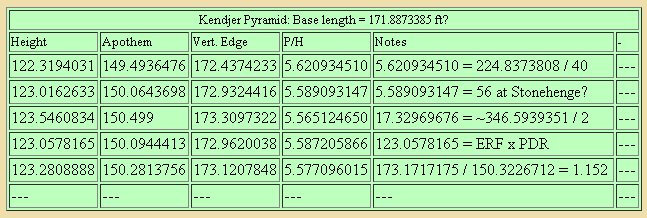
The first set is interesting, and I tended to think the figures were correct. Not only is the perimeter/height ratio an homage to the Venus Orbital Period, but the apothem tries to appear to be one also since 149.8915869^2 = 224.6748781 may be a valid if diverse way of writing the Venus Orbital Period.
Additionally the listed height of 122.3194031 ft is 1/5th of the Great Pyramid’s slope length (apothem), which is itself twice the inner sarsen circle perimeter of Stonehenge.
Aside from the curious vertical edge figure, it does have numerous earmarks of a sound proposal, yet these figures have now been challenged by numerous other possible proposals.
We may ultimately be able to get a better sense of realism about Jequier’s figures by looking at the archaeological environment, i.e., other pyramids at Saqqara and so forth.
Indeed, one of the things that has come to light during this round of attempting to understand the design of Khendjer’s pyramid is there may be some notable parallels between Khendjer’s pyramid and Teti’s pyramid, which is also at Saqqara,even though Teti’s pyramid is dated to the Sixth Dynasty and Khendjer’s to the Thirteenth Dynasty.
Several years ago, I developed this partial model of Teti’s pyramidion based on the available data, which was quite convincing considering it seems to describe a pyramidion base measuring 1 Remen by 1 Royal Cubit.
Teti’s Pyramidion
Length 1.718873385 Royal Cubit
Width 1.216733603 Remen
Diagonal 2.105515605 Palestinian Cubit (Shorter form)
Apothem A (on long side) 1.62231147 Assyrian Cubit
Apothem B (on short side) 1.731717175
1.509 = ? = raw figure for height
What they have done here is seemingly use 1.731717175 as a false square root of 3 and place it in an important and necessary place where a Royal Cubit will not fit, illustrating for us that 1.731717175 / 1.622311470 = 1.067438159.
It’s quite an interesting and compelling model, and seems to have remarkable focus on metrology, revealing the most straightfoward expressions of the Remen, the Royal Cubit, the Palestinian Cubit, the Assyrian Cubit, and by way of ratio, the Hashimi Cubit / Egyptian Royal Foot – almost a sort of “metrological Rosetta Stone”.
More realistic projections of the uncertain height of Teti’s pyramidion may come very close to (1/100th of) the projected apothem length for Khendjer’s pyramid. Hence Khendjer’s pyramid may directly reference both the height and short-side apothem of Teti’s pyramidion, suggesting possible strong observance of Saqqara’s Sixth Dynasty past during Thirteenth Dynasty architectural design.
Also, Hamilton notes data on the enclosure walls, which might be useful further along – generally I am not that far with this study yet.
Returning to the data, then
For the second set, at first I was skeptical of this because 200 / 123.0162633 = 1.625801294, which is data from the Great Pyramid’s apex section, but presumably this figure would come third after 200 / 1.622311470 or 200 / 1.618829140.
However, this gesture has the interesting consequences of generating 5.589093147, thought to be the primary representation of “56” at the 56-holded Stonehenge Aubrey Circle. It was found by fellow researcher Mercurial at GHMB and myself that numbers close to 56 seem to be rather useful for linking components of calendar cycles.
(https://grahamhancock.com/phorum/read.php?1,1233299,1233882#msg-1233882 and other posts in thread).
For this projection, the apothem is plausibly 150 feet “Imperial” and the vertical edge is an important figure since the raw projection 172.9324416 ft seems acceptably close to 172.9249823
It would be a “geodetic modelling cubit” in that it allows modelling the earth at a ratio of feet:miles, i.e, 172.9249823 x 144 = 24901.19742, a high accuracy approximation of the number of miles in Earth’s equatorial circumference.
This value appears in the baselength for Mycerinus’ pyramid in my model, revised from Munck and based on Petrie and Dash rather than I.E.S. Edwards, which Munck based his Mycerinus model on.
In deference to Morton’s Royal Cubit of 1.718873385, we do not need to classify 1.729249823 as a Royal Cubit; rather this value of 172.9249823 can be seen as 162 Hashimi Cubits or perhaps more directly as 150 Egyptian Royal Feet. (Twice this value in Long Indus Feet is Pi x 10^n).
The third set is based on 200 / 1.618829140 = 123.5460834. The ability to express the best and most certain form of the Eclipse Year.
For the fourth set, the apothem can’t quite pass for 150 Imperial accuracy-wise (.9993) but the vertical edge may be able to pass for 172.9249823 and the perimeter/height (P/H) ratio may be the second most likely approximation of 56 to be involved with the Stonehenge Aubrey Circle. The origin of the height may be essentially Egyptian Royal Foot x Hashimi Cubit (Pied du Roi) but it might be doing little more than getting caught in a slight mismatch in this sector of the numbers that might be best avoided.
The 200 / x gesture does generate a known number with 123.0578165, but it may be at least 4th in usefulness behind the number obtained from the Great Pyramid’s missing apex section. To the best of my knowledge, it has never been found in ancient architecture before, which may indicate that it is overshadowed by other similar but more important numbers, and with good reason.
I don’t want to be hasty as there is so much here to consider, but offhand I think I would place the highest confidence in either the third or fifth set of projected figures.
For the fifth set of figures, the merits include that it is “crowned” with a height value that is, as I’m sure many know by now, the second most powerful data retrieval tool known. It has a pleasing and significant P/H ratio, one with an established history reaching back to Munck’s own work, a value that has been shown lately to be in putative Egyptian Sacred Cubits.
What also seems meritous about this is that for the apothem and vertical edges seem to reflect the design of Teti’s pyramid.
If take the Edge/Apothem ratio to be, rather than 1.152, the preferred figure of 1.152 x 1.000723277 = 1.152833215, then
173.1717171 / 1.152833215 = 150.2140248 = 150.2813756 to .9995551835 accuracy.
If the pieces should seem to be poorly interactive, it may be because these figures were put there as “fodder” or “tinder” for the height value to work its powerful magic unlocking various data from them.
So the matter isn’t decided, but a more extensive effort than previously may have been made, and that is the state of the projections at this hour.
The Pyramidion and Subsidiary Pyramid
The data we have from Corinna Rossi, Architecture and Mathematics in Ancient Egypt, gives us for the base length of the pyramidion, 141 cm = 4.625984252 ft, also giving the same value for the vertical edge. Thus we have a pyramidal structure with height approx 3.271064835 ft (3.270127141 ft?), diagonal of approximately 4.625984252 x sqrt 2 = 6.542129669 ft = ~6.540254281
Perhaps the two most likely things for the base length to mean would be (sqrt 2160) / 10 = 4.647580015 and (2.720174976 / 1.177245771) x 2 = 4.621252491
It may actually be difficult to choose between one and the other. The first is a very striking, very straightforward match for the suspected height figure, while the second is part of a remarkable data stream that can be mined with the suspected height figure.
We might wish to place emphasis on this being a dramatic example of mismatched pyramid and pyramidion angles. which may have been something of the norm.
When relating the pyramidion to the pyramid, then, rather than subtracting the pyramidion’s height from the pyramid’s total height, what we want to do is determine the minimum height at which the pyramid is able to fit completely onto the pyramid’s summit.
Thus, 171.8873385 – 4.625984252 = 167.2613542 ft; that is, the edge of the pyramidion sits inward horizontally 167.2613542 ft from the edge of the base – and 167.2613542 resembles a fairly well known figure in Sacred Cubits –
and thus we will use the height/half base ratio from the projection, 123.28088888 / (171.8873385 / 2) = 1.434438278, to determine the height from the edge of the base at which we first encounter the pyramidion horizontally from the edge
(167.2613542 / 2) x 1.434438278 = 119.6630333 = 120 to accuracy .9971919
167.2613542 resembles the figure in Sacred Cubits, 167.3128806 ft = 80 Sacred Cubits = 80 x 2.091411007 ft, and
(167.3128806 / 2) x 1.434438278 = 120 exactly, while
167.3128806 + 4.647580015 = 171.960460615 = 171.8873385 to 0.999574773673
167.3128806 + 4.621252491 = 171.934133091 = 171.8873385 to 0.999727834199
So we see that either base length for the pyramidion combines with 80 Sacred Cubit to successfully approximate 100 Royal Cubits in pyramid base, to .9995 or higher.
We may also want to note that if the projected height of the pyramid is 123.28088888 ft and the height without pyramidion is 120 feet, the difference is 123.28088888 – 120 = 3.280888842, a remarkable approximation of the contemporary meter of 3.280839895.
One other thing that I would like to draw attention to here is simply that 167.3128806 / 2 = 83.56644030.
I could mention that 16731.28806 came from Munck’s own research, I would mention that 167.3128806 x 3.333333333 = 5.577096019 x 10^n (see perimeter / height ratio for total pyramid)…
Mainly, concerning the subsidiary pyramid, wherever Wiki.Fr got the information, it is remarkable that the base length given by them is 25,5 m.
25.5 m = 83.66141732 ft. Again 40 Sacred Cubits would be 40 x 2.091411007 = 83.656444028 ft, which we also found in the main pyramid, not that Egyptology is likely trying to think in Sacred Cubits.
Thus, while at this hour we may still lack a definitive, exhaustive interpretation, we may have made some very meaningful observations about the data and its possible quality, making Khendjer’s pyramid seem as if it is among the ancient Egyptian riddles which can be solved.
Cheers!
–Luke Piwalker
 Luke Piwalker