From where we left off last time, much is still unexplored. (I recommend a look at some of DUNE’s calculations since he has started into the diagonal values projected from Petrie’s data).

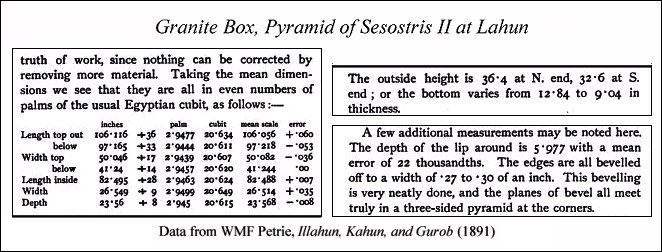
The meaning of 106.116 in = 8.843 ft here is somewhat uncertain. At face value it’s an unusual number, and the definition or identification of the raw value may be contingent on its possible relationships to the 2.2… ft figures discussed in the previous post.
In terms of identifying the value in inches, what seems most likely is probably either (1 / (30 Pi)) x 10^n = 106.10329954 inches (8.848336456 ft), or 106.1800375 inches.(8.848336458 ft).
Sampling some of the ratios between parts, it may be likely that 50.04 / 26.459 = 1.88481675 means (6 Pi) / 10 = 1.884955592 ft; 50.04 / 41.25 = 1.213090909. Conserving the Remen value, this may be 41.25296124 x 1.216733603 = 50.19386416 inches = 4.182822014 ft. a figure in putative Egyptian Sacred Cubits of (Royal Cubit in feet x Remen in feet).
Failing that, a figure of 4.179798861 may be possible. This figure was built into the Great Pyramid’s missing apex section where the very desirable figure of 4.182822014 simply could not be made to fit.

At least on its own terms, the value of 17.553 may be 17.55865396 inches; 175.5865396 feet is traditionally given as the base perimeter of the Great Pyramid’s missing apex section. In turn, 17.55865396 inches / 12 = 1.46322163, a number recently encountered when looking at the possible proportions of the pyramid of Unas.
Alert readers may have already noticed something amiss in the previous post, which is that although Petrie’s raw data provides us with what looks very much like 1.177245771 as the ratio between the exterior length and the interior length (97.165 / 82.495 = 1.177828959), the ratio between the refined figures is actually 97.33868822 / 82.50592248 = 1.179778194, which gives someone some explaining to do.
What we may be seeing could be similar to Teti’s pyramidion, which seems to have recruited a Cubit-like figure in place of an actual Royal Cubit in order to appease a particular mathematical formula. I have written before about the “logistics” of this, where working extensively with a unit informs one what does and does not work, and acquaints one with numerous figures near to but not equal to the target figure. It’s something I’ve experienced for myself.
Because they worked so extensively with the Royal Cubit, the ancient Egyptians were probably well of many very similar figures, which seems to be in evidence in the pyramidion of Teti, and probably the pyramidion of Giza subsidiary pyramid GIII-a (as described by Peter Janosi) as well.
One way to appease the equations for Sesostris II’s granite box in the pyramid at Lahun then is to take 6.890283707 ft as the interior length, rather than 4 Royal Cubits = 6.8754933540 ft. (Our Founder Carl Munck was fond of the number 6.890283707 for good reason, including this number’s sordid past as the “Grid Longitude” of a certain Martian landform according to Munck. As is customary, he assigned an important number because he considered it an important site).
We could make Royal Cubits out of 6.890283707 by dividing it by four, but in 20 years of Egyptological studies, I have never had to resort to accepting 6.890283707 / 4 = 1.722570927 as a Royal Cubit that was actually used in architecture or stone masonry (even though I can brag of the obscure honor of having discovered the value 1.722570927), even while there may be little doubt that it apparently has “ceremonial” value as an “unofficial” Cubit.
(Any readers wishing to know more about 1.722570927 and its nature and relevance can look for previous comments on the “Stecchini” or “Lepsius” Cubit, which have often been used to refer to the value 1.722570927).
Before I comment further, I should note that 1.179778194 is still a value in Megalithic Feet of 1.177245771: 72 x 1.177245771 = (1 / 1.179778194) x 10^n.
I should also note that fellow champion of the Remen, Jim Alison at GHMB, continues to produce high quality research and commentary regarding referring to historical sources to illuminate the use of ancient Egyptian measures geographically, wherein are used two different values for the stadium (stadia, stade) – one of 300 Royal Cubits = 515.6620155 ft, and one of 500 Remens = 608.3668015 (see also Nautical Mile) ft, the difference between the two by ratio being 608.3668015 / 515.6620155 = 1.179778194, which should imbue the figure 1.179778194 with considerable metrological significance.
Adjusting the exterior length to 16.18829140 / 2 instead of 16.22311470 does fix the discrepancy, but the box may have other ways to express 1.618829140 so that this isn’t necessary for that gesture.
All of this reminds me of Teti’s pyramidion, where they are trafficking in things that may NOT be metrological units, but are very similar. The interior length therefore might not be 4 Royal Cubits, but something similar.
Setting up 1.177245771 next to 4 Royal Cubits or its look-alike 6.890283703 sets up a minor series that includes the Venus Synodic Period (VSP).
16.18829140 / 2 = 8.09414570; 8.09414570 / 1.177245771 = 6.875493546 (4 Royal Cubits); 6.875493546 / 1.177245771 = 584.0321295 / 10^n; 584.0321295 = Venus Synodic Period A
16.22311470 / 2 = 8.11155735; 8.11155735 / 1.177245771 = 6.890283703; 6.890283703 / 1.177245771 = 585.2884650 / 10^n; 585.2884650 = Alt Venus Synodic Period x (see VSP = 585 Dresden Codex etc).
8.11155735 x 1.177245771 = (1 / (PI / 3)) x 10^n; 8.11155735 x (1.177245771^2) = 11.24186902 = Venus Orbital Period A 224.8373808 / 20, important built-in extras that combining 16.18829140 / 2 with 1.177245771 does not provide.
So we may be able to infer thus that the preference would probably have been 8.11155735 over 8.09414570 as the outer length of the Illahun box.
Specifically, 16.18829140 could be provided another way without the exterior length of the box having to be 16.18829140 / 2:
Interior Length 8.250592248 (4.8 = 48/10 Royal Cubits) ft x Interior Height including lip 1.962076285 = 16.18829140.
(Other researchers may be eager to infer Phi proper 1.618033989 here, and more power to them).
Thus as with many other artifacts or architectural constructs including the Great Pyramid, Stonehenge, and the Pyramid of Niches, the designer(s) of the granite box may have been eager to incorporate both 1.622311470 and 1.618829140.

Pyramid of Niches in Mexico from Grijalba’s data. Note the calculated diagonal values given at the top of the diagram. Not surprisingly, both 1.622311470 and 1.618829140 seem to be rather blatantly honored in the design.
Before we get more involved with the diagonal values of the granite box, it might be useful to touch base with Petrie’s data again

So, for the end diagonals, errors not withstanding, we should have

The figure 4.271287723 might be 5 / 1.177245771 = 4.247201496 when all things are considered. In inches this is 4.247201496 x 12 = 50.96641795.
4.091273427 is near to 1 / (2 Remens) but probably not near enough if we try to conserve the Remen values by refusing to accept figures as high as 1.22…. Figures like that are attributed to Clagett (1999) (see Wikipedia) who may have not only skewed the Remen value upward but may have likewise skewed the whole catalog of Egyptian measures along with it.
Possibly this is 1.541011111 x (1 / Pi) = 4.9015190714, which is 1/24 of 100 Megalithic Feet.
The raw interior end diagonal of 31.841353939 is very close to (1 / Pi) x 10^n = 31.83098862. In feet, that is 2.652582385, which is 1/4 of 10.61032954.
The raw interior end diagonal of 31.841353939 is very close to (1 / Pi) x 10^n = 31.83098862. In feet, that is 2.652582385, which is 1/4 of 10.61032954.
We may also wish to note the horizontal distance from the outside of the box below the lip to the interior of the opposite side that is noted here, 2.824968330 ft, which as a numerical value is exceedingly close to the number of digits per cubit implied by the Harmhab Cubit rod (see Berriman) and possibly others.
The reciprocal of the standard Lunar Year value of 353.9334578 days for the canonical 354 days = (1 / 2.825389852) x 10^n. This divides a Royal Cubit into 28.25389852 digits of 1.718873385 / 28.25389852 = .608366800 / 10 feet = 5 Remens / 100.
.0608366800 ft x 12 = .7300401608 inches. Values of both .729 and .730 were not surprisingly both corroborated by Petrie. I’ve shared this before to illustrate that metrology is so full of calendar numbers that even the number of digits in a Royal Cubit is a calendar number by way of being the Lunar Year in reciprocal form.
The inner diagonal at either end may represent a Lunar Leap Year of ~354 + 1 = 355 days.
We also have the overhead diagonals including that for the length and width with the lip

The other measures in the diagram are covered elsewhere in this post, but I wanted to point out the 117.3226622 inch diagonal here. I really have no idea offhand what it represents, but I should point out that in a list of new and old “wonder numbers” from last year, we find the value 1.173095008 (as well as 1.174718783). DUNE has a rather interesting take on this raw value.
There may be some hints of the “Faiyum Wonder Numbers” at work here as well.
That is, 97.3386879 / 1.177245771 = 82.68340422 = 41.34170211 (Harris-Stockdale Unifying Value?) x 2; (97.3386879 / (1.177245771^2)) = 70.23461562 = (1 / 1.423799349) x 10^n; 1.423799349 = “Faiyum Wonder Number”.
So now we know that the “Faiyum Wonder Number” is also featured at Stonehenge, because the numbers 97.3386879 / 1.177245771 are extremely integral to Stonehenge.

Above, we are looking at the effect of the slant on the length of the base and one way of interpreting the difference between length with slant, and without. 3.166666666 is a figure we tend to see often enough (it seems to appear within Chephren’s pyramid) and may mean 3.176262621, an important enough figure to ancient calendar systems.

It’s not clear yet what many of these diagonals are meant to represent.
At upper left, the diagonal in blue might be 105.5428996 inches – numerically, this is (the square of the Inverse Roman Foot) x 10^n. In feet, this would be 105.5428996 / 12 = 8.795241636 ft.
The diagonal in purple, 109.8554961 inches, is near to the value of 100 Indus Feet, but does not match any value yet known for the Indus Foot; also nearby is 109.6622711 = 9.138522594 ft.
At upper right, the diagonal in purple is 88.42757666 inches, while the length of the lip of the box from Petrie is 106.116 in / 12 = 8.843 ft. The diagonal in purple, as I believe DUNE at GHMB has noted, looks like a simple fraction of the 346.62 day Eclipse Year.
86.6618395 x 4 = 346.647358
At lower left, the diagonal figure in purple appears to be in Megalithic Yards; assuming the primary value of 2.720174976 ft is in use,
2.720174976 x 4 = 10.880069990 ft; 108.80069990 / 12 = 9.067249920, which a number of people might recognize as essentially the length of a side of the Great Pyramid at the base, when expressed in inches. With the numbers I work with, this is
3022.416640 ft Great Pyramid perimeter / 4 = 755.604160 ft x 12 = 9067.24992 inches
I should also note that the height figure here, 26.623 inches, may mean 26.62867199 = 22.19055999 ft. 26.62867199 represents a number of important things. Metrologically, it 324/10^n Inverse Remens, or 360 Squared Munck Megalithic Yards / 10^n. Munck was fond of the number and assigned it “geomathematically” to at least several notable ancient monuments.
At bottom right we may find something particularly intriguing, the measure of 89.80728270 in = 7.483940225 ft.
Petrie’s data for the King’s Coffer in the Great Pyramid gives 89.62 in = 7.468333333 ft for the exterior length.
Also in some of my data sheets, I have for Chephren’s coffer, Long Diagonal of interior 89.74820890 in = 7.479017408 ft.
These values have never really been resolved, which may more or less interfere with a complete interpretation of the proportions of the coffers attributed to Cheops and Chephren.
Similar data also appears at Tikal: the door height of Tikal Temple V is given as 228 cm = 7.480314961 ft according to Teobert Maler, for which I have several logged speculations of 7.481018186 ft (10.3680 / (1.177245771^2)) and 7.483901069 ft (5.4 x (1.177245771^2)). Additional similar figures probably exist.
Is it possible that the very same measurement was repeated in the coffers of Cheops, Chephren, Sesostris (Senusret) II, and possibly others?
–Luke Piwalker
 Luke Piwalker