I think my big adventure following in Susan Milbrath’s footsteps may have about run out of steam. I’m not sure where the data exists to carry on the inquiry further. Some of it may be in Jean Meeus’ publications but not necessarily because there are clear indications that even his data doesn’t go far enough back in time when it comes to many critical considerations, and most of the relevant works like the “Morsels” series are at present very prohibitively priced.
No doubt I will be screaming about the elitist nature of academia long before I spend a thousand dollars on a reference work that is of zero value.
If that happens to be a matter of supply and demand, it may be a sad statement about a lack of interest even on the part of Mayanists that may be the result of grossly underestimating the “primitive Maya”.
Here are some possibly poignant comments I stumbled across while doing further research on the “Mayan Bee God” or “Diving God” who may not really be a “god” at all, but may be “more of a verb than a proper noun” that generically indicates the passage of an astronomical object below the horizon, something like an aquatic version of the “Jaws of the Underworld” (the horizon) “consuming” objects which disappear below the horizon.
“Imagine a civilization that was so sophisticated that its astronomers could predict the passage of Venus, and yet so primitive that its people made ritual sacrifices to keep Venus on its path. Not only Venus. They prayed for rain. They prayed for the Sun to rise tomorrow!” Secrets of the Gods In Tulum
Indeed, just because that is so difficult to imagine, we may have to keep asking what’s “Wrong with that picture?” and it may well be the idea that we are dealing with anyone primitive, which may be precisely the big mistake that gets in the way of a better understanding of ancient Americans, and ancients everywhere by the same token.
Given the possible absence of the necessary data, I thought I might turn my attention back to Tikal, where there may be there is some possibility of correlating some of the data I do have, with work that I’ve done on the Tikal temples previously. I still really know nothing about how rigid a rule there may or may not be that the two should coordinate.
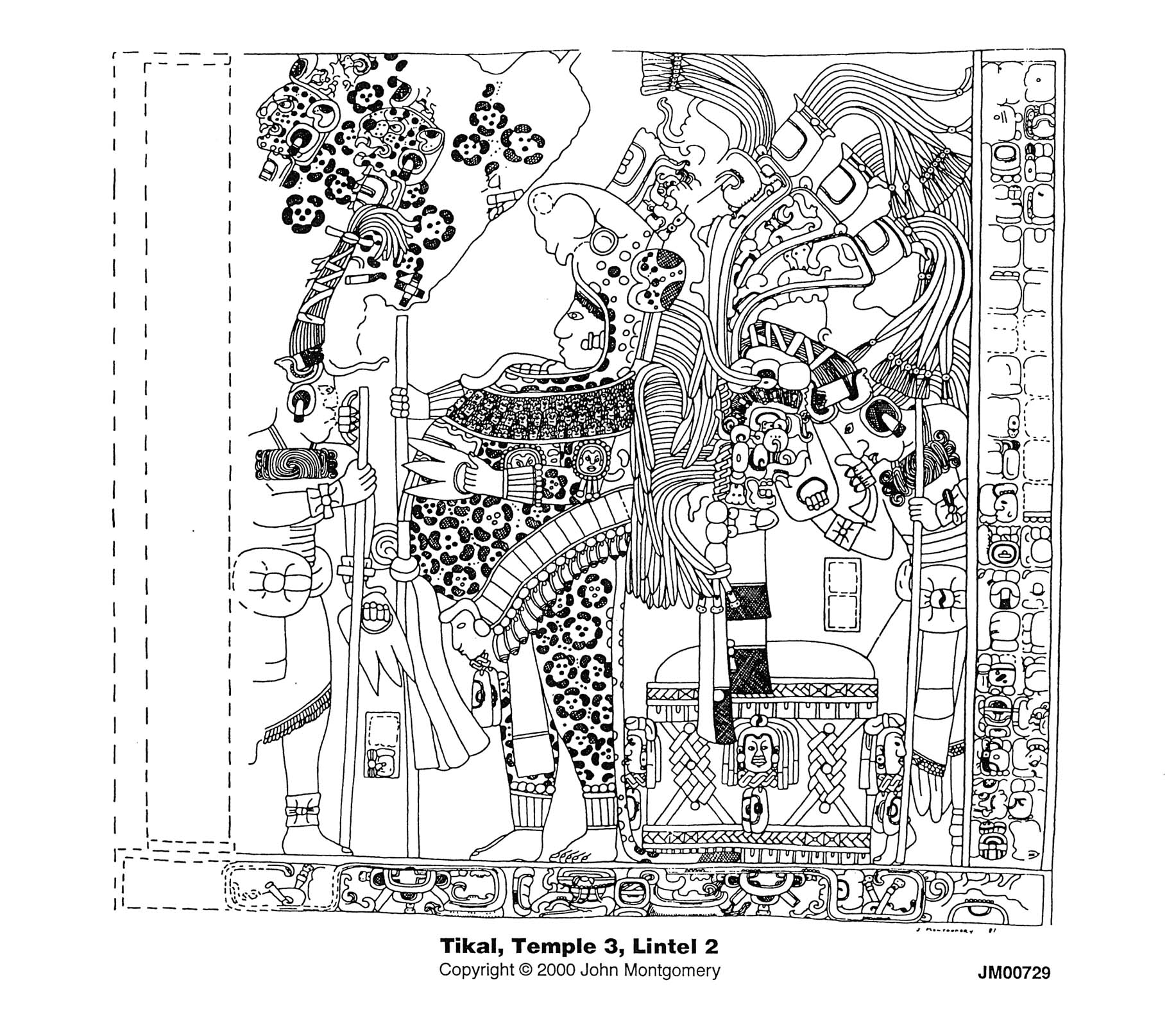
Tikal Temple III may be of particular interest because Lintel 2 features not only a “potbelly” motif that I suspect may signify Jupiter, but an unusual one in which the “potbelly” may be part of a costume.

Higher resolution view: http://research.famsi.org/uploads/montg … T3Lin2.jpg
Location: Tikal, Department of Peten, Guatemala
Caption: JM0073, Tikal, Temple 3, Lintel 2
Category: Maya. Late Classic (c. 810 AD)
Credit: Copyright © John Montgomery
Comments: Nine surviving zapote-wood beams of this lintel still survive above the inner doorway. Text of left side of lintel are missing (originally 80 glyph blocks). Image of ruler with two assistants. All three figures hold weapons – trident flints.
To be honest, though, I haven’t dissected Tikal’s temples that thoroughly as to be able to correlate the planetary associations that the lintel may depict, which the closest nearby mathematics. A lot of focus was given the matter of their exterior doors as opposed to interior doors, because the impression was and continues to be that some of their best efforts may be found in or around the exterior doors, as if they were putting out a welcome mat for visitors and interpreters.
In spite of the intriguing lintel art, I do not seem to have a date for this lintel, and apparently hence no corresponding astronomical data from Milbrath, so it may make for a less promising iconographic study, but it is nonetheless an intriguing mathematical study.
The correct rendition of Jupiter’s cycles still seems to be poorly understood. The natural ratio between two of Jupiter’s primary mathematical features, its Orbital and Synodic Periods, has been difficult to approximate while achieving a sensible pair of values for these parameters, and some initial work on locating the cycles of Jupiter in the mathematics of the calendar stones (“altars”) may have been misleading, because it seems to endorse the strong candidates for the Orbital and Synodic period values that may lack compatibility.
For that, we could hope that any ancient monuments or architecture that refer to Jupiter symbolically, might be places to go to find clarification about how Jupiter is best referenced mathematically.
To review somewhat, the original exterior door proportions of Tikal Temple III have been proposed to be
Temple III Width 12.98787880 ft; Height 10.96622711 ft; Ratio W / H 1.184352528, Product W x H 14.24280364
The width is a fraction of what is probably the most useful approximation of the important canonical calendar number 52.
After finding that even some of Tikal’s most challenging mathematical puzzles seemed to solve themselves if we learn to appreciate the apparent important of the number (Pi / 3) and its power as a data retrieval tool, and after deciding on 10.96622711 for a myriad of other reasons, it was finally noted that 10.96622711 / 10 is the square of (Pi / 3), something that took me a long time to notice because my calculator is programmable so that I can enter “Answer x (a number)” and just keep hitting the “equals” key, so that I am constantly working with (Pi / 3)^2 without ever getting to see what it actually looks like. For me, there have been a number of such surprises that were surprises just because of the way my calculator and I interact.
Suffice to say that finding out 10.96622711 / 10 is the square of (Pi / 3) lends considerably more confidence to the proposed door proportions, which are in some ways a bit unusual even for Tikal. Unlike some of the other Tikal temples, when (Pi / 3)^n is applied, they give a grand tour of some “Pi-based numbers” (numbers that can be formed from a whole number and Pi) rather than the “square root” numbers which often give such amazing results with the series they form interacting with prominent data retrieval keys like Pi, 2 Pi, 1.177245771 or 1.622311470.
The proposed Width/Height ratio of the door is what forms the link between Venus Cycle (or Half Venus Cycle aka Calendar Round) and Venus Orbital Period, something I was more or less taught when pondering the architecture of Rio Bec and how they used astronomical numbers in their architecture there. Again, I personally find the Rio Bec architectural style and the associated sites especially intriguing, because I am not in disagreement with orthodox scholars that the false temple towers of the Rio Bec style evoke Tikal’s temples, and were most likely intended to.
In a way, I have always hoped that this unusual gesture of respect towards Tikal aesthetically is accompanied by unusual gestures of respect toward Tikal mathematically, or in the creation of monuments, that Rio Bec sites might represent a logical continuation of Tikal’s mathematical themes.
The data from George Andrews also addressed the lintel measures of Tikal’s exterior temple doors so that the question could be attempted whether both the door heights with, and without lintels, can be expected to be mathematically significant, with the results of an inquiry being apparently positive in one such case after another where such complete data was available, although the specific details should already have been published and are beyond the scope of the current initial inquiry.
Lastly 14.24280364 is one of the original “Mayan Wonder Numbers”, and this is where and how it was originally found. Perhaps one might take to calling it the “Temple III Number” if it helps keep it sorted out from “The Faiyum Number” which was originally from Egypt, but was quickly found to be prevalent in ancient American architecture as well. Since its discovery, the “Tikal” number 14.24280364 has been found to be a genuine and integral element of certain proposed astronomical formulas.
While observing the possibility that not only the ratio of door width and height by division of the larger by the smaller should give pleasingly significant values, but also the product of multiplying width times height often makes it more of a challenge to develop working models because of the increased demand, there are also some obvious advantages to this parameter having been considered by the architects in their designs, and Tikal Temple III is one of the successful examples of this consideration being observed and applied.
To date, that may be the bulk of anything that may be definitively known about Temple III.
I may have attempted this before, but it’s always good to revisit things to see if new discoveries can make unsolved puzzles less puzzling, so I’m going to ignore any previous work that may exist for now, and begin again from the ground up. Leaving aside of now the issue of the exterior door with and without lintel as well, let’s look back at Andrews’ data on the temple, in spite of any data points that may be missing.
Quoting here George Andrews from Architectural survey Tikal, Guatemala : the great temples
“STRUCTURE 5D-3 (TEMPLE III)
COMMENTS
In common with all but one of the Great Temples (Temple VI), Temple III was first described and photographed by Alfred Maudslay (1889-1902). A few years later Teobert Maler (1911) provided a more detailed description and other excellent photographs. These early photographs are particularly valuable today, since the pyramidal
substructure is now recovered with huge trees (as of 1981) and only the temple proper can be seen. The temple itself was cleared and consolidated as part of the University of Pennsylvania’s 10 year program at the site (1956-66) when the fallen lintels over the east doorway were replaced with new wooden lintels.
It is difficult to suggest any logical reason for the distortion of the temple proper into a parallelogram, since none of the other Great Temples show this amount of deviation. It could be merely an error on the part of the builders, but it seems more deliberate than accidental, and therefore more difficult to understand…
INTERIOR DETAILS: ROOM 1 (Outer room)
DIMENSIONS
Length: 6.65 m front, 6.90 m rear.
Width: 1.62 m.
WALLS
Height: 3.96 m. floor to springline.
Thickness: Front wall 1.73 m thick. Stonework: Walls faced with (text missing)
Doorways: Exterior doorway 3.83 m wide (front); 3.90 m at rear; 3.12 m top of floor to bottom of lintels. Wood lintels (plain) .24 m thick.
Rod Sockets: No data. Cordholders; No data. Wall Openings: None noted. Platforms: None.
Other: Step up to rear room .27 m high. South end wall not perpendicular to front and back wails.
VAULTS
Springline Offset: .075 m (approx.)
Height: 2.57 m (approx.) springline to bottom of capstones. Form: Vault faces have straight sides.
Stonework: Vault faced with long rectangular slabs with faces set to slope of vault.
Capstones: Capstone span about .16 m. Crossbeams: Three rows of crossbeams as in other Great Temples.
Other: Projecting springline has rounded corners.
OBSERVATIONS
This room wider than front room of Temples I and II…”
Note Andrews’ comments about the building being a “parallelogram”, which I have bolded – this is yet another example, and a notable one, of the possibility of ancient architecture being designed with deliberate imperfections that were designed to increase the architecture’s data handling capacity.
There may actually be at least two such deliberate distortions of the geometry here, if we can take Andrews’ diagram at face value that the outer temple is distorted in a different direction that Room 1 is (Room 1 is longer at the back than at the front, even when ancient American builders have shown again and again that they are perfectly capable of regularity in the execution of architectural designs).
Room 1 is the room just outside the inner door with the lintel in question, so we hope it has sufficient proximity to converse with the lintel and any data it may contain.
6.90 m = 22.63779528 ft
6.65 m = 21.81758530 ft
1.62 m = 5.31496063 ft
3.96 m = 12.99212598 ft
6.90 / 6.65 = 1.037593985
6.90 / 3.96 = 1.742724242
6.90 / 1.62 = 4.259259259
6.65 / 1.62 = 4.104938272
6.65 / 3.96 = 1.679292929
3.96 / 1.62 = 2.444444444
Perhaps unfortunately, the maximum length of the room at rear may be a challenge to interpret because it may be easy to be tempted by the possibility of the Venus Orbital Period being represented (22.48373080 ft presumably), which it may or may notactually mean.
There are some figure there familiar enough that perhaps they may be correctly recognized at first sight, and they include the width, which may be 5 Hashimi Cubits, and the minimum length / width ratio, which much resembles the reciprocal of 2 Remens.
The min/max length ratio resembles several things; one is 360 / Eclipse Year and the other is (8 x 1.000723277) x (360^2) / 10^n (to write it one way).
6.65 meters when translated to the so-called “modern Imperial” foot resembles a number from the unfinished proceedings of relating the revised Mycerinus pyramid to its larger mathematical environment at Giza.
It bears repeating that the ratio between the inner and outer sarcen circle at Stonehenge is the same ratio that exists at Giza between the base of the Great Pyramid, and the base of Chephren’s pyramid, and suffice it to say on that basis alone, that the mathematical relationships between Giza pyramids should be considered as being intentionally significant.
However, given the uncertain status of the Mycerinus pyramid because of its unfinished state, it proves challenging to be certain whether the successfully revised model of the Mycerinus pyramid describes a model with pavement in place, or without pavement, and therefore to be certain of the intended relationships between it and other Giza pyramids.
Using Munck’s 150 Pi feet height for Chephren’s pyramid, and the projected 216 foot height of the Mycerinus pyramid, the ratio would be
471.2388980 ft / 216 ft = 2.181661565, but it is still difficult to know whether this is what was intended, or whether a probably more attractive figure of 2.180084761 was intended here, and if so, exactly how it was implemented. It might still turn out to be either, as could this very similar figure from Tikal Temple III.
3.96 m = 12.99212598 ft may be another approximation of 13 though a simple fraction of the Stonehenge outer sarcen circle radius and diameter, or of its fundamental unit being also used in the New World to form an approximation of the 260 day Tzolkin (13 x 2 x 10) that is able to integrate the 260 and 364/5 day calendars rather than them being exclusive to one another in terms of fundamental relationships though division and multiplication.
In other words, this may be a repetition of the exterior door width of Temple III, 12.98787880 ft
6.65 / 3.96 = 1.679292929 could mean the 1.676727943 (Egyptian Mystery Unit) value that is essential in ways to the construction of “Mayan” calendar cycles, and to understanding the importance of the width x height product of the exterior door of Temple III.
3.96 / 1.62 = 2.444444444 may be an occurrence of the Double Remen in forward form, in contrast to the suggestion that 6.65 / 1.62 = 4.104938272 may represent the Double Remen in backwards or reciprocal form
1 / 2.4444444444 = 4.0909090909, very close to 4.104938272.
Rather than give what may be haphazard endorsement to these suggestions, let’s press onward to the door to Room 2, where the lintel in question appears at the top of the doorway.
Sadly, the height of the inner door does not seem to be readily discernible from Andrews’ data. We may have some options of secondary sources, but it may call for some elaborate tables and careful comparison of data sources. Personally, speaking from much experience, I generally take George Andrews’ data to be more reliable than even Teobert Maler’s. That project to may lie beyond the boundaries of the present effort.
For the second room in Temple III which lies just the other side of the lintel in question, referring again to Andrews’ report
“SITE: TIKAL DATE: 3/27/1974
STRUCTURE 5D-3 (TEMPLE III)
INTERIOR DETAILS: ROOM 2 (Rear room))
DIMENSIONS
Length: 3.35 m.
Width: .69 m.
WALLS
Height: 3.68 m (approx.) floor to springline.
Thickness: Dividing wall to front room 2.21 m thick.
Stonework: Walls faced with (text missing)
Doorways: Doorway to front room 2.17 m wide. Carved wooden lintels above; 9 of 10 original wooden beams still in place though defaced by looters (see details).
Rod Sockets: No data. Cordholders: No data. Wall Openings: None noted. Platforms: None. Other: Floor of this room raised .27 m above floor of outer room.
VAULTS
While much narrower, all details of vault over this room similar to those seen in vault of Room 1.
OBSERVATIONS
Very small, exceptionally narrow room.”
We also may not have certain data then for the vault measurements of Room 2, only that they are “similar” to those of Room 1, and it may simply not be safe to speculate on the basis of Andrews’ data alone how “similar” they are or in what ways.
3.35 m = 10.99081365 ft
0.69 m = 2.263779528 ft
3.68 m = 12.07349081 ft
Offhand it seems difficult to guess whether .69 m is intended as exactly 1/10th of the 6.90 m maximum length of the first room, although it certainly a possibility to not overlook, or whether the 3.35 m = 10.99081365 ft is a repetition of the proposed 10.96622711 ft height of the exterior door, but at the rate that the suggestions of repetition are accumulating, it may be an increasingly viable possibility that repetition was used here to reinforce some of the message contained in the exterior door.
3.68 / 3.35 = 1.098507463
3.68 / 0.69 = 5.333333333
3.35 / 0.69 = 4.855072464
This too may be suggestive of more repetition. The tentative suggested interpetation of 1.62 m = 5.31496063 ft now appears probably even more convincingly as a ratio as well as a possible measure of Room 1 as 3.68 / 0.69 = 5.3333333333; the suspected figure is half of 10.67438159 or 10.67438159 / 2 = 5.337190795.
Likewise, the height / length ratio of 3.68 / 3.35 = 1.098507463 appears if it may be a repetition though ratio of what appears as a measure with the Room 2 length of 3.35 m = 10.99081365 ft and the proposed 10.96622711 ft height of the exterior door.
Such reinforcement of important figures so that they appear as both measure and as ratio is not uncommon, and seen also in the ancient architecture of the “Old World” such as in Egypt.
Just to prove to the reader that I haven’t entirely overlooked the possibility that either of these numbers represent the number 11 (or 11/10), in this math we might want to write 11 in Indus Feet, but the classic Indus Foot value here which may often be used to approximate 11, is technically a quantity in Megalithic Feet, and to present it in Indus Feet may perhaps be to weaken the potential of the message.
For the record, in the context of proposed figures for major periods of Jupiter, 10 x (Pi / 3)^2 = 10.96622711, is loosely related to the present suspected intended approximation of the Jupiter Orbital Period – 4329.29292 days representing the textbook figure 4332.59 days, a quality approximation speaking relatively to approximations of the Calendar Round – by the square of almighty 2 Pi, and the relationship between the two also includes a possible high quality approximation of the Saros Cycle of 6585.3211 days
10.96622711 / 4329.292929 = 2.533029594 / 10; (2.533029594 x 2)^3 = 6586.899478 / 10, probably a very fit candidate for quality approximation of the Saros Cycle even if the systematics of this are still not yet well understood.
We may wish to note that another way of seeing this is that the square of the reciprocal of 2 Pi = 2.533029594 / 100.
Regarding the suggested value of 1/2 of the Hashimi Cubit, in a number of ways this is a rather sensible thing to combine with the so far standard Jupiter Orbital Period, and because it connects as a series with the Great Pyramid’s proposed diagonal length (at pavement level), informs us further of what even the diagonal of the Great Pyramid is capable of when the Hashimi Cubit (actually a proposed variation on the Egyptian Royal Foot).
For Jupiter’s Synodic Period, I’m not ready to pursue the matter more aggressively even if Tikal Temple III should prove to be our “Rosetta Stone” in this matter. There are a few hints at least that Tikal Temple III may indeed be able to do this, in a matter that relates to what the basic problem tries to be, which is that the ratio between my primary candidates for Jupiter’s Orbital and Synodic periods is a little too low, and that the correct Synodic Period value to match an Orbital Period value may be lower than the current candidates, even if the current candidates may be viable in variant formulas, the Dresden Codex being a prime example of variant astronomical formulas.
To use short numbers for a probe, the canonical Synodic Period of Jupiter of 399 days divided by 1.0966 = 363.8519052, which looks rather like a possible approximation of the Solar Year reckoned as 364 days, which may also relate to the symbolism on the lintel, where a rotund Jupiter has seemingly been festooned with feline characteristics that may be best associated with the Sun in Mayan iconography just as they might be in “Old World” iconography – again a possible “uncanny parallel” between Old and New World myth and symbolism that might owe to ancient diffusion (distribution) of culture.
We can also observe that for 690 / 665 = 1.037593985, that 399 x Tzolkin 260 = 103740, which might (or might not) prove to be an important clue as to exactly what was intended here.
In terms of the suggestion that it might also represent 360 / Eclipse Year (360 / 346.62 = 1.038601350), we may see several instances of a similar operation here involving 360 / Lunar Year, which continually seems like a common subject addressed in the mathematics of ancient American architecture.
Canonically, 360 / Lunar Year 354 days = 1.016949153, and where we may find this in Tikal Temple III is the inner/outer width ratio of the exterior door Max Width 390 cm / Min Width 383 cm = 1.018276762, and in 690 cm / 162 cm (Max Length / Width of Room 2), where this is about Jupiter Orbital Period textbook figure 4332.59 d / (360 / Lunar Year in days)
690 / 162 = (4332.59 / 1017.216783).
I’d like to draw attention to something else here now, which is Andrews’ data for the thicknesses of the walls. According to his data, the thickness of the wall between Room 1 of Temple III and the outer front face is 1.73 m, a number we may have been poorly equipped to appreciate until relatively recently when this mysterious value that recurs in Tikal “Bat Palace” in a manner that is probably highly uncharacteristic of ancient American architecture was tentatively identified.
Perhaps it part of a practice of putting their best at the front door to greet guests that we find this here, and because it is here has led to the observation in the context of Jupiter that “the Bat Palace Number” divided by 7 = 398.66, very close to the textbook figure for Jupiter’s Orbital Period, 398.88 days. Of course, I have no expectation that a canonical value for the number 7 is represented here, for that reasons that include that even the canonical number isn’t canonical. In spite of the way we think of calendars, that there are 52 weeks of 7 days in a 365 day year, 52 x 7 = 364 and not 365, and 365 / 52 = 7.019230769 and not 7.
It also comes to my attention that there is a number, 399.8649086 that successfully interacts with the “Wonder Number” that is the product of the exterior door’s width x height, all the way to the third power, although it remains to be seen if this could actually be a viable possibility for the Jupiter Orbital Period.
Perhaps we should consider all of this rather satisfactory for a “first outing” with the inner workings of Temple III, and having now shared this with readers, perhaps I can move on to other examples of Tikal lintels which have their dates intact so that we might better understand the nature of their symbolism.
–Luke Piwalker
 Luke Piwalker