A fundamental premise of Carl Munck’s teachings was that ancient monuments reveal mathematical formulas that only tell us “why they are where they are”, but that can also tell us where other monuments are, forming in essence an ancient global positioning system, and even inspiring hope of being able to use his grid system to locate lost monuments or even cities now lost beneath jungles.
It’s quite a tempting proposition, especially since location might be the only data we can recover from many ancient monuments that have badly damaged or worse, eroded until there is little left of them but a crop stain in an aerial photograph, but unlike the mathematics of Munck, it doesn’t stand up well to scrutiny.
There may be some small consolation in that IF Munck were correct about the original position of the Great Pyramid, his findings on the location of most if not all of other monuments at Giza could still be correct since they are so close to the Great Pyramid, but sadly I think the truth is that the subject has failed to catch the attention of anyone with the requisite cartographic skills to really sort out the proposition.
Accurate mapping is a highly complex, technically demanding skill, and there may be few qualified to expertly clarify how much of Munck’s map-based theories can be preserved. In short, right or wrong, mapping may have never been quite as simple as Munck used to think.
So where does that leave use when the global positioning theory collapses? We know there is great logic and great merit to his math even as it applies to the parts of individual structures, but to what does this math refer if it not to the global positions of ancient monuments.
A few years ago, when I resumed my studies and began to focus on ancient American architecture, I asked myself what mathematics the Maya might concern themselves with, and of course the obvious answer had been staring me in the face the whole time – calendars.
Imagine my surprise when I started looking for mathematical and metrological references to Venus, and began to find them with a prominence that matches well the preoccupation with Venus in ancient myth and symbolism.
Most striking of all, when I began to understand how incredibly integrated that ancient calendars had become, encompassing not only the cycles of Earth or the moon, but the cycles of the visible planets as well, that the recognition of the common denominators required to coordinate such a complex system should have only occurred to those ready willing and able to compile charts of the planetary cycles and the ratios between them and to comb through them one at a time.
I got no further than looking at the relationship between Earth and Venus in calendar terms – 365 days / 225 days = 1.6222222222 and was immediately struck by the resemblance to what had already become one of the most important numbers in Munck’s math, 1.622311470.
I had known this number as a mathematical constant, and as a metrological unit, but here it was again as one of the most important ratios of internal calendar systems. If my findings had been limited to that, I could have stopped there, but the findings continue.
Other hugely important numbers I had already been working with under other auspices flow freely from the mathematics of calendars, including the values in modern feet for the Egyptian Remen, the Egyptian Royal Cubit, and Munck’s “Alternate Pi” 1.177245771 – although not absolutely perfectly, with virtually uncanny precision nonetheless.
This the simplest, most basic expression of what may have been required in order to recognize an integrated calendar system such as the ancients are known to have used, using textbook figures for the calendar values of the planets. Several non-visible (with the unaided eye) planets have been included in order to watch for possible indications that ancient optics may have become more advanced that is generally realized).
This table is already in trouble for omitting the calendar value of a number of planets, such as the canonical 365 day Earth Year. We seem to be dealing with a system of math that even for being self-limited, was able to effectively approximate both rounded simple canonical values, and least in some cases, more complex and more accurate approximations of the “textbook” values.
The math involved can be so complex that to this very day I have not been able to be certain what was intended for the approximation of Mercury’s cycles, even though I have the advantage of a pocket calculator.
Please bear in mind that this also does not include the data spread that may have been required to in turn further coordinate these planetary cycles with a myriad of lunar cycles.
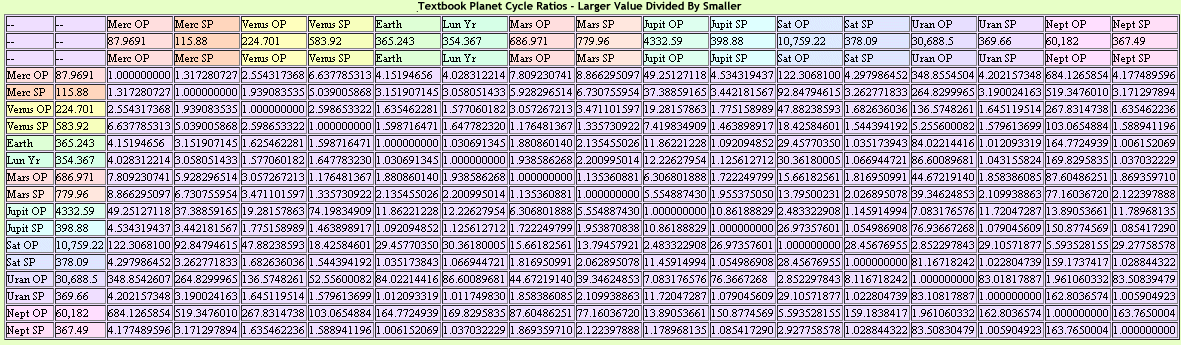
There are many important things that can be observed here, including numbers that are easily approximated by direct derivatives of Pi (Morton’s Royal Cubit of 1.718873385 is one of these and direct derivatives of it appear here repeatedly), and many numbers that are easily approximated by numbers that should be highly familiar to avid students of Munck’s work.
Notice for example the similarity of the raw value Venus Synodic Period (SP) divided by Mars Orbital Period (OP), calculated at 1.176481367, to Munck’s “Alternate Pi” 1.177245771 – or the similarity of Mercury Synodic Period / Lunar Year = 354.367 / 115.88 = 3.058051433 and of Mars Orbital Period / Venus Orbital Period = 686.971 / 224.701 = 3.057267213 to 1/100 of Munck’s 305.7985077 (360 / 1.1772435771) foot inner circumference for the Stonehenge sarcen circle, a finding well in accord with the data provided by both the esteemed WMF Petrie and RJC Atkinson.
That’s only where the similarities begin between these “numbers from the sky” and the numbers that Munck already had us working with.
Simple fractions or multiples of of the “wonder number” 1.067438159 can be seen here as well (this too appears to be an ancient metrological unit value – historically at least, it appears to be the Hashimi Cubit which somehow later surfaced as the French “King’s Foot” or Pied du Roi, even though it is apparently considerably older, and may in fact be a derivative of the Egyptian Royal Foot).
Note the similarity between the raw value of Saturn Synodic Period / Lunar Year = 378.09 / 354.367 = 1.066944721 and the refined value 1.067438159, or the similarity between Mars Synodic Period / Earth Year = 779.96 / 365.243 = 2.135455026 and 1.067438159 x 2 = 2.134876318.
From my perspective, the raw value Jupiter Orbital Period / Saturn Synodic Period = 4332.59 days / 378.09 days = 11.45914994 – compare this to 360 / Pi = 11.45915590 – is as striking as Mars Synodic Period / Saturn Synodic Period = 779.96 / 378.09 = 2.062895078 – compare this to the 20.62648062 inch value of Morton’s Royal Cubit (360^2 / 10) / (2 Pi), just as Taylor and Petrie suspected.
That is “Pi from the Sky” – literally – to a minimum of six accurate digits. That is Egyptian Royal Cubits and numerous other ancient units as if literally by order of celestial decree.
Imagine the additional work that must have gone into weighing, balancing and fine-tuning such a system for optimum performance, efficiency, and ease of memorization.
Almost unthinkable, particularly for ancient “primitives”, and yet the evidence may be right in front of us in the form of the ancient metrological units we have inherited, and their internal relationships as well.
This is why Carl Munck has given us something priceless and perpetual, completely independent of any possibly questionable concerns about “why things are where they are”.
— Luke Piwalker
 Luke Piwalker