Featured

A New Dimension To Ancient Measures by Dr. Thomas Gough and Peter Harris

Greetings to all

I’ve mentioned this very important new book before, but there are some new developments including that the book is now available from Amazon.com.

What I wrote about Peter’s the new book earlier today, because I sincerely mean it:

I would gladly and confidently say that Peter Harris’ new book with Thomas Gough exceeds even the work of Professor Thom of Megalithic Yard fame in important. Harris not only shows us an unexpected unit, but generously illustrates how to use it for the very obvious purpose of recording astronomy data and formulas.

It is therefore a work on ancient Megalithic metrology of unprecedented quality and importance, and one absolutely vital for understanding the surprising level of success Megalithic astronomers may have been able to achieve in aspiring to preserve their observations and formulas through architectural geometry and proportion.

Available from the Megalithic Portal bookshop and Amazon.co.uk

Peter has also announced several personal appearances at gatherings related to Megalithic archaeology. More details on this and other recent developments can be found in the more recent pages of Peter’s thread at the Megalithic Portal forum.

– -Luke Piwalker

Status Report, and a Name for the Whole Number/Pi^7 Unit

Greetings, all

Many apologies for another unexpected period of inactivity the past several months. At present, I have limited use of both hands dues to yet unknown causes and most often still having to type with two fingers the past eight weeks. (I also had a ten-day hospital stay in January with even more pressing issues, also of yet unknown causes but the doctors do seem to have learned enough so far to be able to try to stabilize my condition with medication).

For now, there is one bit of unfinished business that isn’t so much of a challenge to address. Previously, we saw

One unit, the Whole Number/Pi^7, remains without either a historical identity or working title, the Pi^7 unit seen above.

I plan to be referring to it in the future as the Polar Circumference Unit, since I noticed that the primary representation of the earth’s Polar Circumference in miles is based on a whole number and Pi^7. (The Pi^8 unit is also notable as being the unit of the Great Pyramid’s base diagonal at the upper platform level).

The equation looks like this: 24858.38047 / (Pi^7) = 1/.1215, a Whole Number (1215) which has been diminished by shifting the decimal place.

So now we have something relevant to refer to the Whole Number/Pi^7 unit by.

Among other hopes for the future of this blog, I’d be quite happy to return to the subject of Professor Thom’s flattened circles.

To recapitulate some of the highlights of that effort, I started looking closer at the internal relationships (generally ratios) between various parts of Thom’s four Flattened Megalithic Ring design after being inspired by Peter Harris’ remarkable ability to mine lunar data from Megalithic monument measures using the Megalithic Foot value (that is, converting the Imperial foot values into Megalithic feet). I think I have been largely successful in finding lunar data using my usual methodologies, although some of my experiments do indeed suggest to me that we intended to convert the Imperial Foot values to Megalithic Feet, because there may be a modest wealth of lunar data distributed through both the Imperial and Megalithic Foot values.

Although the values obtained have sometimes been mysterious at first sight, the reason for seeing certain numbers in the lunar data observed have often soon been solved, with some surprises. To give a quick example of one such number

For this design, Thom’s Type B Modified Flattened Circle in generic form (major radius MN = 114.5915590 units), MC = 35.39334578 units (equals days in Lunar Year / 10.), and BH calculates as 9.793076850 units, which presumably means 360 Megalithic Yard / 10^n, giving 9.792629914. I’ve seen this number before, in Egypt, where is appears to be the reciprocal of the length of an enclosure wall, but I’ve never been sure what it meant.

Truly amazingly, if we take the number next door here and multiply,

35.39334578 x 9.792629914 = 346.5939366, our favorite representation for the Eclipse Year. 

As it turns out, 9.792629914 IS indeed an important Lunar number, and what a prestigious place it occupies in astronomy and calendars – it’s the Eclipse Year divided by the Lunar Year!

–Luke Piwalker


Is This The Original Plan For The Giza Pyramids?

Who knows? It’s hard to tell since apparently someone went and lost the blueprints…

It’s been giving me fits most of the day that some of what I proposed in the previous post yesterday doesn’t add up, and I’ve been checking on all sorts of things trying to get to the bottom of what happened.

It’s speculative – I guess this is all speculative in the first place, isn’t it? – but I’m come up with a possible scenario that may create a remarkably harmonious model for the Giza layout, and for what we might call “The Great Giza Rectangle”. Also keep in mind there is more than one way to do math, hence there can be more than one right answer, but I think this is what we might have been intended to see from our particular perspective.

The possible scenario that occurs to me a possible handwritten error in Petrie’s notes as he was recording measurements in the field, that managed to color his later calculations, and went unnoticed both because of a possible lack of direct line of sight readings from the Mycerinus’ pyramid to Cheops’ – I am not certain here but it seems the Chephren pyramid might have blocked the sighting lines between the two most extremely positioned major pyramids, meaning that this figure would arise purely from calculation – and possibly also due in part to a certain disinterest in the figures once he had made his declaration that there seemed to be no discernable logical scheme to the layout.

If it wasn’t often that Petrie found cause to read his own books for being too busy going forward with his prodigious and laborious career, perhaps it is not all that surprising if such an error could have gotten past him in the long term.

It’s merely speculation, but I am trying to be as sensible as possible. What I’m proposing is an approximately 2.5 ft error in his figure for the NS distance from the apices of Cheops’ pyramid and Chephren’s that would otherwise be not only uncharacteristic for Petrie, but quite possibly entirely without precedent.

This then is the model I’ve developed.

ALWAYS a misprint in my own work! The bottom label for the Giza layout should read (104976 / 10) / Remen = ((81) x (360^2) / 1000) / Remen

Let’s hope I’ve got it right this time. It would be first solid evidence from my own realm of ancient architectural mathematics that the ancients even bothered to do things like this in the first place. No shortage of data stored via measures in the pyramids and temples themselves, by any means. I wasn’t entirely sure they’d even see the need for things like this.

For further background on some of the metrology in use (including the Egyptian Mystery Unit of 1.676727943 feet), several older diagrams:

The Short Remen seen in the first diagram is simply a matter of scale, and to some degree, taste. The ideal figure at 45* to the Royal Cubit is a Remen of 1.216733603 ft, which causes negligible differences from real life examples at a smaller scale, such as shapes measuring like those in these two examples or interior rooms or passages. At a scale the size of pyramids, these differences accumulate until the errors become much less tolerable and at some point, it is preferrable to revert from a Remen of 1.216733603 to a Remen of 12 / (Pi^2) feet = 1.215854204 of accuracy’s sake.

The “Short Remen” in not necessarily the rightful name of this unit value but I have called it this in recognition of these considerations. Some, and perhaps especially those who experiment with the value of the meter in Royal Cubits, may prefer to think of the value as an ancient meter of (to be exact), (360 / 2 Pi)^2 / 1000 = (57.29577951^2) / 1000 = 3.282806350 ft, the apparent thickness of the Stonehenge sarsens and etc.

10 Ancient Meters of 3.28280635 ft = 32.82806350 / 1.215854204 = 27 Short Remens (exactly).

Of what consequence is this Giza Layout in terms of the overarching concern of ancient data storage and retrieval?

Every number that appears in the layout should form part of a set of equations where every number divided by (and ideally, multiplied by as well) every other number should optimally yield significant data.

If I could sum up my impression of the character of the layout in a single sentence, I think it would be by saying that it’s rather quirky, but extremely clever – and deliberate looking, naturally.

–Luke Piwalker

A Strange (and Wondrous) Day at Giza

Greetings, all

I find my attention drawn toward ancient Egyptian architecture again, for a number of reasons that might sound tangential if I went into full detail, but today started out with the realization that the Harris-Stockdale Unifying Value could perhaps be an oversized variant of the Full Moon Cycle.

The original note that expresses this observation: “It misses a whole number relationship to the Anomalistic Month… roughly, 411.78 / 27.55 = 149.466 whereas 150.00 x 27.55 = 413.25, the HSUV exactly. That’s part of Peter’s formula that’s associated with the distinction of Unifying Value…”

Naturally, this has drawn new attention to the Full Moon Cycle, and I started puttering around and soon noticed what seems like a conspicuous absence of the leading candidate, 411.82022774, in the A Column of the recently posted projections for the Planetary and Lunar Cycle values, in spite of several equations that point to the possibility that it may belong to the A Column and not B or C.

These suggestions include affinities with various for the Jupiter Orbital Period, the Saturn Synodic Period, and the A Column value for the Lunar Calendar Year (the Lunar Calendar Year value placement in the three columns is much less negotiable after what the Chephren Pyramid has taught us about the Lunar Year), and I’m sure there’s more.

I’ve also been glancing at Petrie’s data for the placement of the three big Giza pyramids again – not that it was relevant but Petrie’s data contains a raw measure that is an “Annoyance” for the same reason the “Real Mayan Annoyance” is an “Annoyance” – because it makes us think it’s 2.920160646 x 10^n, but probably can’t be. Having seen at least several equally “Annoying” 293…. figures in the recent table that combines Planetary and Lunar Data to obtain their ratios, I basically needed to go back to Giza and compare “Annoyances”.

Petrie’s Giza layout data with the “Annoying” 29102.0 inches showing. Many experiments try to point to 29201.60646 ft, but that’s quite a liberty being taken with Petrie’s data, almost 100 inches = ~8.33 ft. Surely other possibilities should be considered before associating an error that great with Petrie’s surveying. 29102.0 inches when converted to feet tends to resemble the reciprocal of the Full Moon Cycle:  29102.0 / 12 = 2425.1666666 ft = 1 / (412.3427943 / 10^n), Full Moon Cycle (textbook value) = 411.78443010 days.

Already thinking of the Full Moon Cycle then, somehow it wasn’t long before I was reminded that the total number of feet directly North and South between the apices of Cheops and Mycerinus’ Pyramid has a history of suggesting the reciprocal of the leading Full Moon Cycle candidate, and soon I found myself falling down a rabbit hole into a strange world of relationships between this candidate and other figures, both established and still struggling to become established…

Then I tried again to work out the length/width ratio for this Great Rectangle that is defined by the locations of the centers of the three biggest pyramids at Giza, and down the rabbit hole, again

I tried to take a break, went over to GHMB to see what was new, where Siiiiisame had started several threads about possible relationships between the Precessional Cycle (as in the rather impressive book “Hamlet’s Mill”) and 28 mansions from Chinese astrology, and (can you see it coming?) down the very same rabbit hole the third time in only several hours.

I’m still thinking about how best to even try to describe what’s down there… Suffice it that if the total North to South distance between the peaks of Cheops and Chephren’s pyramids really is the reciprocal of the leading Full Moon Cycle candidate, there may be a remarkable number of tie-ins.

Naturally, all this generated considerable curiosity and determination to try to understand more about the mysterious Giza layout plan. Given some of the relationships that prompted the suggestions, there may now be fairly high confidence in all but 2 projections from this model. To illustrate, that means something like this:

Latest suspicions about the original intended values for Petrie’s data for the main layout of Giza’s pyramids. The estimate for the diagonal looks oversized, but it passes inspection after being reformed from refined length and width for the “Great Giza Rectangle”. (Errors in the length and width may be magnified during the generation of the diagonal).

In a number of ways, this generally seems to be so self-referential that I’m not sure I’ve seen anything like it since the putatively self-referential formulas that might have been used for rooms in structures at Rio Bec in Mesoamerica, although I don’t know if that trend is quite able to continue to the very end.

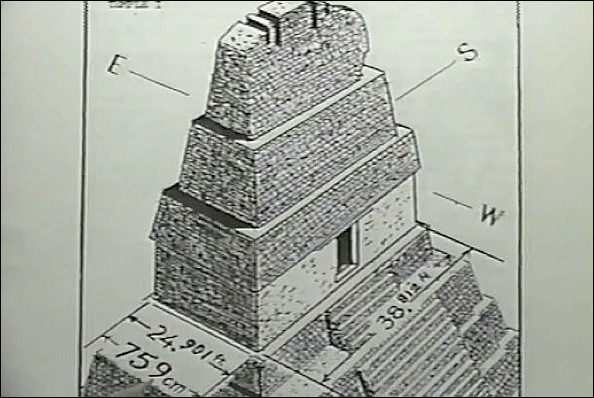
One thing that might be noteworthy about all this very curious business is what seems to be considerable conversancy with the width of Tikal Temple I’s temple platform.

Drawing of Tikal Temple I labelled with data from Teobert Maler, by Our Founder, Carl P. Munck

Quite a bit has been learned the past few years about the figure 38.81314681 and its significance to astronomy and calendar formulas, but there appears to be still more to the story and I am still aspiring to try to articulate some of it here.

Previously it was suggested that Temple I has a high affinity for the Great Pyramid mathematically, including parallel geodetic functions and utilization of one of our top two Phi-like numbers, 1.618829140, sometimes referred to as “Not-Phi”. The Great Pyramid shows it to us as a close approximation of the natural half base / apothem ratio of any true 2 Pi pyramid. Note that the natural ratio from geometry in this circumstance isn’t Phi either, it’s more like about 1.6189 than the Golden Ratio Phi, 1.618033989.

So how did we climb Temple I in Guatemala and end up down the same rabbit hole as at Giza?

1 / 411.8202774 = 2428.243714 / 10^n; 2428.243714 / 2 = 1214.121857 = “Not A Remen” x 10^n; 2428.243714 x 4 = 9712.974856 = Inner lintel circle diameter of Stonehenge x 100 = 6 x 10^n x Not Phi 1.618829140; 2428.243714 x 8 = 19425.94971 = number of earth hours, minutes, and seconds in the standard Venus Orbital Period of 224.83738008 days: 224.83738008 x 24 h x 60 m x 60 s = 19425949.70 is part of the story…

When we go to look at the length/width ratio of the great Giza Rectangle, length 2428.243714 ft (?), width 1884.955592 (600 Pi) ft,

2428.243714 / 1884.955592 = 1.288246069 = 5 / 3.8813246106, and there the Tikal Temple I number is again.

What has this to do with Chinese astrology and astronomy? Well, if we take the 360* of the sky and try to divide them into “28 mansions”, we get 360 / 28 = 12.85714285. If we match that to 1.288246069, we get the Great Pyramid’s answer to “280 Cubits high”, which is 27.94546572 x 10…

So, the height of the Great Pyramid (from the final pavement) in Royal Cubits OR ten times the height of the missing apex section in Imperial Feet / (360 x 2) = 3.8813246106.

As for the Precession Cycle, for which many alternative researchers including myself may work with 25920 (years) as an experimental approximation, we can obtain the leading candidate for Full Moon Cycle from (1067.439159 / 25920) x 10^n = 411.8202774

So, (1 / 411.8202774) x 10^n = 2428.243714 = (3.8813246106 / 16) x 10^n.

Suffice it to say then that I think Tikal Temple I may know some things about the Full Moon Cycle (as well as many other major solar system objects), and Giza seems to know a lot about it too.

As for the rest of it, perhaps it should wait for a little while. If the last several pieces would fall into place as neatly as the rest of it has been trying to, I will have a completed basic plan of the Giza Layout for the very first time.

Maybe it will take one more very strange day… (besides how very strange it seems that the ancient astronomers still seem to be that far ahead of us somehow, that is).

–Luke Piwalker

Planetary and Lunar Data

I’ve been working on a new data table. On the one hand, it’s meant to save on having solar system astronomy formulas scattered everywhere over posts to five forums and over pages and pages of written notes; on the other hand, there may be no replacing taking the time to work out those notes. One shortcoming of the data tables I’d like to present here is that it is all in terms of ratios – diving the larger number in a situation by the smaller. There is much to be said for what can be learned by multiplying the two numbers involved instead to generate a multiplied product, data that is still not presented here. Thus these tables are not definitive reference tools, although if one lingers over them a bit it may still inspire all sorts of relevant insights.

Also not included here (still looking for them) are versions of the two oldest tables featuring the ratios between major planetary cycles, and between major lunar cycles, which were notated to show “coincidences” in the data output. I’ve included that step with the latest data table presented here.

Here are the two older tables in their basic form

Figure A: Basic ratios between major planetary cycles.

Figure B: Basic ratios between major lunar cycles, with several Mayan calendric cycles added.

Figure C: Here for the first time (why does no one else seem to be doing this?) on my part is a table that looks at the ratios between planetary and lunar cycles.

Figure D: Figure C with color coding used to indicate some of the remarkable coincidences in the solar system that produce recurring numbers. Note that this applies to Uranus and Neptune. It’s ALMOST enough to generate a sense that the Solar System is designed by an intelligent mathematician deity, were it not that us mere mortal mathematicians tend to notice that it ISN’T all exactly perfect and that we have struggle with it and tweak it to turn into a harmonious interconnected system. Not the kind of thing that it necessarily seems ancient peoples could make into a religion, but enough that we could understand if they build temples to it.

I am indebted recently to author Crichton Miller for suggesting that the words time (Latin, tempus) and temple may well stem from the same root, implying that an original context for “temple” might have been a place where they kept track of time or taught about timekeeping – that certainly seems very consistent with my experiences studying and attempting to interpret ancient temple architecture.

Figure E: Figure C with highlighting of certain numbers that may be of particular significance for various reasons, for being easily recognizable or familiar from previous work, or for being particularly poignant.

One entry I’d classify as “poignant” is the interaction between lunar Apsidal Precession Cycle and Uranus Orbital Period. Essentially,

30668.5 / 3233 = 18.97216208 / 2 – see Mayan Half Venus Cycle, canonical value 18980. It certainly gives the impression that the Half Venus Cycle that was so seemingly important to the Maya, can even help to harmonize things like the Apsidal Cycle and the Uranus Orbital Period into a single calendar system.

Figure F: Here is a version of Figure C where various random suggestions for “perfected” figures have been offered in the table boxes colored in green.

Figure G: As long as we’re doing this, here is a version of Figure A with some suggestions for “perfected” figures (green boxes) and a few values suspected of being potentially problematic (orange boxes).

Figure H: the recent Planetary and Lunar tables that attempt to narrow down the candidates to some of the best overall suggestions.

These are all tools that can be used in various ways to help understand what ancients were doing with their preposterously ambitious calendars that sought to integrate all kinds of solar system cycles into what is essentially a single system, and again, they can be used not only to try to help recreate ideal “Master Formulas” for the solar system cycles, but also to help us to design architecture that embodies key data about the solar system that we wish to express, or novel formulas that relate some of the diverse parts together.

Chances are, ancient astronomer-architects had and used very similar references even if we have yet to find or recognize them after cumulative cultural damage in many quarters. Once again, it’s one of the most natural kinds of questions that can be asked, to inquire “How many Lunar Years are in one Solar Year?” or “How many Venus Orbital Periods are there in a Solar Year?” or “How feasible is it to have multiplanet calendars?” – and if we set down that path as the ancients must have, this is something like where one may eventually end up. There seems little doubt that ancient astronomers must have given a great deal of time, effort, and thought to these same matters.

When we start to do that, we also quickly see an amazing collection of numbers that have long been familiar because they have been written in numerous places around the world as measurements used in specialized architecture such as pyramids and temples, and it has been spotted even with the relative shortage of freely available architectural data that currently exists.

At any rate, much of the data that I have to work with is now available in the same form for readers of this blog, and that is the point of this blog, to be as much as possible a sort of clearing house for data of this nature – so even though I have done a truly abysmal job here explaining some of the finer points or pointing out some amazing facts, this much progress has been made at least.

(PS: If you experience legibility problems with the tables, please check the original uploaded images. Some or all images presented on this page may be at a somewhat reduced scale).

–Luke Piwalker


It’s Only A Prototype…

Greetings, all – and a Safe and Happy Thanksgiving, even to those who don’t celebrate the holiday.

Today I am thankful for, among other things, having beaten my Planetary and Lunar Tables into the form of the first prototype. It’s still a work in progress, but I have been slaving away on it for days going on weeks going on months and I had started to think I would never get this far with it. I apologize that it’s still only a prototype, but when things reach a certain point of readiness I like to share them, finished or not, just in case I’m run over in my bed by a city bus or what have you.

I’m not quite sure what to say about it – I could ramble for hours without actually doing a good job explaining – but for ages now, I’ve making reference to data in this table and talking about the Venus Orbital Period A value or the Venus Synodic Period B value or whatever, and meanwhile no one else have ever seen what this looks like, and it must be difficult to picture. For brevity, I’ve edited the screen shot and cut out the explanatory formulas in a column to the right not shown here.

That’s most unfortunate, because readers would be able to see for themselves what kind of formulas are being used if I just posted the whole sprawling mess (which I still might do because of that). It’s quite remarkable how often familiar and particular important numbers are found in these formulas linking the planetary cycles, even though I’ve had to throw out a great many promising formulas that ALMOST worked. One reason I’ve omitted the formulas is because I could still give some thought about the best way to display them without a sprawling mess if more accumulate, and I’ve already had to resort to a lot of shorthand that readers may or may not readily decipher to keep things concise for now.

Not everything does work, which ultimately isn’t surprising considering what an absurdly tall order it actually is that the major cycles of the planets should possess such tidy internal relationships in the first place. Even at their worst, things have gone rather well in the face of such demands, although there has been a great deal of testing and weeding out of less promising candidates and formulas that just don’t work, however promising they seem.

This much in itself represents a major milestone for this work of trying to piece together how the ancients would have represented the solar system cycles AS A WHOLE, particularly given what we can project for the metrological units they would have used to measure out representation of the solar system in their architecture. I’ve at least managed to include data on how the similar columns in three values relate to one another (A Value x 1.000723277 = B Value and etc).

No doubt changes and revisions will take place in the future, I can almost guarantee that – but I’ve put a preposterous amount of effort already into trying to make sure that most of what’s here is solid and won’t be overwritten by future changes. Future changes are expected to mainly concern representing more formulas that support the choices of values you see displayed, and expansions relating to cases of multiple rows of values for certain things. There is already – quite obviously – more than one right answer to some of these. The future will probably also include more agonizing about whether I’ve really gotten things right, but that could be going on a long time. Why hold up the show any longer?

Still an item in the experimental stages, the very first draft of the Planetary and Lunar Tables I work with. Naturally being me I have to miss some corrections – Nodal Precession a and i should be a and b, Saros c and h should be a and b, and Full Moon Cycle c and d should be a and b of course, for ease of reader reference. Today I’m just going to be thankful if it isn’t much worse than that.

That might give a hint of just how much the table has been trimmed down the last few days. Because of the many experiments that were conducted in the course of trying to optimize these figures, there were 14 columns where there are now three, and as many as 150 rows where there are now 55. (The 14 columns came from simply experimenting with every valid number I could find that might be used to approximate the 18980 day Half Venus Cycle, after Stonehenge and the Great Pyramid both “testified” that there might be more than two valid columns).

In some cases there are a and b rows simply because the MOST ideal value hasn’t quite been settled on, and in some cases because, again, it’s become apparent that there can be more than one right answer. We assume that when there is more than one right answer, it’s likely to be because there are variations in traditional common whole number calculations for these values. The most obtrusive examples of that like 364 for 364 (again 7 days in a week x 52 weeks = 364 days, NOT 365 like most people think, and the average ancient person may have therefore used more than one formula which more advanced mathematics aspires to emulate), or the Dresden variations which use 117 and 585 for the Mercury and Venus Synodic Periods respectively.

I’ve mentioned that in addition to the link between Mercury and Venus that the Dresden variations provide (585 x 2 = 1170), these variations might have also been chosen to better harmonize with the 260 day Tzolkin. There may be still more to it than that, they may also afford better harmony with Mars’ Synodic Period (585 / 780 = .75; 780 / 3 = 260, the Tzolkin), and then there is the part where 18980 / 117 = 162.2222222, while 365 / 225 = 1.622222222, so there are hints of greater harmony with both the earth’s 365 day Solar Year and Venus’ 225 day Orbital Period, even if most scholars wouldn’t give the ancients credit for recognizing the existence of this Phi-like natural values arising from whole numbered calendar cycle values.

Ideally, there will turn out to be related justification for some multiple versions of other figures as well, which is still under investigation. I’m still getting mixed signals about exactly which column the best value for the Eclipse Year, (346.5939368) actually belongs to, as well as a few as conflicting indicators for a few other very important details, so investigations into the structure and functionality of this experimental grand scheme do continue, even if putting this to rest for the moment may provide a moment to think about other things.

I still have yet to publish some of the formulas that led to the firmest of realizations that the Maya (and others) HAD indeed chosen a calendar system that IS able to incorporate even the cycles of Uranus and Neptune, yet another possible hint that they were perfectly aware of them, as well as there being other possible offerings to consider working on. (It seems like ages since I’ve got to do anything with ancient doorways, which are a favorite subject. Some of the best ancient math I’ve ever seen was integrated into ancient doorway proportions, starting with – but by no means limited to – the amazing Tikal Temple Pyramids in Guatemala).

Anyway, that will probably be plenty for all to ponder for now… Thanks for stopping by!

Cheers!

–Luke Piwalker

Short Reports 8

Greetings!

A few more random items from my desktop…

The “Garsalian” State of the Tropical Month

I’ve been considering candidate values for representation of the Tropical Month the last several weeks. Cerrig at the Megalithic Portal has posted several threads with excellent details of several Megalithic sites which have me quite intrigued. Cerrig advocates for the importance of what he calls  “Garsalian” geometry (there should also be a few YouTube videos about this), which I’m quite impressed with.

One of Cerrig’s diagrams showing geometry projected from Garsalian Triangles. I’ve callously decolorized it to provide contrast with the crude overlay of Hively and Horn’s diagram of the Newark Octagon in Ohio (green), which I’ve created to commemorate the possibility that the geometry that Cerrig is advocating could have been involved in the Octagon’s design. 

Here we can see a description of a Garsalian triangle which if the base has a length of 1, has a hypotenuse of 1.366; here we can see Cerrig’s diagram showing his field measures of Cerrig Duon, giving a circular radius of 30.12 ft. The diameter of the circle would be 30.12 x 2 = 60.24 ft. Alexander Thom gave slightly different measures, with a diameter of about 59.8.

59.8 is course near to 59.9, and an x99 numerical motif at the beginning of a number may often indicate a reference to Jupiter’s ~399 day Synodic Period, so that is a tempting direction to consider, but the intriguing thing here is just from Cerrig’s data, 1.366 x 20 = 27.32 and 30.12^3 = 27325.29773, so that is another tempting direction to explore, the possibility that the Brecon Beacons are where we might go to get a Megalithic lesson in how to express the Tropical Month, which is not necessarily a teaching so easily obtained from Stonehenge, although we are still learning…

In order to feel better prepared to even tackle this problem in the first place, one of numerous parts of the Planetary and Lunar Cycles table I’ve been working on lately is the Tropical Year. I at least found a scheme that incorporates what I think is my favorite candidate from the Tropical Year, Palestian Cubit 2.107038476 ft x 360 x 360 = 27.30721864 x 10^n, and with a 360 Palestinian Cubit upper with for its platform, the Great Pyramid can easily express such a figure.

If anything, I may have more good candidates for the Tropical Year values than are actually useful, but it’s a gray area that calls for some thought, because the dynamics here and the relationship to the Sidereal Month may call for a particular degree of care.

So I am not sure what I know yet about the ways in which ancient astronomers and mathematicians might have rendered the Tropical Year, but I think I know much more than I did a month ago, and Cerrig’s excellent work may have provided us with some very important leads.

An Imposter Detained

Here’s something I hate to spring on people, but there is something of a segue here. It’s in the course of trying to work on some values like the Tropical Year which are still not accounted for that I got some hints that there may be a tangle somewhere (perhaps in more than one place) in the Planetary and Lunar Tables. I think the trouble starts when we go to respect the numerical value of the Hashimi Cubit in Imperial but end up with 2/3 our Saturn Synodic Periods coming out seemingly strange and rather dysfunctional.

There IS an imposter for the Hashimi Cubit value, and it’s a wily one, but I’m starting to wonder if it’s something we need to know to get the ancient calendars to align in harmony, so instead of running out of the room every time it appears on the calculator display, I decided to brave up and try to grab it by the back of the neck before it bit me.

We literally have its number now.

The notes from the moment of discovery – not the initial discovery, I’ve been seeing it now and then for some time now, but the moment of its capture and of the discovery of what it might actually be. At the moment, this is more or less everything I know about it.

So YES, it COULD be a value we need to know in addition to the Hashimi Cubit value, and I should be taking notes on formulas concerning it because I cannot even state the number offhand without a mnemonic formula.

Okay… It is THIS: 225 / PALESTINIAN CUBIT = This particular FALSE Hashimi Cubit value (there are more false Hashimi Cubits).

225 / 2.107038476 / 100 = 1.067849508 vs the standard Hashimi Cubit value of 1.067438159 ft

1.067849508 / 1.216733603 = Pi^6 Unit (Tikal Temple III Unit)

1.067849508 interacts with the Megalithic Foot to produce x/MF = 28125 / (Pi^3) Draconic Month Unit

Sacred Cubit / 1.067849508 = 15625 / (Pi^5); the (Pi^5) Unit is the AE Megalithic Yard.

So it will be interesting in the hopefully near future to see if there is an imposter to the throne, or if the King has an almost identical twin.

You Can Tune A Piano But You Can’t Tune Neptune… And You May Not Need To

Since I’ve been trying to do more work with the planetary tables lately, I finally decided that one glaring omission is that of Uranus and Neptune data, which in my opinion should be tentatively included so we can monitor the possibility of finding out whether, had the Maya known about Uranus and Neptune, the cycles of Uranus and Neptune would be harmonious with the Mayan Calendar.

When I started researching the Mayan Calendar, I found one site that bravely alluded to such a possibility, but I’ve never really seen anyone address this question, and that’s unfortunate because if the Maya WERE talking about Uranus and Neptune we’re going to need more data to round out the evidence for that because presumably we would have to match symbolism for Uranus and Neptune events to actual written Mayan dates.

Few may think to prioritize obtaining and distributing such data if we simply assume that the Maya somehow lacked knowledge of assistive optics, so such data may not be easily forthcoming and we may be at risk of being pulled into an unproductive vicious cycle where there is no evidence because there is no data, and no data because there is no evidence to show it would be relevant.

Relying on recent experience, I think the answer is most likely YES – Yes, the Maya may well have known about Uranus and Neptune, because they may have picked a rather brilliant calendar system that CAN incorporate and harmonize the cycles of BOTH of them. If we can’t file that under possible evidence that ancient astronomers possessed some quality assistive optical devices, we may have to file it under possible evidence of an ALMOST intelligent design to the Solar System.

We can file it under actual intelligent design for those so inclined, but I do so much work trying to harmonize these cycles to a higher level of perfection that nature seemingly DIDN’T do for me, that I tend to be inclined toward non-intelligent (but probably mathematically meaningful) design.

At any rate, if things go well the next several weeks I can hopefully make a presentation of some of these latest amazing cosmic near-coincidences and what we might do about harmonizing them as perfectly as possible. I hope to learn a little more about the way planetary Orbital Period / Synodic Period ratios and the way they they might work other planetary values, because there’s where I think a substantial amount of the remarkable action has been when finding out these things about Uranus and Neptune for the first time.

I’m sorry it took so long to get to the question, they might be some of the easiest planetary cycle values I’ve ever figured out if I was lucky enough to figure any of them out, but you know the drill — the Maya didn’t have telescopes. Everyone knows that. Show me one. Aha! You can’t. Rinse lather repeat.

Quite the contrary, my studies of the Codices suggest to me people who could see Jupiter close-up enough to be aware of its coat of many colors, a realization that helped to precipitate a renewed interest in the question.

In the meantime, I’m not exactly certain where we can look for assistance if we want to move further ahead with the question. All I can think to tentatively suggest is perhaps the data from George F. Andrews on Oxtintok, which I once declared (possibly hyperbole) to be the “Maya capital of the lunar Apsidal Cycle”.

It’s true that I seemed to find considerable resonance between the measures at Oxkintok and the Apsidal Cycle and it’s also true that it’s one of the things that dragged me into thinking about the question of Uranus and Neptune again was the boost of confidence in the relevance of the question when I saw how readily values for both planets seemed to potentially harmonize with the Apsidal Cycle.

Can You Build Us A Table? (We Meant for the Kitchen)

I’ve been doing some work on other tables besides the grand Planetary and Lunar Cycles table that I’ve been trying lately to tidy up and fill in. My very latest at the moment is my newest post to my Megalithic Portal thread, in case the data is of interest in the meantime until I can do more with the table (still no listing at left for the Sacred Cubit — sacrilege!)

The effort included my first rather half-baked attempt to actually design some architecture (or at least create an initial design) in what I am experimentally taking to be the ancient traditional manner, which I undertook to try to illustrate how I think such reference tables might be of great assistance in both interpretation and design of astronomy-oriented ancient architecture. As I noted in the post, I don’t think I could have done it without them (nor do I think I could have half as well without them).

I also marvel at how quickly I was able to complete the exercise.

I hope some of these reference tables will be appearing here in the future, hopefully a few more omissions and typographical errors will be worked out by then.

I posted this recent table to the Portal awhile back. It remains state of the art for illustrating the two metrological series that can be represented as derivatives of the Imperial Foot and the Sacred Cubit via 2 Pi and a progression of circles where the circumference of one becomes the diameter of the next (even if this schemata would probably not reflect a chronically correct description of the origin of the Sacred Cubit; as Remen x Royal Cubit in Imperial, my Sacred Cubit was likely to come after both of those units, not before)

Included here for the first time are the NUMBER of units involved in the unit to unit conversions that define and organize these two metrological unit series, and the +pos(itive) and +neg(ative) indicators intend to tell us whether the normal “forward” (+pos) form of the unit is being referenced, or whether the “backward” inverse or reciprocal (-neg) form of a unit is being referred to. (For example, in my model of Stonehenge, the inner sarsen circle circumference is technically a figure in inverse Megalithic Feet).

Thanks to jonm at the MP for encouragement toward including such important details that I sometimes hesitate to include because I tend to wonder if people want to bother with them. I really DID want to create something that made it easier for readers to verify for themselves what I am saying about metrological unit relationships, so hopefully this actually will help in the here and now.

A Wrong Turn Diagonally or A Diagonal That Points The Way?

I’ve reconsidered the problem of the minimum Great Pyramid platform diagonal. I projected it at possibly being (57.29577951 x 2) / 106.9734371 = 107.1215080 / 10^n, but it may be that a different candidate belongs there. I was skeptical that the ancient Egyptians would have used a false Megalithic Yard here (even though we can create one at Stonehenge as a compromise with Thom by (mis)interpreting the inner sarsen circle circumference as 48 Megalithic Rods as literally as Thom may have.

The Great Pyramid platform diagonals seem to have a format of (2Pi)^2 x “X”, which could give to the upper diagonal a potential value of (2Pi)^2 x (false Megalithic Yard 3.2 / 1.177245771) = 107.3105884 ft, which apparently DOES pass accuracy standards compared to projections, and might even make a more sensible bookend for that side of the mean value.

Something that encouraged me to try to dig deeper into this and to slow down before I get too sure what’s going on here, is that during the experiments with Uranus and Neptune cycles, even while it’s going to be difficult to make (32 / Megalithic Foot 1.17724771) = 2.718208958 into either a Megalithic Yard or what the Megalithic Yard actually represents which is 1/10th of the approximated Draconic Month (and we already have three very good ones), the reciprocal of 2.718208958 COULD serve a valid approximation of Neptune’s ~367.49 d Synodic Period (1 / 2.718208958 = 367.8893034 / 10^n)

The other two proposed values for Neptune’s Synodic Period could be reciprocals of actual Megalithic Yards, which could in turn allow synchronization of Neptune Cycles with the lunar Draconic Month.

So these are some recent thoughts on the possible ways of ancient timekeeping and architectural recording of astronomy data and formulas. I hope that time will soon tell us more about these things.

–Luke Piwalker

Short Reports 7

Greetings all!

Having a number of bits and pieces on my mind, another Short Reports article might be a good way to address them.

We Salute Mercurial Pathways

Mercurial Pathways is a remarkable blog that I haven’t been able to view in about as long as I’ve had troubles posting to my own blog here. The proprietor, Mercurial, is a regular contributor on the GHMB Mysteries Forum where I am no longer participating as a regular contributor (although it is still always good for some very interesting and thought-provoking reading) and has contributed a great many interesting ideas. I may not always be on the same exact wavelength (which is probably to be expected just because I tend to look for signs of more holisitic systems), but many times the findings of one researcher are translatable into the terms of another researcher (that is where we can often obtain some very important consensus), and more importantly I still believe personally that no one labors sincerely at the ancient Mysteries long without uncovering real treasures.

So… I have a lot of excellent reading to catch up on! Many thanks, Mercurial, and keep up the great work!

Back to the Flattened Drawing Board?

I was going over some figures I posted to the Megalithic Portal concerning projected diagonals for the platform that the Great Pyramid rests on. It may or may not be news now, but quite some time ago I’d worked out a figure for the platform width based on data from Glen Dash. What I apparently didn’t realize is that Dash published several works which were similar in nature, and I mistakenly remembered matters as having read both of them. A while back, I finally really read the other one and was able to make further data projections for the platform, and was able to clarify that the original width figure I gave (equal to 300 “Palestianian” Cubits of 2.107038476 ft each) would likely be the width at the top, while the width at the bottom of the pedestal would likely be about .4 Royal Cubits wider on each side.

The Great Pyramid’s platform: The original rough projections based on a combination of data from Dash and very crude pixel measures of materials from Dash. (The incomplete present pavement seen here is not the theoretical missing pavement layer of highly prized and easily accessible material that may have resulted in its complete removal even before the pyramids themselves began to be plundered for building material for later projects at nearby locations).

.4 Royal Cubits or just a little over 2/3 foot – about .6875 ft – is also the final projected thickness of the missing layer of pavement that would reconcile Carl Munck’s model of the Great Pyramid with one based on John Michell’s conception of a base of 1111.111111 Megalithic Yards – not Cubits! (For a Giza Pyramid based on Royal Cubits we want to look at our available models of Chephren’s pyramid rather than Cheops’).

While I believe I successfully projected all of minimum, mean, and maximum width for the Great Pyramid platform in one or more posts to the Megalithic Portal, and may have successfully worked out reasonable proposals for the mean and maximum diagonals of the platform, it looks like I must have mistyped a number into the calculator, and need to go back to the drawing board and start over concerning the likely minimum diagonal of the Great Pyramid platform…

That would also mean that any inferences as to the function or theme of the pedestal’s diagonal values should probably go out the window with the erroneous figure.

This is something I wish hadn’t happened, because the projection for the platform’s minimum diagonal comes to about

Minimum platform width 300 Palestinian Cubits = 300 x 2.107038476 = 758.5338514 ft, and the raw diagonal for a basic square-based design therefore projects as 758.5338514 x sqrt 2 = 1072.72886 ft…

Which may be just into range that is dark, mysterious, and increasingly contentious after my having observed the number 107.0581434 as a raw projection of the minor diameter of the modified Type A Thom Flattened Circle design, which Thom also referred to as the Type D Flattened Ring.

I have been struggling with what that is doing there, and have some unconfirmed notes that there are significant internal solar system ratios that look like this, which may inspire a sense of caution. The data projections I have thus far for the Flattened Rings suggest there is a good deal of solar system data that appears in their deceptively very simple designs (including recurrence of what is apparently lunar data).

It would be simply enough to try to qualify the Flattened Ring projection as meaning 107.3519415. In feet, this would be – like the Great Pyramid baseline in Munck’s model, whether Munck knew it or not – measured out in “Egyptian Mystery Units” (that which used to be called the “LSR” or “Le Serpent Rouge” unit and I’ve told the story here before of how all that came about and how the unit was discovered). 107.3519415 was identified in height data from Maler for the El Castillo Pyramid at Chichen Itza, and can be found in Petrie’s data for the still unsolved Bent Pyramid of Egypt…

Thom’s Flattened Circle Types: For Type D, if major diameter MN = 2 Radians = 57.29577951 x 2, minor diameter AB has a raw data value of 107.0581434.

This figure x 10 also easily qualifies as the mean diagonal of the Great Pyramid’s platform, but that brings us to the problem that it can’t be the minimum diagonal if it’s already the mean diagonal value.

So, I may have more to say about numbers in this range soon, and perhaps should, since the issue also came up here recently… As hinted at in the preceding post, numbers in this range also appear while looking at the square root figures for the Double Radian. 2 x 57.29577951 = 114.5915590, which is the square of 10.70474470. That square root value isn’t likely to be valid, but there may be two numbers very similar that would serve in its place (something we have seen with other important numbers, although I do not like to often mention the “false square root pair” concept for fear of confusing people about something that already outwardly seems rather complicated).

The Two Latest Wonder Numbers

One of them we already knew about from Stonehenge and working on the bluestone “Oval with Corners”, as Alexander Thom described it. It belongs to a rather rare variable equation, which seems to become permissible because a number of situations at Stonehenge appear as they were deliberately chosen because, at least in part, they readily accommodate all three versions of the Megalithic Yard that would be attested to and legitimized by the mathematical organizing schemes themselves which can be projected for ancient units of measure.

So far, in my experience, it’s been rare to find accommodation of all three Megalithic Yard values in ancient designs, let alone single equations which accommodate all three – that in itself may very much speak of conscious, intelligent design at work in this respect.

Without further ado, the first number is 1.451809286, and it has very recently been discovered that one of things it is apparently doing in the Stonehenge design is that not only may it be capable of helping us to find the Eclipse Year value, but when we subject it as a measure to metrological analysis, we find its metrological unit would be the Anomalist Month Unit of about 27.55 ft (27.551828115, which is actually made from 100 of the Megalithic Yard values / (Pi^2). That’s one of the things the planetary and lunar tables I’ve been building have provided us with, that with (Pi^2) we can transform Draconic Month Units (i.e., Megalithic Yards) into Anomalistic Month Units.

1 / (1.451809286 / 4) = 27.55182818 / 10^n.

While I was experimenting with it recently, I realized that 1.451809286, even though it is somewhat “secular” or limited in its response to classic data probes, still responds enough to meet several classic criteria associated with giving out the title “Wonder Number”, one of them being the prodigious stream of data that issues forth when exposed to the right common data probe.

Here are the notes I was taking at the very moment of discovering this, giving you a ringside view of metrological history in the making 🙂

Okay… What was I REALLY doing? lol

1.451809286…

Is it Pi-friendly? Well it’s good for DIVISION by Pi by up to at least the Fourth Power… the series provides us with Meg Yard/Meg Foot, 1 / IMY, and what I believe is the approximated Dresden Codex VSP, 585.2884657, since the Dresden modifies the 584 day Venus Synodic Period to 585 for various purposes.

I’m not sure the status of discoveries there. I think scholars have beaten me to the 585 d Dresden VSP being half of 10 Dresden Mercury Synodic Periods (MeSP) = 10 x 117 d, as if it were to synchronize Mercury and Venus Calendars better, but I don’t know about my observation that this odd gesture perhaps seems better explained if we include that Venus ORBITAL period 225 x Tzolkin 260 = 58500.

Synchronize Venus and Mercury calendars indeed???

Not a bad Pi / 3 series… has Eclipse Year, Callanish Number, Egyptian Royal Foot, Indus Foot, 1.003877282 and others.

1.451809286 IS more than halfway to Wonder Number, at very least, I think…

1.451809286 seems fairly Remen-resistant until we apply the Remen in its most powerful known permutation, the backhanded 2/ 1.622311470, when it spawns a series bookended by false Megalithic Feet and a strange doppleganger of the target number… wait, NOT bookended. It continues…

IT’S A FRAKKIN’ WONDER NUMBER.

Not more than several hours later, the number was discovered at Giza

…somehow 1.451809286 converts the height of the Great Pyramid (Munck) into the perimeter of the Great Pyramid (Michell), so odd gesture though it may be, but I guess we can therefore say we have just found the Stonehenge number 1.451809286 in the Great Pyramid now…

Extra! Extra! Read all about it, etc…

The other Wonder Number I wanted to introduce is… (let me see, there are a great many interesting tangents in my notes at about this point, including no less than an attempt at a finished set of projections for the Mycerinus pyramid, and what amounts to roughly a DOUBLING of the number of known sightings of what I am often calling the “Valley of Kings Number” for lack of a better idea)…

It concerns that there is already a Wonder Number near to the range of these 107-like figures we are seeing here. It’s part of one of the most classic Tikal exponential series that launched the very idea of Wonder Number in the first place (that is part of their character, generally making excellent “fodder” for exponential data recovery, they “conceal” many important pieces of data “within” them if we can find the right tool or tools to recover it.

It’s convenient to begin the series at 1/2 of the standard Venus Orbital Period, and begin dividing consecutively by (Pi / 3)…

(224.8373808 / 2) / (Pi^3) = 107.3519416 – see El Castillo Pyramid and the Bent Pyramid further back in this post – and then the series passes through more of the Tikal Wonder Number or their reciprocals, and then at (224.8373808 / 2) / ((Pi^3)^4), we find 106.9734371…

So if someone builds 106.9734371 into a scheme, they are really building in the whole series, and this qualifies 106.9734371 itself as a Wonder Number…

So if we apply this to the observation that 107 is about ten times the square root of 2 Radians,

(57.29577951 x 2) / 1.069734371 = 107.1215080, and THAT turns out to be a Wonder Number too, even if no one’s ever heard of it before.

Here is the bulk of the original notes from at the moment of this discovery

Here’s another for the “may be something, may be nothing” file.

The natural square root of 2 Radians is 10.70474470, very like some of the mysterious numbers we see with Thom Flattened Circles and some of the Planetary & Lunar Cycle ratios.

If we give a “false square root function” to our nominee 106.9734371, we get

(57.29577951 x 2) / 106.9734371 = 107.1215080 / 10^n

Having that “pedigree” may designate this as an important number

IT IS ALREADY A BONA-FIDE WONDER NUMBER. It forms an adequately powerful series with Pi / 3 as does 106.9734371 to qualify for this description.

That is all I know about it so far. It has never gotten on the radar before that I know of.

Offhand it is seemingly another “secular number” with a limited spectrum of powerful data probes it responds to and DOESN’T care for the Radian or 360… It DOES also respond well to the Megalithic Foot, which probably makes it a little less secular than the last designated Wonder Number.

Did we do this one? It’s TRYING to make me think it’s Eclipse Year / Apsidal Cycle (346.62 / 3233 = 107.2131140)

It is in Anomalistic Month Units at 38880 AMU = 107.1215080 x 10^n; 38880 = 108 x 360

So there is another new Wonder Number to learn more about, and it COULD be not only the intended value from the Thom Type D Flattened Ring, but also the intended minimum diagonal of the Great Pyramid’s platform… MAYBE…

A Long Standing Stonehenge Mystery Solved?

This particular discovery is not all of 24 hours old as I am writing this.

For some time there has been an unsolved mystery at Stonehenge, which is the “Lintel Circle Circumference Remainder”.

It isn’t the sort of place I normally look for data in ancient architecture, but some time ago it came as rather encouraging that for the SARCEN circle at Stonehenge, if we go to compare the inner and outer circumference by subtraction, we get a figure that is very convincingly in Egyptian Royal Cubits, and I believe I was impressed enough with that fact to include it in a very informal paper I’d written in Thom’s defense, which largely concerned the presence of ancient Egyptian units in the Megalithic Landscape, since Euan MacKie, John Michell, and others offered that the Megalithic Yard was related to common ancient Egyptian units of measure through the simple geometry of squares, rectangles or right triangles.

For the sarsen circle, it looks like this: We take Petrie’s 100 Roman Ft. inner diameter for the Stonehenge (I prefer 80 Remens because that’s probably older and more rightfully the identity of the value, 80 x 1.216733603 = 97.33868824 ft), and multiplied by Pi to get the circumference gives us 97.33868824 x Pi = 305.7987059 ft, just as Carl Munck called it so long ago. For the outer perimeter, we indulge Thom’s 120 Megalithic Yards, using a refined Megalithic Yard of 2.720174976 ft in place of “2.72” ft = 120 x 2.720174976 = 326.4209972 ft, and so the difference between outer and inner circumference is

326.4209972 – 305.7987059 = 20.62229122, whereas 12 of Morton’s Royal Cubit is 12 x 1.718873385 = 20.62648062.

For the LINTEL circle projections that would be

327.0127142 – 305.1421040 = 2.187061018.. and what on earth is THAT?

We fire mathematical probes at it but it keeps wanting to come back as 2.188537567 (which may be valid as an ancient Middle Eastern metrological unit in Imperial Feet) or maybe 2.185419355 ft, but they can’t seem to pass a standard of accuracy.

2.187061018 / 2.188537567 = .999325326

2.185419355 / 2.188537567 = .999249347

Both BELOW the minimum standard of accuracy of .9995 we are still aiming for with ancient architecture.

I’ve written about this in previous blog posts, but if memory serves, I’ve probably never really touched on the original logic at work here; I think it might be THIS: What happens if we divide 12^2 x 10^n by the Best Value for the Saros Cycle?

14400 / 6584.4495242 = 2.186955791

2.186955791 / 2.187061018 = .999951872, which DOES pass the accuracy of approximation test with a score greater than .9995.

Also, if we divide 218.6955791 by 8, we get

218.6955791 / 8 = 27.33826310, which MAY yet turn out to be a valid approximation of the Tropical Month, and

2.186955791 / 1152 = 18983.99124 / 10^n, 18983.99124 being the best approximation of the 18980 day Half Venus Cycle or Mayan Calendar Round.

By now we might have guessed from all that, that as a unit of length measure, 21.86955791 is a whole number of the so-called “Palestinian” Cubit (might as well continue to call it Palestinian Cubit but the ancient Egyptians were rather obviously quite aware of it, and used it often as well).

So there for now are a few things that might be new and hopefully interesting in the world of what ancient mathematics might have been like after hundreds of thousands of years of preoccupation with astronomy and the complex task of synchronization of diverse calendars.

It’s good to be back.

–Luke Piwalker


Testing, Testing, One Two Three…

Greetings, all… I hope all have been keeping safe and well.

A funny thing happened about six months ago apparently having to do with my becoming a victim of obsolescence and losing the ability to post this blog due to sudden lack of a supported browser. Ironic in a way; here I have a blog where I try to encourage the world to have some respect for our ancient ancestors and was silenced by a lack of respect for a 15 year old computer that had been limping along after having been the victims of a Windows update…

Anyway, I hope to be back posting here soon, and my apologies for suddenly vanishing without notice. In a way, it may be as well because I’ve devoted some months now to trying to unravel the symbolic astronomy language used in the surviving Mexican Codices and I had my work cut out for me there – but that might have been sort of a bait-and-switch for me to keep posting about those matters on a blog that started out devoted to ancient architectural mathematics, even if the subject of the mathematics does seem to be astronomy.

I have wrestled with some ancient architecture the past few months. Being rather excited about the new book by Peter Harris and Dr. Thomas Gough about the Megalithic Foot (most highly recommended), my enthusiasm for Megalithic monuments was stoked a bit and I ended up going back to try to scout out some of the finer details and mathematical infrastructure of Alexander Thom’s Flattened Megalithic Rings. I’ve also been a bit inspired by Peter’s skill at finding lunar cycle data in Megalithic sites using the Harris-Stockdale Megalithic Foot (HSMF) as the unit, and seem to have been finding a notable amount of lunar cycle data in my data projections for the Flattened Rings.

I also found out there may be more of the Golden Ratio, Phi, in them that was previously realized, and I do believe both the kind familiar to most, and the two main Phi-like numbers that feature in some major calendar cycle conversions. These deceptively simple geometry schemes really did deserve closer scrutiny, and still more scrutiny than I’ve been able to give them, although there have certainly been some notable highlights.

It was probably after I wasn’t able to blog anymore (I’ve been posting some things on a thread on the Megalithic Portal forum instead in the meantime, where Peter Harris also has an active thread about the HSMF) that I ended up looking at what I think must be a paper by Glen Dash that I had thought I’d read already because of its similarity to several others, and managed to deduce what I think seems a very satisfactory solution to the questions of whether it is the top or bottom width I been giving figures for from the projections, and what the minimum, maximum and mean widths (and diagonals) likely were.

At least the break may have been slightly refreshing; I managed to be encouraged by developments with the Flattened Rings and decided to tear into another set of unsolved mysteries, this time going back to the Giza pyramids. I worked out figures for the Mycerinus Pyramid some time ago, but was never able to tell if they were meant to be maximum, minimum, or mean figures, not to mention I’ve never produced a set of mean figures for the Great Pyramid or for Khafre’s pyramid that I’ve been comfortable enough with to “endorse”.

I’m still having trouble quite accepting this, but my current data projections make it look like for the mean values, each of these three big Giza pyramids have mean values that are skewed in an individual way. Mean values and their ratios to the minimum and maximum values that they come from, are typically skewed slightly because of the way the math in question works of the Stonehenge sarsen circle , which fortuitously increases the data storage and retrieval capacity of the monuments,

Of course, I’ve never had mean data for the exteriors of three adjacent monuments before, so it could be typical for all I know, but it still takes me some getting used to the idea that the mean values for the Big Three at Giza could be as skewed as some of them look.

Because the min, max, and means will be very similar for them, the ratios are going to be very fine and that is the other thing that make a little while to get used to – the projected individualized means generate a diverse spray of fine constants that it can be difficult to make sense of.

There may have been method to the madness of the ancient Egyptian architects, however. It’s quite possible that the variety of fine ratios projected from the data was intended to equip us with a variety of fine ratios we might need to better understand ancient calendar systems (the ratios between some of the planetary values can also be very fine ones, barely over 1:1), and it is striking how the almost preposterously “geodetic” Great Pyramid manages to get in a very rarely seen but very important constant, the ratio between Earth’s equatorial circumference and its polar circumference, another terribly geodetic gesture.

The curious data projections also seem to be making a good deal of sense astronomically speaking. It looks like that where Chephren (Khafre’s) pyramid was intended to “write a book” on the values for the Lunar Year, the Mycerinus’ design may have been intended to “write a book” on the values for the Eclipse Year – including that there is evidence that the design of the Mycerinus deliberately uses the multiplicity of maximum, minimum, and mean values to even address the similarity of the Eclipse Year to 1/10th of half the Metonic Cycle.

This work has of course been looking for evidence that the Metonic Cycle was actually discovered long before Meton is credited with it, as well as evidence of a possible greater antiquity for many mathematics and astronomy innovations that is popularly thought at present.

Something compelling about the data projections is the way that the Mycerinus Pyramid projections seem to be able to “unbundle” other important astronomy data when exposed to some of the more obvious things, requiring little if anything that is exotic to perform such an impressive feat, and the way the projections provide for the Great Pyramid to do the very same, with the mean length of a side finding the true best half Venus Cycle approximation via Pi and the ideal Anomalistic Month value via the Radian.

360 / 2 Pi = Radian being three of the most obvious statements of the Great Pyramid and its 2 Pi perimeter/height ratio and they seemed determined to have meaningful mathematical interactions with so many of the numbers we find through the measures and proportions of things at Giza.

I hope to have more – possibly lots more – to say about the Flattened Circles and the main Giza Pyramids soon. There are many other unsolved mysteries left to visit or revisit, including Egyptian’s Bent Pyramid, and one of the intriguing things about the current work on Giza is that the Mycerinus might just also be able to fill in one or more of numerous missing pieces in the Bent Pyramid’s original design scheme.

Also, of late I’ve designated two new numbers as “Wonder Numbers” according to some of the classic criteria that earned other numbers that title, as seen in previous posts to this blog. One of them has been under my nose the whole time and is a curious number that is part of the proceedings at Stonehenge and has been for quite awhile now; the other is a new one discovered after trying to place an unfamiliar number in the projections for the Thom Flattened Rings, and it finally being noticed that this number, slightly over 107, resembles the square root of 2 Radians.

A number slightly over 107 has also started to appear in certain astronomy calculations, so there’s quite a bit to think about there.

I might also mention that in recent weeks, some of the excellent fieldwork and geometry on several Megalithic sites in Wales posted to the Megalithic Portal by Cerrig have roused my curiosity, since something looking like the Tropical Month seems to recur in his data, and I’m still hopefully that the sites in question might indeed have something to teach us about ancient reckoning of the Tropical Month, because that is a subject I seem to have yet to find guidance on among the voluminous teachings of the Stonehenge design, or other Megalithic Sites.

All of that has also had me hard at work again on the master table of planetary cycle approximations and formulas. I like to think things have progressed there as well, but there are still a good number of tough choices to be made.

So, there will be many things to talk about in the subject area where this blog started out if I can get my act together. It will be good to be back!

Very best to all!

–Luke Piwalker


Ancient Astronomical Symbolism: Movies Versus Snapshots

Hopefully a little more of a brief note for once, but back in Short Reports 8 I announced a paper uploaded to Academia.edu, A Forest of Stars, wherein I attempt to ask some challenging questions about the state of affairs with Mesoamerican archaeology and the possibility that our current rather incomplete understanding of things hasn’t been in part caused by popular preconceived notions about ancient American culture that have been exacerbated by rough matches between ancient American symbolism and biased and often somewhat surreal “Colonial” accounts.

The title is of course a take on the book A Forest of Kings by Schele and Freidel (an outstanding work aside from the tedium of what may be gratuitous gore), altered to indicate that the stars may have actually been more important than kings in the scheme of things, whether or not anyone literally believed the stars or planets were “gods” per se.

I continue to do research on ancient American symbolism that may be astronomical in nature (isn’t it all?) and I continue to be pleased with the progress that seems to be made even if progress is very slow and it’s really too soon to tell how well any proposals will hold up in the long run.

Material continues to accumulate that may be suitable for a second paper or an addendum to the first if my confidence level in the premises can grow a little more.

I really only know that there have been far too many pointers overall in this particular direction, many of which I’ve mentioned in more recent posts.

If there’s one thing I would want to say to encapsulate the content of the first paper, A Forest of Stars, I think it’s that where mainstream Mesoamerican studies may have gone wrong most of all so far, is mistaking snapshots for movies, so to speak.

A key consideration here is that the current model under experimentation provides that artistic scenes and symbol sets may provide more detailed descriptions of the heavens at a particular point in time than anyone suspected, rather than describing actions or attributes that are to be associated with particular mythical characters or symbols continuously.

For example something that emerges as a possible proposal is that the association of Venus with war-like attributes like flinging spears is really an attribute that is only in effect when Venus is doing something noteworthy at the same time as what may be the rightful “war planet” Mars, something we may be able to see for example in the artwork of Yaxchilan Lintel 25 when compared to the description of the activities of astronomical objects for the associated date provided by the appendices in Susan Milbrath’s book Star Gods of the Maya.

Mars is cited therein for doing something noteworthy on this date, but may have only found its way into the scene symbolically by equipping Venus with a warlike attribute so that the character represents Venus and Mars both.

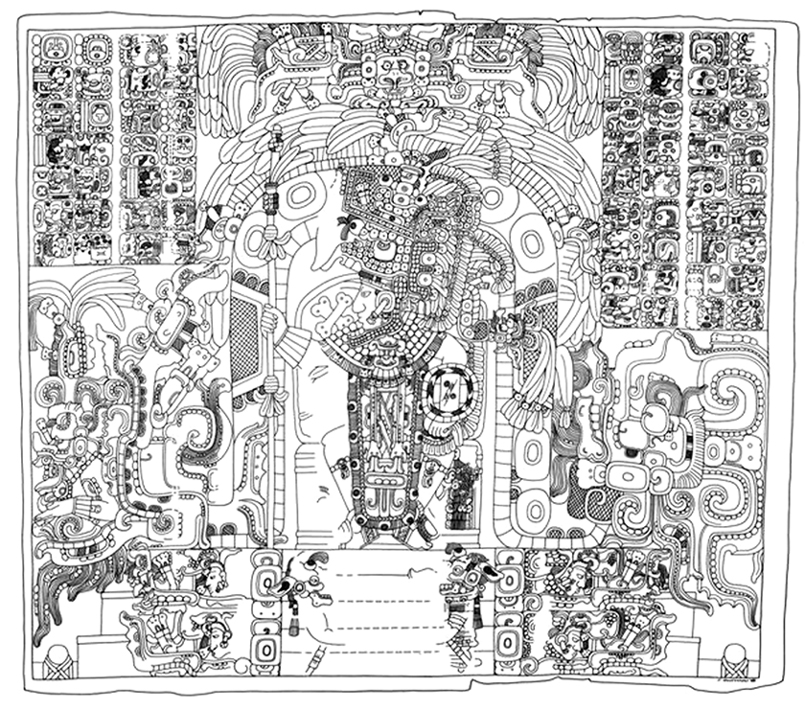
The lintels of Temple IV at Tikal may have held some surprises after I did a bit of coloring on several of the drawings by John Montgomery at FAMSI

I hope I’m not the first one to notice some of these things, but as noted on the diagram, I still cannot find any prior references to either the Bee God at Tikal, nor to the octopus or squid in Mayan Cosmology.

I haven’t worked out yet what it means – one way of looking at ancient Mesoamerican art suggests Mars could be represented by a seven headed serpent and Venus by a five headed serpent; perhaps the octopus could be an analogous symbol that identifies Venus by the associated number eight rather than the associated number five.

Perhaps alternately in the specific context, some ancient Americans conceptualized the Milky Way as a cloud of squid ink?

Glass Jigsaw at GHMB has very astutely suggested that the loss of the Bee God’s feet may refer to Pisces, and notably the other way of interpreting the Bee God’s figure would be take what is directly to the right as his lower torso, in which case his feet might be fish fins. It may be a zoomorphism; the following detail from the very same lintel shows a possible zoomorphism that may be highly suggestive of some of those at Quiriqua.

Seen one way the figure is a crocodile (green); seen another way it’s something else (red), perhaps a peccary?

Also as noted, thus far it may be holding up that the Bee God / Diving God represents an event or an action rather than a particular astronomical object. Virtually anything in the sky might “dive” below the horizon; secondary determines that help us to know which thing in the sky is being referred to specifically should most likely be expected, and may yet help account for some of the variations in Diving God figures.

–Luke Piwalker

Design a site like this with WordPress.com
Get started