Return to Tikal, Part 1

I think my big adventure following in Susan Milbrath’s footsteps may have about run out of steam. I’m not sure where the data exists to carry on the inquiry further. Some of it may be in Jean Meeus’ publications but not necessarily because there are clear indications that even his data doesn’t go far enough back in time when it comes to many critical considerations, and most of the relevant works like the “Morsels” series are at present very prohibitively priced.

No doubt I will be screaming about the elitist nature of academia long before I spend a thousand dollars on a reference work that is of zero value.

If that happens to be a matter of supply and demand, it may be a sad statement about a lack of interest even on the part of Mayanists that may be the result of grossly underestimating the “primitive Maya”.

Here are some possibly poignant comments I stumbled across while doing further research on the “Mayan Bee God” or “Diving God” who may not really be a “god” at all, but may be “more of a verb than a proper noun” that generically indicates the passage of an astronomical object below the horizon, something like an aquatic version of the “Jaws of the Underworld” (the horizon) “consuming” objects which disappear below the horizon.

“Imagine a civilization that was so sophisticated that its astronomers could predict the passage of Venus, and yet so primitive that its people made ritual sacrifices to keep Venus on its path. Not only Venus. They prayed for rain. They prayed for the Sun to rise tomorrow!” Secrets of the Gods In Tulum

Indeed, just because that is so difficult to imagine, we may have to keep asking what’s “Wrong with that picture?” and it may well be the idea that we are dealing with anyone primitive, which may be precisely the big mistake that gets in the way of a better understanding of ancient Americans, and ancients everywhere by the same token.

Given the possible absence of the necessary data, I thought I might turn my attention back to Tikal, where there may be there is some possibility of correlating some of the data I do have, with work that I’ve done on the Tikal temples previously. I still really know nothing about how rigid a rule there may or may not be that the two should coordinate.

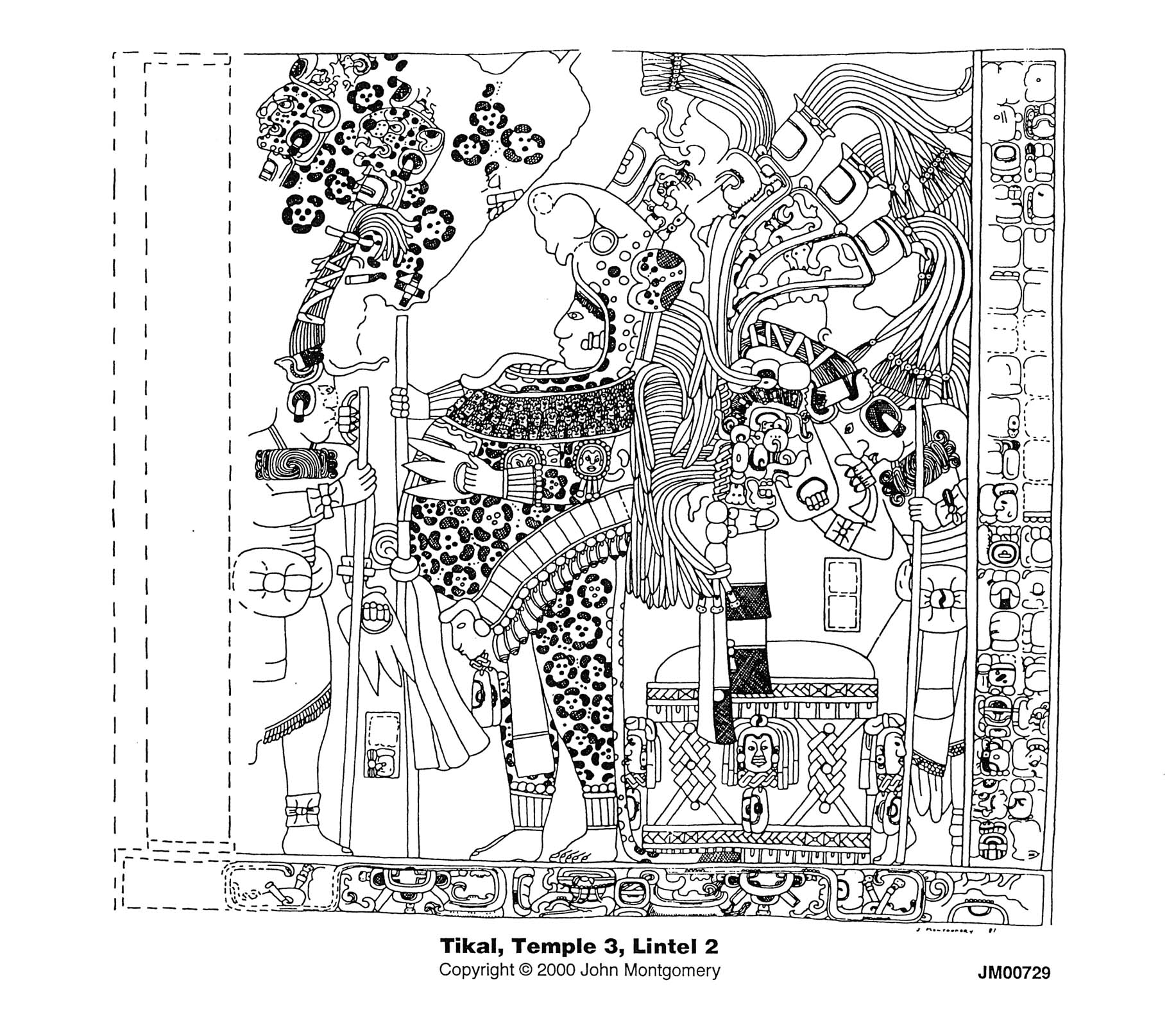
Tikal Temple III may be of particular interest because Lintel 2 features not only a “potbelly” motif that I suspect may signify Jupiter, but an unusual one in which the “potbelly” may be part of a costume.

Image
Higher resolution view: http://research.famsi.org/uploads/montg … T3Lin2.jpg
Location: Tikal, Department of Peten, Guatemala
Caption: JM0073, Tikal, Temple 3, Lintel 2
Category: Maya. Late Classic (c. 810 AD)
Credit: Copyright © John Montgomery
Comments: Nine surviving zapote-wood beams of this lintel still survive above the inner doorway. Text of left side of lintel are missing (originally 80 glyph blocks). Image of ruler with two assistants. All three figures hold weapons – trident flints.

To be honest, though, I haven’t dissected Tikal’s temples that thoroughly as to be able to correlate the planetary associations that the lintel may depict, which the closest nearby mathematics. A lot of focus was given the matter of their exterior doors as opposed to interior doors, because the impression was and continues to be that some of their best efforts may be found in or around the exterior doors, as if they were putting out a welcome mat for visitors and interpreters.

In spite of the intriguing lintel art, I do not seem to have a date for this lintel, and apparently hence no corresponding astronomical data from Milbrath, so it may make for a less promising iconographic study, but it is nonetheless an intriguing mathematical study.

The correct rendition of Jupiter’s cycles still seems to be poorly understood. The natural ratio between two of Jupiter’s primary mathematical features, its Orbital and Synodic Periods, has been difficult to approximate while achieving a sensible pair of values for these parameters, and some initial work on locating the cycles of Jupiter in the mathematics of the calendar stones (“altars”) may have been misleading, because it seems to endorse the strong candidates for the Orbital and Synodic period values that may lack compatibility.

For that, we could hope that any ancient monuments or architecture that refer to Jupiter symbolically, might be places to go to find clarification about how Jupiter is best referenced mathematically.

To review somewhat, the original exterior door proportions of Tikal Temple III have been proposed to be

Temple III Width 12.98787880 ft; Height 10.96622711 ft; Ratio W / H 1.184352528, Product W x H 14.24280364

The width is a fraction of what is probably the most useful approximation of the important canonical calendar number 52.

After finding that even some of Tikal’s most challenging mathematical puzzles seemed to solve themselves if we learn to appreciate the apparent important of the number (Pi / 3) and its power as a data retrieval tool, and after deciding on 10.96622711 for a myriad of other reasons, it was finally noted that 10.96622711 / 10 is the square of (Pi / 3), something that took me a long time to notice because my calculator is programmable so that I can enter “Answer x (a number)” and just keep hitting the “equals” key, so that I am constantly working with (Pi / 3)^2 without ever getting to see what it actually looks like. For me, there have been a number of such surprises that were surprises just because of the way my calculator and I interact.

Suffice to say that finding out 10.96622711 / 10 is the square of (Pi / 3) lends considerably more confidence to the proposed door proportions, which are in some ways a bit unusual even for Tikal. Unlike some of the other Tikal temples, when (Pi / 3)^n is applied, they give a grand tour of some “Pi-based numbers” (numbers that can be formed from a whole number and Pi) rather than the “square root” numbers which often give such amazing results with the series they form interacting with prominent data retrieval keys like Pi, 2 Pi, 1.177245771 or 1.622311470.

The proposed Width/Height ratio of the door is what forms the link between Venus Cycle (or Half Venus Cycle aka Calendar Round) and Venus Orbital Period, something I was more or less taught when pondering the architecture of Rio Bec and how they used astronomical numbers in their architecture there. Again, I personally find the Rio Bec architectural style and the associated sites especially intriguing, because I am not in disagreement with orthodox scholars that the false temple towers of the Rio Bec style evoke Tikal’s temples, and were most likely intended to.

In a way, I have always hoped that this unusual gesture of respect towards Tikal aesthetically is accompanied by unusual gestures of respect toward Tikal mathematically, or in the creation of monuments, that Rio Bec sites might represent a logical continuation of Tikal’s mathematical themes.

The data from George Andrews also addressed the lintel measures of Tikal’s exterior temple doors so that the question could be attempted whether both the door heights with, and without lintels, can be expected to be mathematically significant, with the results of an inquiry being apparently positive in one such case after another where such complete data was available, although the specific details should already have been published and are beyond the scope of the current initial inquiry.

Lastly 14.24280364 is one of the original “Mayan Wonder Numbers”, and this is where and how it was originally found. Perhaps one might take to calling it the “Temple III Number” if it helps keep it sorted out from “The Faiyum Number” which was originally from Egypt, but was quickly found to be prevalent in ancient American architecture as well. Since its discovery, the “Tikal” number 14.24280364 has been found to be a genuine and integral element of certain proposed astronomical formulas.

While observing the possibility that not only the ratio of door width and height by division of the larger by the smaller should give pleasingly significant values, but also the product of multiplying width times height often makes it more of a challenge to develop working models because of the increased demand, there are also some obvious advantages to this parameter having been considered by the architects in their designs, and Tikal Temple III is one of the successful examples of this consideration being observed and applied.

To date, that may be the bulk of anything that may be definitively known about Temple III.

I may have attempted this before, but it’s always good to revisit things to see if new discoveries can make unsolved puzzles less puzzling, so I’m going to ignore any previous work that may exist for now, and begin again from the ground up. Leaving aside of now the issue of the exterior door with and without lintel as well, let’s look back at Andrews’ data on the temple, in spite of any data points that may be missing.

Quoting here George Andrews from Architectural survey Tikal, Guatemala : the great temples

“STRUCTURE 5D-3 (TEMPLE III)
COMMENTS
In common with all but one of the Great Temples (Temple VI), Temple III was first described and photographed by Alfred Maudslay (1889-1902). A few years later Teobert Maler (1911) provided a more detailed description and other excellent photographs. These early photographs are particularly valuable today, since the pyramidal
substructure is now recovered with huge trees (as of 1981) and only the temple proper can be seen. The temple itself was cleared and consolidated as part of the University of Pennsylvania’s 10 year program at the site (1956-66) when the fallen lintels over the east doorway were replaced with new wooden lintels.
It is difficult to suggest any logical reason for the distortion of the temple proper into a parallelogram, since none of the other Great Temples show this amount of deviation. It could be merely an error on the part of the builders, but it seems more deliberate than accidental, and therefore more difficult to understand…
INTERIOR DETAILS: ROOM 1 (Outer room)
DIMENSIONS
Length: 6.65 m front, 6.90 m rear.
Width: 1.62 m.
WALLS
Height: 3.96 m. floor to springline.
Thickness: Front wall 1.73 m thick. Stonework: Walls faced with (text missing)
Doorways: Exterior doorway 3.83 m wide (front); 3.90 m at rear; 3.12 m top of floor to bottom of lintels. Wood lintels (plain) .24 m thick.
Rod Sockets: No data. Cordholders; No data. Wall Openings: None noted. Platforms: None.
Other: Step up to rear room .27 m high. South end wall not perpendicular to front and back wails.
VAULTS
Springline Offset: .075 m (approx.)
Height: 2.57 m (approx.) springline to bottom of capstones. Form: Vault faces have straight sides.
Stonework: Vault faced with long rectangular slabs with faces set to slope of vault.
Capstones: Capstone span about .16 m. Crossbeams: Three rows of crossbeams as in other Great Temples.
Other: Projecting springline has rounded corners.
OBSERVATIONS
This room wider than front room of Temples I and II…”

Note Andrews’ comments about the building being a “parallelogram”, which I have bolded – this is yet another example, and a notable one, of the possibility of ancient architecture being designed with deliberate imperfections that were designed to increase the architecture’s data handling capacity.

There may actually be at least two such deliberate distortions of the geometry here, if we can take Andrews’ diagram at face value that the outer temple is distorted in a different direction that Room 1 is (Room 1 is longer at the back than at the front, even when ancient American builders have shown again and again that they are perfectly capable of regularity in the execution of architectural designs).

Room 1 is the room just outside the inner door with the lintel in question, so we hope it has sufficient proximity to converse with the lintel and any data it may contain.

6.90 m = 22.63779528 ft
6.65 m = 21.81758530 ft
1.62 m = 5.31496063 ft
3.96 m = 12.99212598 ft

6.90 / 6.65 = 1.037593985
6.90 / 3.96 = 1.742724242
6.90 / 1.62 = 4.259259259
6.65 / 1.62 = 4.104938272
6.65 / 3.96 = 1.679292929
3.96 / 1.62 = 2.444444444

Perhaps unfortunately, the maximum length of the room at rear may be a challenge to interpret because it may be easy to be tempted by the possibility of the Venus Orbital Period being represented (22.48373080 ft presumably), which it may or may notactually mean.

There are some figure there familiar enough that perhaps they may be correctly recognized at first sight, and they include the width, which may be 5 Hashimi Cubits, and the minimum length / width ratio, which much resembles the reciprocal of 2 Remens.

The min/max length ratio resembles several things; one is 360 / Eclipse Year and the other is (8 x 1.000723277) x (360^2) / 10^n (to write it one way).

6.65 meters when translated to the so-called “modern Imperial” foot resembles a number from the unfinished proceedings of relating the revised Mycerinus pyramid to its larger mathematical environment at Giza.

It bears repeating that the ratio between the inner and outer sarcen circle at Stonehenge is the same ratio that exists at Giza between the base of the Great Pyramid, and the base of Chephren’s pyramid, and suffice it to say on that basis alone, that the mathematical relationships between Giza pyramids should be considered as being intentionally significant.

However, given the uncertain status of the Mycerinus pyramid because of its unfinished state, it proves challenging to be certain whether the successfully revised model of the Mycerinus pyramid describes a model with pavement in place, or without pavement, and therefore to be certain of the intended relationships between it and other Giza pyramids.

Using Munck’s 150 Pi feet height for Chephren’s pyramid, and the projected 216 foot height of the Mycerinus pyramid, the ratio would be

471.2388980 ft / 216 ft = 2.181661565, but it is still difficult to know whether this is what was intended, or whether a probably more attractive figure of 2.180084761 was intended here, and if so, exactly how it was implemented. It might still turn out to be either, as could this very similar figure from Tikal Temple III.

3.96 m = 12.99212598 ft may be another approximation of 13 though a simple fraction of the Stonehenge outer sarcen circle radius and diameter, or of its fundamental unit being also used in the New World to form an approximation of the 260 day Tzolkin (13 x 2 x 10) that is able to integrate the 260 and 364/5 day calendars rather than them being exclusive to one another in terms of fundamental relationships though division and multiplication.

In other words, this may be a repetition of the exterior door width of Temple III, 12.98787880 ft

6.65 / 3.96 = 1.679292929 could mean the 1.676727943 (Egyptian Mystery Unit) value that is essential in ways to the construction of “Mayan” calendar cycles, and to understanding the importance of the width x height product of the exterior door of Temple III.

3.96 / 1.62 = 2.444444444 may be an occurrence of the Double Remen in forward form, in contrast to the suggestion that 6.65 / 1.62 = 4.104938272 may represent the Double Remen in backwards or reciprocal form

1 / 2.4444444444 = 4.0909090909, very close to 4.104938272.

Rather than give what may be haphazard endorsement to these suggestions, let’s press onward to the door to Room 2, where the lintel in question appears at the top of the doorway.

Sadly, the height of the inner door does not seem to be readily discernible from Andrews’ data. We may have some options of secondary sources, but it may call for some elaborate tables and careful comparison of data sources. Personally, speaking from much experience, I generally take George Andrews’ data to be more reliable than even Teobert Maler’s. That project to may lie beyond the boundaries of the present effort.

For the second room in Temple III which lies just the other side of the lintel in question, referring again to Andrews’ report

“SITE: TIKAL DATE: 3/27/1974
STRUCTURE 5D-3 (TEMPLE III)
INTERIOR DETAILS: ROOM 2 (Rear room))
DIMENSIONS
Length: 3.35 m.
Width: .69 m.
WALLS
Height: 3.68 m (approx.) floor to springline.
Thickness: Dividing wall to front room 2.21 m thick.
Stonework: Walls faced with (text missing)
Doorways: Doorway to front room 2.17 m wide. Carved wooden lintels above; 9 of 10 original wooden beams still in place though defaced by looters (see details).
Rod Sockets: No data. Cordholders: No data. Wall Openings: None noted. Platforms: None. Other: Floor of this room raised .27 m above floor of outer room.
VAULTS
While much narrower, all details of vault over this room similar to those seen in vault of Room 1.
OBSERVATIONS
Very small, exceptionally narrow room.”

We also may not have certain data then for the vault measurements of Room 2, only that they are “similar” to those of Room 1, and it may simply not be safe to speculate on the basis of Andrews’ data alone how “similar” they are or in what ways.

3.35 m = 10.99081365 ft
0.69 m = 2.263779528 ft
3.68 m = 12.07349081 ft

Offhand it seems difficult to guess whether .69 m is intended as exactly 1/10th of the 6.90 m maximum length of the first room, although it certainly a possibility to not overlook, or whether the 3.35 m = 10.99081365 ft is a repetition of the proposed 10.96622711 ft height of the exterior door, but at the rate that the suggestions of repetition are accumulating, it may be an increasingly viable possibility that repetition was used here to reinforce some of the message contained in the exterior door.

3.68 / 3.35 = 1.098507463
3.68 / 0.69 = 5.333333333
3.35 / 0.69 = 4.855072464

This too may be suggestive of more repetition. The tentative suggested interpetation of 1.62 m = 5.31496063 ft now appears probably even more convincingly as a ratio as well as a possible measure of Room 1 as 3.68 / 0.69 = 5.3333333333; the suspected figure is half of 10.67438159 or 10.67438159 / 2 = 5.337190795.

Likewise, the height / length ratio of 3.68 / 3.35 = 1.098507463 appears if it may be a repetition though ratio of what appears as a measure with the Room 2 length of 3.35 m = 10.99081365 ft and the proposed 10.96622711 ft height of the exterior door.

Such reinforcement of important figures so that they appear as both measure and as ratio is not uncommon, and seen also in the ancient architecture of the “Old World” such as in Egypt.

Just to prove to the reader that I haven’t entirely overlooked the possibility that either of these numbers represent the number 11 (or 11/10), in this math we might want to write 11 in Indus Feet, but the classic Indus Foot value here which may often be used to approximate 11, is technically a quantity in Megalithic Feet, and to present it in Indus Feet may perhaps be to weaken the potential of the message.

For the record, in the context of proposed figures for major periods of Jupiter, 10 x (Pi / 3)^2 = 10.96622711, is loosely related to the present suspected intended approximation of the Jupiter Orbital Period – 4329.29292 days representing the textbook figure 4332.59 days, a quality approximation speaking relatively to approximations of the Calendar Round – by the square of almighty 2 Pi, and the relationship between the two also includes a possible high quality approximation of the Saros Cycle of 6585.3211 days

10.96622711 / 4329.292929 = 2.533029594 / 10; (2.533029594 x 2)^3 = 6586.899478 / 10, probably a very fit candidate for quality approximation of the Saros Cycle even if the systematics of this are still not yet well understood.

We may wish to note that another way of seeing this is that the square of the reciprocal of 2 Pi = 2.533029594 / 100.

Regarding the suggested value of 1/2 of the Hashimi Cubit, in a number of ways this is a rather sensible thing to combine with the so far standard Jupiter Orbital Period, and because it connects as a series with the Great Pyramid’s proposed diagonal length (at pavement level), informs us further of what even the diagonal of the Great Pyramid is capable of when the Hashimi Cubit (actually a proposed variation on the Egyptian Royal Foot).

For Jupiter’s Synodic Period, I’m not ready to pursue the matter more aggressively even if Tikal Temple III should prove to be our “Rosetta Stone” in this matter. There are a few hints at least that Tikal Temple III may indeed be able to do this, in a matter that relates to what the basic problem tries to be, which is that the ratio between my primary candidates for Jupiter’s Orbital and Synodic periods is a little too low, and that the correct Synodic Period value to match an Orbital Period value may be lower than the current candidates, even if the current candidates may be viable in variant formulas, the Dresden Codex being a prime example of variant astronomical formulas.

To use short numbers for a probe, the canonical Synodic Period of Jupiter of 399 days divided by 1.0966 = 363.8519052, which looks rather like a possible approximation of the Solar Year reckoned as 364 days, which may also relate to the symbolism on the lintel, where a rotund Jupiter has seemingly been festooned with feline characteristics that may be best associated with the Sun in Mayan iconography just as they might be in “Old World” iconography – again a possible “uncanny parallel” between Old and New World myth and symbolism that might owe to ancient diffusion (distribution) of culture.

We can also observe that for 690 / 665 = 1.037593985, that 399 x Tzolkin 260 = 103740, which might (or might not) prove to be an important clue as to exactly what was intended here.

In terms of the suggestion that it might also represent 360 / Eclipse Year (360 / 346.62 = 1.038601350), we may see several instances of a similar operation here involving 360 / Lunar Year, which continually seems like a common subject addressed in the mathematics of ancient American architecture.

Canonically, 360 / Lunar Year 354 days = 1.016949153, and where we may find this in Tikal Temple III is the inner/outer width ratio of the exterior door Max Width 390 cm / Min Width 383 cm = 1.018276762, and in 690 cm / 162 cm (Max Length / Width of Room 2), where this is about Jupiter Orbital Period textbook figure 4332.59 d / (360 / Lunar Year in days)

690 / 162 = (4332.59 / 1017.216783).

I’d like to draw attention to something else here now, which is Andrews’ data for the thicknesses of the walls. According to his data, the thickness of the wall between Room 1 of Temple III and the outer front face is 1.73 m, a number we may have been poorly equipped to appreciate until relatively recently when this mysterious value that recurs in Tikal “Bat Palace” in a manner that is probably highly uncharacteristic of ancient American architecture was tentatively identified.

Perhaps it part of a practice of putting their best at the front door to greet guests that we find this here, and because it is here has led to the observation in the context of Jupiter that “the Bat Palace Number” divided by 7 = 398.66, very close to the textbook figure for Jupiter’s Orbital Period, 398.88 days. Of course, I have no expectation that a canonical value for the number 7 is represented here, for that reasons that include that even the canonical number isn’t canonical. In spite of the way we think of calendars, that there are 52 weeks of 7 days in a 365 day year, 52 x 7 = 364 and not 365, and 365 / 52 = 7.019230769 and not 7.

It also comes to my attention that there is a number, 399.8649086 that successfully interacts with the “Wonder Number” that is the product of the exterior door’s width x height, all the way to the third power, although it remains to be seen if this could actually be a viable possibility for the Jupiter Orbital Period.

Perhaps we should consider all of this rather satisfactory for a “first outing” with the inner workings of Temple III, and having now shared this with readers, perhaps I can move on to other examples of Tikal lintels which have their dates intact so that we might better understand the nature of their symbolism.

–Luke Piwalker

Mayan Telescopes?

In my recent attempt at a paper posted to academia.edu, I audaciously suggest that ancient Americans were aware of Saturn’s rings and capitalized on this knowledge in making symbolic representations of what the stars, planets, moon and sun were up to at a given point in time.

I deliberately tried to avoid getting into the subject of ancient optics in the course of the paper, but I may address it in some upcoming addendum to it.

Naturally, no one seems to be able to produce a Mayan telescope even if the Maya built at least two astronomical observatories including El Caracol at Chichen Itza that look like they could be near cousins to modern ones.

A little bit of unorthodox history of optics for readers who might be unaware of some of it:

“The Nimrud lens, also called Layard lens, is a 3000-year-old piece of rock crystal, which was unearthed in 1850 by Austen Henry Layard at the Assyrian palace of Nimrud, in modern-day Iraq. It may have been used as a magnifying glass, or as a burning-glass to start fires by concentrating sunlight, or it may have been a piece of decorative inlay.” Wikipedia: Nimrud Lens

The article continues, “Assyrian craftsmen made intricate engravings and could have used a magnifying lens in their work. The discoverer of the lens noted that he had found very small inscriptions on Assyrian artefacts which he suspected had been achieved with the aid of a lens.

Italian scientist Giovanni Pettinato of the University of Rome has proposed that the lens was used by the ancient Assyrians as part of a telescope and that this explains their knowledge of astronomy (see Babylonian astronomy). Experts on Assyrian archaeology are unconvinced, doubting that the optical quality of the lens is sufficient to be of much use. The ancient Assyrians saw the planet Saturn as a god surrounded by a ring of serpents, which Pettinato suggests was their interpretation of Saturn’s rings as seen through a telescope. Other experts say that serpents occur frequently in Assyrian mythology and note that there is no mention of a telescope in any of the many surviving Assyrian astronomical writings.

According to his book, Layard found the lens buried beneath other pieces of glass which looked like the enamel of an object, perhaps made of wood or ivory, which had disintegrated. The British Museum curator’s notes propose that the lens could have been used “as a piece of inlay, perhaps for furniture” and that there is no evidence that the Assyrians used lenses for their optical qualities, e.g. for magnification, telescopy or for starting fire.

A similar object was mentioned in The Epic of Ishtar and Izdubar, Column IV, Coronation of Izdubar, written about 2,000 BC. 10th stanza. It reads:

The King then rises, takes the sacred glass,
And holds it in the sun before the mass
Of waiting fuel on the altar piled.
The centring rays—the fuel glowing gild
With a round spot of fire and quickly. spring
Above the altar curling, while they sing!”

Already we seem to encounter scholarly reticence to give ancients the benefit of a doubt, resulting in what is probably a rather questionable declaration that ancient people discovered this fantastic item with magical properties and then restricted its use to decorate furniture inlays.

Of course ancient people were bright, learned, inquisitive, experimentative, imitative – everything they’d need to be for there to not only be more of these where this one came from, but also for their creators to know how to use them for their optical properties such as starting fires without rubbing sticks together, and gazing at the stars.

Realistically, within minutes of the first discovery of the optical properties of a lense, the idea for combining the optical properties of two lenses probably came along, much like we can imagine the discovery of the effects of one beer led to questions about what the effects of two beers were like.

Of course, another way to have a telescope might be to have a good reflector, and ancient Americans don’t seem to have been empty handed there. They made convex and concave mirrors from polished obsidian and pyrite.

John Dee is said to have owned an ancient American mirror (now said to be in the British Museum) which he allegedly used for “divinatory” purposes, but we can imagine he was probably quite intrigued with its optical properties.

It is variously stated by different sources that Dee created parabolic formulas for “burning mirrors” – concave mirrors capable of lighting fires – and even that such a “burning mirror” was tested on the seas for prospects of setting fire to enemy ships at a distance.

Wikipedia’s article on Mirrors in Mesoamerican Culture (a photo of John Dee’s Aztec mirror appears at upper right in the article)

“Early mirrors were fashioned from single pieces of iron ore, polished to produce a highly reflective surface. By the Classic period, mosaic mirrors were being produced from a variety of ores, allowing for the construction of larger mirrors. Mosaic pyrite mirrors were crafted across large parts of Mesoamerica in the Classic period, particularly at Teotihuacan and throughout the Maya region. Pyrite degrades with time to leave little more than a stain on the mirror back by the time it is excavated. This has led to the frequent misidentification of pyrite mirror backs as paint palettes, painted discs or pot lids. By the Postclassic period obsidian mirrors became increasingly common.”

Amid all the mystical mumbo-jumbo of most contemporary interpreters,

“Fire

Mirrors were associated with fire in Mesoamerica, and representations of mirrors could take the form of flowers and be combined with representations of butterflies. Both butterflies and flowers were associated with fire in central Mexico from the Classic to Postclassic periods, with butterflies representing flames. The Olmecs of the Preclassic period fashioned concave mirrors that were capable of lighting fires…

Although hundreds of mirrors have been excavated in the Maya area, comparatively few mosaic mirrors have been recovered from lowland Maya sites. Large quantities of mirrors have been recovered from some highland sites, such as Kaminaljuyu and Nebaj in the Guatemalan Highlands. The high concentration of mirrors in a few highland sites probably indicates centres of production and distribution into the trade network. It is likely that they were manufactured in the highlands and then were traded as finished objects to the Maya lowlands…

In the Valley of Oaxaca, only San José Mogote has produced evidence of mirror production dating as far back as the Preclassic. Mirrors produced at San José Mogote were distributed to relatively distant places such as Etlatongo and the Olmec city of San Lorenzo. The mirrors from San José Mogote that were excavated at San Lorenzo have been dated to between 1000 and 750 BC. Towards the end of this period, mirror production at San José declined and halted altogether.

The incomplete slate back of the earliest known Maya mirror was excavated from Cahal Pech in Belize; it was dated to around 600 BC, in the Middle Preclassic.”

Here is an interesting curio:

Moctecuzoma (Montezuma or however scholars are spelling it this week) from the Florentine Codex (upper) and redrawn from probably Victor Von Hagen’s popular paperback on the Aztecs (lower). The captions tell us that Moctecuzoma was scrying in the mirror and had a vision that constituted the seventh prophetic sign of the end of the Aztec empire, but even the redrawn version shows us that what Moctecuzoma actually seems to be looking at in the mirror are stars.

Says HistoryCrunch,

“The seventh omen is related to a bird that was caught by a hunter on Lake Texcoco.  The bird was gray in color and apparently had a black mirror-like object on its forehead.  The hunters reported seeing the stars and the night sky in the mirror. They took it to the Aztec leader, Moctezuma II, and when he looked into the mirror he reportedly saw a large number of warriors riding on animals that appeared to be large deer. Moctezuma II then gave the bird to his high priests who were told to view the mirror and interpret its meaning.  However, when the priests looked into the mirror they saw nothing and were unable to offered their advice to the Aztec leader.”

I don’t know what complicit role deer might play in the end of the Aztecs, but Mars is said to be sometimes symbolized by a deer in ancient American iconography, and I am beginning to sense a dreadful misinterpretation save for the part where the hunters saw the stars and the night sky in the mirror too.

I really haven’t made much effort to write a piece on the subject, but there is already more that might be included, including contentions that the great geoglyph spider design at Nazca, Peru shows not only a species-correct rendition of an often tiny genus of spider (Ricinulei, or tick spiders) found in the rain forests to the north of Peru, but that it shows anatomically correct detail about the usual features and traits of the species that cannot be seen with the unaided eye, i.e., without magnifying lenses.

I haven’t gotten to the bottom of that matter yet as my spider-measuring time is often limited, but readers may wish to be aware of this fascinating contention.

Of course, we probably shouldn’t leave out the ancient Greeks. While mighty Tikal’s stargazing days apparently had yet to even begin, the ancient Greeks demonstrated knowledge of advanced optics

Astronomy Trek informs us of the

History of the Lens

According to Roman historian Pliny, glass-making was discovered accidentally by the Phoenicians around 5000 BC, while cooking on the desert sand. However, the earliest man-made glass objects were found later around 3500 BC in Egypt and Mesopotamia, with lenses no doubt being made soon after the discovery.

The earliest known lens currently unearthed is the Nimrud lens (750 BC) found at the Assyrian palace of Nimrud in modern-day northern Iraq. It is believed to have been used as a  magnifying glass, or as a burning-glass to start fires. Lenses were certainly well known by the time of the Greeks, with even the dramatist, Aristophanes, referring to them in his Comedy of the Clouds in 424 BC:

Strepsiades: “Have you ever seen a beautiful, transparent stone at the druggists’, with which you may kindle fire?”
Socrates: “You mean a crystal lens.”

Uses of these early lenses included starting fires and cauterizing wounds, although their magnifying properties would obviously have been known. However, in the 1st century AD we find the first written record of magnification with the Roman Seneca the Younger explaining:

‘Letters, however small and indistinct, are seen enlarged and more clearly through a globe or glass filled with water.’

Ancient Telescopes

The most powerful ancient lens yet discovered was found in Crete dating back to the 5th century BC and had the ability to magnify clearly up to seven times and even as much as twenty times, albeit with considerable distortion.

It has even been suggested that a piece of Greek pottery discovered dating back to 4th century BC depicts a man using an early telescope and that ancient people were able to connect two lenses inside a simple tube to make an early, crude telescope. However, making lenses and a telescope useful for astronomy purposes requires a level of expertise and precision probably undiscovered by the ancients, although it is good to keep an open mind on the subject.”

Once again, there are probably plenty more where these came from, and sooner or later the earliest dates will get pushed further and further back.

We expect no less from bright industrious ancestors who so demonstrably obsessed with astronomy and astronomical objects because “they thought the planets were gods” – well, they certainly the thought the planets were worth a good look at least, and just look at some of the tools they had at their disposal to carry out that all important edict.

–Luke Piwalker


Short Reports 6

The Great Turtle

In high school, my best friend used to occasionally refer to the “Great Turtle” with a gleam in his eye. I never found out where he got this concept, but I always took it be something like a refinement of the idea of the “Flying Spaghetti Monster” – if you’re going to believe in something silly, it might as well be something that’s pleasant, or something you like, right?

At the time, I had no idea that there was such a thing in Native American mythology, and didn’t find out until years later.

Curiously, I still find myself looking at turtles in indigenous American mythology, and I’m still not sure exactly what they mean, but spending some time reviewing the iconography of some of the very sites and artifacts I’ve been studying mathematically, it occurs to me there may be much room for progress in Mayan studies, and I hope a little has been made with my latest attempt at a paper.

A Forest of Stars: Weighing Archaeoastronomy Against Other Social Considerations in the Assessment of Ancient American Iconography and Conduct

It’s probably a bit preachy, but then I’m a bit weary of being fed a steady diet of morbidity just for trying to learn about people’s roots (including my own), and Mayan history has probably been made out to be most morbid of all.

As detailed in the paper, the turtle symbol in ancient Mesoamerica seems to have to do with the earth, but possibly also with Saturn. It may be a hybrid symbol, and there may still be work to do understanding why that’s why it is, and exactly when, why and how it was used as one.

A similar situation exists with the moon and Venus; in the paper I have suggested that Xipe Totec (the “flayed” deity) may primarily a lunar goddess, so some consideration may have to be given to how this character may have acquired a connotation oriented to Venus.

Hopefully, asking questions like these is part of the process of gaining a more genuine and more satisfactory understanding of ancient symbolism, and the surprisingly extensive role that astronomy may actually play.

At any rate, I hope people will find the paper inspiring, or at least interesting. Just maybe it will be the start of something good.

Mayan Humble Pie?

I have a confession to make – there is something that still confounds me about ancient American sculpture, and it’s too important of a point to be in the dark about, but I have yet to be able to shed light on it.

While the circular altars I’ve been studying appear to usually be regular enough in shape for us to obtain meaningful measurements from, I still have no idea if the same is true for their accompanying stela.

It’s most strange how even though the stoneworkers in question easily had the skill to form more regularly-shaped stela, for some unknown reason they seem to have routinely declined.

What this means then in interpreting their measurements as possible astronomical data remains unknown.

Rarely if ever are the datasets inclusive enough that we could use them to try to answer that question, and even if they weren’t, exactly which measurements are we intended to use, and how?

It’s actually part of the reason I decided to do something more with my experience with symbolism and mythology and less with mathematics.

As it currently stands, the stela seem something of a humbling subject, because thus far if we are to learn anything from them, the usual tools – mathematics – may not avail us.

This even when many successful studies have been conducted of whether ancient architecture was designed with deliberate irregularities design that were seemingly intended to increase their data storage and retrieval capacity for handling astronomical data.

Stairway Denied?

One cannot do much looking around Copan without taking notice of the famed Hieroglyphic Stairway.

Click to access copan1.pdf

It’s something of a frustrating subject since it’s an intriguing study, but to date I have virtually zero architectural data on it, and no data collected describing any restorative efforts that might address the usual concern as to whether we are working with the original measurements as designed by the architects, or the measurements as they are following “consolidation”.

After the archaeological follies at both Chichen Itza and possibly El Tajin, I’m increasingly wary.

However, after finding some better photographs like the one included, I think I might have managed to get something out of Copan’s Hieroglyphic Stairway, since we can hopefully trust that at least the major architectural features are original.

Previously I have talked about Mayan stairways with “inclusions” – features placed right in the middle of stairways where one might even think they could be a hindrance – and how thus far (2 for 2) they seem to indicate the presence or applicability of square root functions, rather like the way Stonehenge’s unusual display of sarsens and lintels seems to do likewise.

It might sound crazy, but it’s been profoundly successful, and has seemingly promoted a greater understanding of many things.

The first person to my knowledge to suggest a refined value for any measure of a Tikal temple per se* is “Our Founder”, Carl P. Munck who, based on the data, proposed an exterior door width for Temple II of 1 “Squared Munck Megalithic Yard” or (2,71971567^2) = 7.396853331 ft.

Munck was no doubt proud to think of the Maya using his proposed Stonehenge unit, but there’s no vanity about it. In 20 years, not only have I been unable to overturn Munck’s finding, but I ended up going back to the data and building on it to have a more complete model, only to discover the amazing fact that while Temple II’s exterior door seems to honor Munck’s metrological unit, it’s height/width ratio seems to honor one of Munck’s particularly favorite numbers which he called “Alternate Pi”, 1.177245771.

Temple II rather inexplicably has a large block set in the middle, and even more curiously, in proximity to the upper temple itself. Using the best photograph I could find (from Edwin Shook), I attempted to use pixel measurements to complete an incomplete set of measures for it. The proximity to the temple provides for being able to make a guess from the photograph that it is the same length as the width of the door, and the pixel measures and calculations provided a height of approximately 5.7 feet.

Assigning this the value of 1/10 of 1 Radian in arc degrees, or 57.29577951 / 10, the Radian being an extremely important number from Munck’s basic vocabulary of constants, this provides a ratio of

7.396853331 / 5.729577951 = 1.290994449

Remarkably, this is the reciprocal of the square root of 60

1 / (sqrt 60) = 1.290994449 / 10

Sqrt 60 and its reciprocal happen to be the two most powerful mathematical probes ever discovered for working with these numbers. In recent years, we have seen them turn up again and again and again in ancient architecture, which is not surprising since like 1.177245771 and 1.622311470, they would be something that ancient architects would enthusiastically want to incorporate into virtually everything they design somehow.

The Pyramid of Niches at El Tajin also has “inclusions” in the middle of a stairway, there are five such inclusions each with 3 niches.

(3 x 5)^2 = 225; Venus Orbital Period canonically 225 days

Much more strikingly

(sqrt 5 / sqrt 3) = 1.290994449

The very same basic message communicated by the model of the block on the stairs at Tikal!

I couldn’t quite figure out the Copan stairway until I found a picture that gives a better view of the bottom. I’d counted six inclusions on the main stair and couldn’t figure out why they’d want to talk about the square root of 6.

The “sixth” on at the bottom is actually an apparently separate tripartate (three parts) construct. What we seen to really have here (can you see it coming a mile away?) is 5 inclusions of one and one inclusion of 3, no different at all in constitution than the Pyramid of Niches stairway with its 5 inclusion of 3 parts each, except that the same numbers have been arranged slightly differently, perhaps so that the inclusions might dominate the stairway less than takes place at the Pyramid of Niches.

That is now seemingly 3 of 3 of Mayan stairways with something set in the middle of them that not only seem to reaffirm the idea of this architectural gesture referring to square root functions, but 3 of 3 which are capable of specifically indicating what may well be be the most important square root there is this apparently ancient mathematical system.

–Luke Piwalker

What Is Stonehenge?

I continue to wrestle with some of the details involved in exploring my questions about ancient American iconography and planetary/stellar symbolism, such as a considerable amount of rather time-consuming manual data entry and searching for scattered images and drawings of monumental artifacts like stelae and altars.

Ideally, this may help provide the opportunity to better understand many things, but the proof of this remains to be seen and the matter demands much attention – even to the point of being so distracted by it that I let May 4 (as in May the Fourth Be With You) pass by without trying to prepare a blog post.

At present, I wouldn’t mind being back in a more familiar element for a moment, and one of the ancient monuments that has become most familiar is Stonehenge.

Hopefully it has become familiar enough that we can actually give meaningful answers to its purpose, or at very least we can put some focus on some of its functions.

From my perspective, Stonehenge is of course, among other things, a very sizable calendar calculator, whose proportions enter into equations that give considerable insights into numerous matters.

Stonehenge might also be considered a metrological tutorial, and as if just to prove that metrology isn’t always a light subject, it acts as a metrological tutorial that risks confusing us by taking strident steps toward trying to clear our confusion by tackling potentially confusing subjects head-on.

One of its functions in this capacity seems to be that it is a tutorial on the Megalithic Yard – and in the Megalithic Yards’s myriad forms, no less – because that is precisely how its design is effectively able to work.

In this capacity, Stonehenge would share a great deal with the Great Pyramid, because over years of study, that is exactly the picture that has emerged of the Great Pyramid – over and over again, it is implicated as a metrological standard, as a metrological tutorial on a grand scale.

With some of the latest things we have have learned, we can now see that even more clearly than before – the Great Pyramid’s perimeter / height ratio of 2 Pi is according to this research, the glue that holds ancient metrological systems together.

Almighty 2 Pi is also the buffer that keeps the diversity of units required for fluid storage and retrieval of data, from collapsing upon one another.

Using 2 Pi to remarkable advantage, the actual proportions of the Great Pyramid use 2 Pi to practice exactly what they preach.

Almost ironically, the perimeter of the Great Pyramid at the presently attested pavement level, according to this research, is measured exactly as John Michell (corroborated by Hugh Franklin) suggested, in an inverse number of Megalithic Yards – and one of the “true” ones at that.

That is some of the confusing business that ultimate Stonehenge aims to clarify, which is a real Megalithic Yard and which is not.

The most recent metrological discoveries help to corroborate the teachings of Stonehenge, emphasizing that there are probably only three true Megalithic Yard values, primarily the “Alternate e'” and “Incidental” types, but also the “Draconic” Megalithic Yard.

These are the first three Megalithic Yard values I discovered, and in that order.

I have mentioned before how close Sir WMF Petrie seems to have come during his study of Stonehenge, to being the discoverer of the Megalithic Yard before Alexander Thom. Had Petrie only experimented the slightest bit more with some of his data, that might well be the tale that history tells.

In a very similar way, the mean measures of the sarsen circle (mean diameter and circumference) help provide a reference point that illuminates all three of these genuine Megalithic Yards. It’s only one of the aspects of Stonehenge with this property, which has thus far proven to be remarkably rare – the sort of thing that might most likely happen more than once in a design, only by very careful planning and deliberate intent.

Sometimes I wax toward the sentiment that Stonehenge represents an ultimate Megalithic packaging to reflect and ultimate Megalithic design, but this may do poor justice to countless other Megalithic sites whose designs may be every bit as clever.

Having written somewhat extensively on Megalithic sites before, I have demonstrated previously how some of Thom’s Flattened Ring designs inherently contain some key data from Stonehenge – quite an amazing thing to discover, and yet it’s quite plain in Thom’s data (yet to the best of my knowledge, I am the first person to point it out, almost 30 years after the publication of Thom’s first book).

Again, regarding Stonehenge as tutorial on the Megalithic Yard, it features what appear to be some extremely well chosen metrological situations that highlight the true nature of a number of metrological entities that might present a challenging puzzle.

Stonehenge uses an ingenious reciprocation of the inner sarcen circle circumference (one of its parameters that appear in probably all Type A Flattened Megalithic Rings, except that where at Stonehenge it is a measurement value derived from consensus data, in the Type A rings it appears as a ratio) to not only inform us of a useful value for the Indus Foot, but to show it to us in such a way that we understand that it is really an expression of the Megalithic Foot, and most likely indistinguishable from the Harris-Stockdale Megalithic Foot even through field measures.

This affords us understanding that “lesser” (less elaborate) stone circles may be just as ingenious mathematically as Stonehenge, and every bit as worthy of protection and conservation, in spite of Stonehenge’s grandeur.

The sarcen circle’s basic measures also feature a comparison of a genuine Megalithic Yard with a false one.

Professor Thom’s conceptualization of the sarsen circle with outer circumference of 48 Megalithic Rods (Megalithic Rod = 2.5 Megalithic Yards) and inner circumference 45 Megalithic Rods is almost perfect – Thom’s ratio is 48/45 = 1.066666666 whereas 45 false Megalithic Rods constructed from Megalithic Feet, is what provides the eminently more useful ratio of 1.067438159.

It’s in the course of working that out that we are treated to a remarkable example of a real Megalithic Yard and an example of a false one, with the two cued up for comparison, although it’s a puzzle capable of confusing anyone with a preconceived notion that the designers were using only one unit of measure over and over and over.

It’s the apparent fact that Stonehenge utilizes a myriad of different ancient units of measure that nearly won Petrie the honor of being the discoverer of the Megalithic Yard, as I have detailed earlier in this blog.

Petrie discovered a novel unit of measure at Stonehenge of 224.8 inches, although to give a more typical value for an ancient unit we would need to move the decimal point one place to the left and observe that what Petrie thought was one unit was likely 10.

What Petrie’s unit really seems to be is the unit of 1.067438159 ft, itself an expression of the candidate Egyptian Royal Foot, being only one of a number of “Egyptian” units found in the design of Stonehenge, including Petrie’s own observation of the Roman Foot (more properly, the Egyptian-Roman foot, itself in turn being the Egyptian Remen) in use there.

Because I think it has been rarely mentioned, I will devote a few passages to it here: the sarsen circle means works out to mean diameter 100.6036766 ft, mean circumference 100.6036766 x Pi = 316.0557714 ft.

The circumference equates to 150 Palestinian Cubits as 2.107038476 x 150 = 316.0557714, and the diameter equates to 60 “Egyptian Mystery Units” as 1.676727943 x 60 = 100.6036766.

In standard Megalithic Yards of 2.720174976 ft (the “AEMY” Megalithic Yard), that is

316.0557714 / 2.720174976 = 116.1895004

In the course of trying to convert the mean circumference to Megalithic Yards, we find that no less than 3 different true Megalithic Yard values can be used here, and thus we are able to discover all three of them if we pay careful attention to this equation that arises from the extremely obvious question of how many Megalithic Yards there are in the circumference of the sarsen circle (even though it isn’t really measured in Megalithic Yards at all).

Similar accommodations for 3 different Megalithic Yards seem to have been provided by Thom’s “Bluestone Oval With Corners” which has also be discussed here in some detail before.

Thus, like the Great Pyramid, Stonehenge serves as a metrological standard as well as a high-capacity data storage unit for astronomy data, or “astronomical calculator” if one prefers.

That is only a little of what Stonehenge shows us, and why Stonehenge and all stone circles are so important. There are still more ways of looking at them, including as they are seen through the work of author Geoff Bath, who has been a major influence in the great metrological advances of the past year or so, essentially showing me what has been right under my nose the whole time – that 2 Pi isn’t just an interesting number for the Great Pyramid (or a circular monument) to flash at us, it’s the greatest metrological unit unifier of them all.

At long last we know what 2 Pi is capable of when it gets it hands on ANY of a long series of units related to the Megalithic Foot and Egyptian Sacred Cubit, and also when it gets its hand on a whole number, the first thing it does in this later series being to give us the Egyptian Royal Cubit.

–Luke Piwalker


In the Footsteps of the Noble Ancient Astronomer

My apologies to patrons of this blog for the major slowdown in news and new posts. I’d been making the effort this year to try to post daily on average as there are still many new things that can be pointed out even for as much as we seem to have been catching up with the subject of ancient units of measurement and their nature.

Susan Milbrath’s paper on Jupiter and Saturn retrogrades and their commemoration by the Maya has ultimately presented us with multiple choices of unexpected directions.

One such direction is the enticing prospect of possibly being able to correlate Mayan date inscriptions with the sort of mathematics that this blog is devoted to investigating, which so far has already inspired the review of a relatively large volume of conventional source materials on the Maya (a somewhat demanding and very time-consuming process).

Another such direction, and one less expected, that arises though the review of conventional Mayanist materials is the possibility of genuinely being able to offer constructive criticisms to academia on their terms rather than just our own.

Over the years I’ve had many encounters with the idea of considering other cultures innocent of ignorance until proven guilty. In the years I spent learning about ethnobotany especially (picture Sean Connery in the movie Medicine Man as something like what my career aspirations looked like at the time), I hopefully learned a genuine sense of respect and humility toward traditional cultures that ethnobotanists perennially hope will serve as benefactors and share some of their secrets of natural medicine.

Many of us even now remain the fortunate beneficiaries of numerous medical discoveries that came from traditional cultures.

It’s one thing of course to wish we could extend this sense of respect and humility (and sometimes even awe) in other areas of traditional life. We could wish that in spite of what we may have heard, ancient peoples will turn out to be rational, even scientific-minded in ways that we can appreciate, but wishing doesn’t provide us with evidence.

Fortunately, we have at least one scholarly ally on our side if we prefer to consider the idea of what was once called “the noble savage”. I much enjoyed reading James Q. Jacobs’ The Cannibalism Paradigm: Assessing Contact Period Ethnohistorical Discourse and I enthusiastically applaud him for the courage and the candor to speak up about the problem, which is, if one wants to put it that way, archaeology and anthropology may have wandered off into what may be little more that parroting Conquistador propaganda against indigenous peoples, some 500 years after the fact.

One reason I am considering trying to more involved into trying to sort all that out on a more conventional academic level is that I have a perspective that informs me how the reputations of ancient people may have been victims of an unfortunate convergence of factors, and from there I can see how easily fatal mistakes might have been made even by the most well meaning of historians.

Conquistadors writing propaganda is one thing; having artifacts and iconography that seems to corroborate these incredibly biased accounts is quite another. Already these two factors alone may constitute a powerful conspiracy of factors that may compromise both the reputations of our ancestors, and our understanding of them as well.

It seems absolutely vital to any real kind of understanding to be able to sort out whether the wealth of imagery of morbidity and brutality isn’t in fact referring euphemisically to the activities of the only thing that ancients may have really saw fit to keep records of, the activities of astronomical objects. If all of the morbid imagery in fact refers to the “deaths” or endings of planetary cycles rather than of captives or sacrificial victims, we need to know, and the sooner the better.

It’s also been a humbling experience to work with basic Mayan calendar mathematics and metrology closely enough to get the chance to see that the evidence of intellectually advanced ancient humans may be present, front and center – to be able to understand that the discovery that the solar system lends itself to complex calendars, must be one of the great unsung intellectual achievements of all time.

Eventually one also learns that the orthodox mathematics involved may look simple at first sight, but sooner or later even it encounters complexities that may discourage the perception of actually dealing with anything inherently simple. Much of the reconciliation of variable calendar systems through a universal master system of ancient mathematics (in spite of a true wealth of stunning successes that tell us that we are indeed on the right track) is frankly still giving me fits.

I think it’s also come as a surprise to me that I could find my self more or less having to make some challenges to any prevailing paradigms that are unflattering to the ancients, but as touched on somewhat in preceding recent posts, understanding the meaning of some of the artifacts may ultimately try to require that of those who seek answers.

A case in point, if we find what seem to be particularly overt indications of the cycles of Jupiter or Saturn in the measurements of an ancient “altar”, we may not only want to look at whether any dates recorded by the Maya associated with the altar or its accompanying stela correspond to these mathematical observations, but whether any iconography or symbolism found on these artifacts is able to match the recorded dates or the math from the measurements.

The first thing that has happened here is getting the impression that even now we may actually have a poor grasp of which mythical characters the Maya used to represent certain planets (or constellations), and when, why and how. To check correlations like these, if we happen to find the mathematics of Mercury seemingly obvious in a set of measurements, we would probably want to know if characters represented on a stela in question could represent whatever mythical character(s) the Maya used to represent Mercury.

If no one really knows the answer to that question, then obviously there is work left to be done, and sooner or later the work I do may hinge on that.

So it is that I’m gaining a whole new perspective on what might be missing from the conventional archaeological or sociological perspectives on ancient cultures like the Maya, what therefore remains to be contributed. Likewise, a new perspective might be gained regarding what particular mistakes might have been made that have led to challenges to or gaps in our understanding.

The bottom line may remain that we’ve had troubles in understanding ancient peoples because of widespread preconceived notions about them, and even about the timeline of human consciousness and intelligence itself.

It’s easy enough to say that one might be spared this with simple “golden rules” – never judge a book by its cover, never judge a man until you’ve walked a mile in his shoes, innocent until proven guilty, etc etc. In all fairness however, if academia in general has been taken in by illusions regarding the “primitive” or “barbaric” nature of our more immediate ancestors, at some point in our lives we have shared in being their fellow victims of an unfortunate convergence of influences.

Even now, the science of archaeoastronomy and its role in understanding past cultures still seems to be finding its feet. Great advances have been made and yet maybe it still hasn’t really sunk in just how central ancient astronomy may have been to ancient life. We already see the tip of the iceberg of mythical astronomical symbolism pervading all sorts of aspects of ancient life.

Maybe I myself have been particularly slow in the realization since I’m already in the habit of trying to think the best of our ancestors, but I do still find myself surprised at the degree to which astronomy themes may have pervaded ancient cultures, and it puts me in a position to see where that could have led to interpretive challenges. It’s as if we get the concept of archaeoastronomy perfectly well and yet we still don’t get, or where it actually fits into ancient cultures.

Hopefully I don’t aspire to some humility completely in vain that I don’t think my view of things mathematically is more important than an iconographic perspective, and yet it may be true that having such a focus has led me to think somewhat as if ancient astronomy existed in service of ancient mathematics rather than vice versa. When a notion that is contrary to what I already believe may be established – that mathematics was first created as a tool to serve work with calendar cycles – tries to do an end run around my thinking like that, there may certainly be cause to rethink things just a little and try to make sure I have my thoughts in order.

It’s easy enough to say that mythical “gods” refer to astronomical objects – the sun, moon, planets and stars – and that the study of astronomy and the periodicity of these objects that identifies them as inanimate have led them safely away from ideas that the planets/gods were sentient or demanded sacrifices or obedience, but if orthodox archaeology or anthropology are still reading ancient symbolism and iconography wrong in spite of being at least some level of literacy in these areas, what exactly is the right way to read them?

That’s one of the vital questions that is now taking up a great deal of my time and attention, and getting in the way of finding further mathematical revelations for this blog.

Still, there may be room to take the time, because as of late, my metrological models may have gotten as perfected as they may ever be, aside from giving ancient historical names to a few units of length measure.

There’s still plenty of astronomy related mathematics to look at (and I hope readers will entertain the thought of exploring some of it for themselves), but it seems almost too valuable a thing to pass up to have a chance to see if myth, symbols, astronomy and mathematics all meet up to form the Rosetta Stone we may ultimately need dropped on our heads concerning just how central and how vital archaeoastronomy may really be to our understanding of ancient people and the monuments we’ve inherited.

It may come as news to many just to think the ancients may have so preoccupied with astronomy that keeping astronomical records may have taken precedence far above keeping accurate records of kingly deeds, but the more I look, not only is that exactly what the evidence seems to point to. It in fact seems remarkable in itself to be able to say that there may indeed be evidence of it, let alone a possible abundance of evidence.

That has been something that is tremendously encouraging in the present direction. I might wonder if I could piece together scholarly arguments for the ancients as “noble astronomers”, and yet I am astonished (and no doubt emboldened) at the amount of ammunition I’ve been given by scholars who might still end all too easily on the opposite side of the debate.

It’s difficult at present for me to tell just how far reaching the ramifications may be. For example, it’s immediately difficult for me to imagine the Maya being so devoted to keeping accurate count of the year and the date and not think the ancient Egyptians were doing exactly the same thing, and yet if such records exist, I’m not even sure if we know yet what they would look like. Just what we find in ancient America may be enough to hint at major unsolved “Old World” archaeological mysteries if we follow where they lead.

We will see what happens in the nearer future – hopefully I will be able to get back into the swing of things with more regular posts, but I have been given a great deal to think over more carefully.

By rights, it would probably take a month just to give adequate attention to David Warner Mathisen’s books. I finally broke down and bought the first two in spite of my worries that what he’s aspired to may not be something one is likely to get right on the first try. (Indeed, I skipped ahead in the first book to the section on ancient America and I already have my differences, but I nonetheless think he is very much worth hearing out).

Perhaps on the other hand, may it isn’t as difficult as all that – or isn’t supposed to be. That’s one of the things that’s really compelled to toward the present train of thought, that when we get a little deeper into some of the Mayan mythical characters, we find out that orthodox scholars have ended up making the association between a “thunder god” and Jupiter, just as in the Norse and Grecian mythologies. Yet another incredible coincidence, or are we past coincidence by now?

We may all do a double take if next we find out that the standard bearers in Mayan mythical and semi-mythical scenes represent their personification of the planet Mercury.

It may yet be that underneath all the iconographic blurring, which is another subject I hope to explore here more in the future, not only did the ancient world share the same very mathematical system, but the very same mythological system as well.

This is actually the reason I finally gave in regarding Mathisen’s works on ancient astronomy. The title of the first volume is The Ancient World Wide System, which becomes more and more irresistible because the more I look, the more the indications of an ancient world-wide system is exactly what I seem to see. I really am curious to see exactly what it is that has led Mathisen to make such a similar declaration.

I should also make time to go over Linda Schele’s work more carefully, which may also be another month’s worth of reading. I may find some of the material incredibly distasteful but there is no doubt that it is essential material of high quality – if I can just remember that the light at the end of the tunnel that is dark with misconceptions, is the possibility of being in a position to help clear up those misconceptions.

Anyway, I’m still here. Quieter for now, but still present, doing my best to stay safe and well, and hoping readers of this blog and everyone else are doing the same.

Best wishes,

–Luke Piwalker

Return to the Pyramid of Niches

I have posted my partial model of the base dimensions of the Pyramid of Niches at El Tajin in Mexico frequently enough, because in many ways it serves as a very good example, and it is quite remarkable that we have anything like it with there being so seemingly few reliable data sets for ancient American pyramids.

Mostly, it’s only Maler’s data for El Castillo and the data for the Pyramid of Niches of that I have much faith in when it comes to the base proportions of American pyramids.

One reason I like to refer back to the Pyramid of Niches frequently is because according to the data, the diagonal calculations greatly resemble what the sarsen-lintel arrangement of Stonehenge was intended to do, which is to afford us a dynamic opportunity to learn about 1.622311470 and 1.618829140 if we don’t already know about them; another is that I consider it a dramatic and memorable example of the use of the (Harris-Stockdale or other) Megalithic Foot in ancient America.

The other day on GHMB I was discussing how some aspects of El Castillo and the Tikal Temple Pyramids facilitate expression of Lunar Year values though their measurements (with a little help from Pi and to a lesser degree several other important numbers that serve as the “glue” that bond the whole system of numbers together), and naturally the El Tajin pyramid will try to find its way into the discussion of these pyramids somehow.

This time it came up because I wanted to warn people that at the same time Ric Hajovksy has called into question how much of what we think makes El Castillo a “calendar pyramid” may be the wishful thinking of archaeologists, Vincent Malmstrom’s book Cycles of the Sun, Mysteries of the Moon spends a few pages questioning whether the main things that make most of us think of the Pyramid of Niches (such as its purported 365 niches) might not also be archaeologist fantasies.

The proverbial cat is out of the bag I think – even if both of them were correct, it’s still very difficult to get around the idea of ancient American pyramids as bundles of calendar numbers expressed through design details – we just need to be careful when making examples that the features we are discussing as ancient really are ancient features and not the result of any liberties taken during the course of the restoration of structures that had often suffered considerable damage before they were rediscovered.

At any rate, while I’m very comfortable in stating that if we can believe the data, the slightly irregular Pyramid of Niches has at least one particularly impressive value for width, we can also subdivide those width values at the central axis, which is in fact already done in the data set.

These should be meaningful figures that result from doing this, but to date I have been unable to determine with much certainty what those figures might be, and have largely moved on to a great many other matters.

The diagram of the base footprint of the El Castillo Pyramid that usually appears in these materials. 

Here is the original version from an issue of Cuadernos de Arquitectura Mesoamericana that is typically available free on-line, along with my conversion of the original measures from Meters to British Feet, our standard working unit for analytical purposes.

Victor Grijalba’s plan for the base dimensions of the Pyramid of Niches with notations added. Note the calculated width of 117.7821522 ft (i.e. 117.72435771 ft = 100 Megalithic Feet) at vertical center. 17.50 m = 57.41469816 ft and 17.47 m = 57.349081356 are at present suspected of possibly meaning 57.41903085 ft and either 57.3775310 or 57.3372202 ft, respectively.

The number 57.41903085 has been part of these attempts at interpretive study of Mayan architectural mathematics ever since the serious work on the subject commenced with the Tikal data from Maler and Andrews; 573.7753105 ft is currently thought to belong to an extended model of the Great Pyramid.

Often enough, I like to go back to a project for the sixth time if it’s been left unsolved (as so many things still have) and see if whatever I’ve learned since then helps to make sense out of it. A prime example is that recently, I made what may be my fifth attempt to figure out the mysterious recurring measure of Tikal’s “Bat Palace”, and I don’t know how many more years it could have taken me if I hadn’t been taught a few things by the architecture of Egypt’s ancient Faiyum Region just prior.

In fact, anyone who’s been paying much attention can probably already spot it – as soon I took another look at the diagram, there it is – at least two subdivisions of the Pyramid of Niches’ widths in British feet look almost uncannily like the Bat Palace Number.

As stated at GHMB,

“Thanks to recent work, these figures of 17.35 and 17.36 m = 56.92257218 and 56.95538058 ft become highly suggestive of half the internal Saturn Ratio of Orbital Period 10759 / Synodic Period 378 = 56.92592593 / 2.”

The Bat Palace Number is 5.695197376. It is precisely twice the ratio between the “refined” figures chosen as primary representations of Saturn’s Orbital and Synodic Periods.

In forum posts I also mentioned several measures missing from the first diagram, including 3.40 m = 11.15485564 ft, which I believe to probably mean 11.15419204 ft, and 12.63 m = 41.43700787 ft, which I believe to probably mean 41.34170226, which is 1/10th of my interpretation of the Harris-Stockdale unifying value of 413.42 days, which their book points out as 15 Anomalistic Months and 14 Lunar (Synodic) Months.

It’s easy enough to find such a value in the workings of Stonehenge (for example), and the value of 41.34170226 may also have important exponential data retrieval properties and connective value in other astronomy related equations.

I should mention at this point that if we combine these two adjacent proportions suggested for the Pyramid of Niches, we get

41.34170226 / 11.15419204 = 3.706382507

Which “happens to be” the “Chichen Itza Number” that remains under discussion in a number of recent matters.

I explained this number on GHMB the other day:

“In the second diagram showing the adjacent side and its measures according to Maler, we see the width of just the steps is given as 861 cm = 28.2480315 ft and the total width of the staircase is 1129 cm = 37.04068241

That’s where the Chichen Itza Number comes from. 1 / 28.2480315 = 354.0069686 / 10^n, Lunar Calendar Year canonically 354 days.

If I use my standard figure to represent the Lunar Calendar Year, 353.9334578 days, this is

1 / 353.9334578 = 28.25389852 ft, and 28.25389852 / ((Pi / 3)^2) = 1 / (38.81315681 / 10^n)

28.25389852 / ((Pi / 3)^1) = 26.98048567 = (1 / 3.706382503) x 10^n

That is how we obtain the “Chichen Itza Number”, and it shows how some of these numbers are neatly knitted together.

So what it tends to look like is that the designer included a series of important numbers in the proportions that are linked by (Pi / 3)

The Chichen Itza Number has other useful interactions with (Pi / 3) including 3.706382503 / ((Pi / 3)^2) = 1 / (29.58741334 x 10^n); 29.58741334 seems to be the most useful approximation thus far of a Lunar Leap Year

29.58741334 x 12 months = 355.0489601 = ~354 + 1 days” 

We may also want to note the calculated value of 35.80 m = 117.4604199 ft as the width at the front of the pyramid. Thanks to the discovery of additional equations supporting the idea of the “Wonder Number” 1.174718783 (my notes say that this was first found in Megalithic architecture in the UK), I’m feeling rather comfortable with the proposal that that is what we are looking at here.

We learned a bit more about that number most recently back at Tikal’s “Palace of the Vertical Grooves”, not the least of which is that thanks to the mechanics of our system, when we write 1.177245771, we are also writing 1.174718783

“However, the distinction between 1.174718783 and 1.177245771 can be somewhat rhetorical, since we are at “Tikal, the Home of Pi / 3” and we learn that (1 / 1.177245771) / ((Pi / 3)^8) = 5.873593914. To become a Wonder Number, 5.873593914 need only show usefulness in its own right, independent of the (Pi / 3) series.

Not only is it able to do that, but it is able to do so dramatically:

5.873593914 x 2 = 1.174718783″

Encouraged by the apparent finding of the “Bat Palace Number” 5.695197377 in the design of the Pyramid of Niches, I have been looking more closely at several more aspects of it.

The “41.6666666 ft figure isn’t so certain, but two of the more important original Tikal “Wonder Numbers” from the exterior doorway proportions of Tikal Temple IV, 1.021513527 and 1.025135527, arise readily from of some of the suggested measures for the Pyramid of Niches – yet another “fantastic coincidence” or yet another indication of deliberate and careful design?

An additional observation might be that the width value of ~35.80 m, tentatively interpreted as 117.4718783 ft, is a value that interacts with 41.34170226, among other things, 97.12974833 / 2 and 83.00399156.

We may wish to note that 97.12974833, which is half of a number that first appeared at the Rio Bec site in Mexico and was soon found next in both ancient Greek architecture, and at Stonehenge as the calculated inner diameter of the lintel circle (just slightly less that the inner diameter of the sarsen circle, 97.33868822 ft).

It belongs to a (Pi / 3) chain that includes 11.15419204, so just as with Tikal and Chichen Itza, we begin to get the sense of someone deliberately choosing multiple numbers from a particular series.

Interestingly if we read it as half of the Rio Bec number rather than taking it whole as suggested by Rio Bec, it may be considerably easier to see its relevance to a (Pi / 3) series, although we learned several years ago that as written at Rio Bec, the number serves to express the number of seconds in a Venus Orbital Period of the standard A value of 224.8373808 days.

224.8373808 d x 24 h x 60 min x 60 sec = 19425949.7 seconds in a Venus Orbital Period seen as 224.8373808 days.

We can likely remember it, and enter it into a calculator, more easily as simply 12 x “Not Phi” 1.6188249140 x 10^n = 19425949.7.

Written as a half value, as at Stonehenge, we can think of it as 360 / (the Chichen Itza Wonder Number)

360 / (194.259497 / 2 = lintel circle inner diameter 97.12974833 ft) = 360 / 97.12974833 = 3.706382499, the Chichen Itza Number.

Thus we have just learned that the Chichen Itza Number is readily available at Stonehenge, like so many “Wonder Numbers” before it. In typical fashion, it will probably also be found at Giza momentarily, probably in the Great Pyramid.

(We also know that courtesy of Pi, the Chichen Itza will take some of Tikal’s numbers with it wherever it goes).

Let’s see how long it actually does take to find the Chichen Itza Number at Giza – let’s take Munck’s height for the Great Pyramid, and divide by almighty 360, one of the very things that the Great Pyramid should represent to us

Height Great Pyramid (from top of projected pavement layer) 480.3471728 ft (Munck) / 360 / 360 = Chichen Itza Number 3.706382507 x 10.

There we are – the Chichen Itza Number is also readily available from the Great Pyramid and it took less than two minutes and only 2 of the most obvious mathematical probes to discover this.

Part of the history of this number from Rio Bec is that Pi / 1.94259497 = 1.617214450, another approximation of Phi that has shown legitimacy yet is still not well enough understood to promote the utility that it should enjoy. It is one of a set of similar numbers that have been collectively known as “Rio Bec Phi”.

If we apply our developing “Pi Jedi” powers of number classification, we know that 1.618829140 is really a form of the Hashimi Cubit, and our organization of units shows that the Hashimi Cubit is linked to either the Egyptian Mystery Unit or the Megalithic Foot, we can quickly find that 1.94259497 is an unusual fraction of the Egyptian Mystery Unit, of which ancient American architects (with good reason) seemed to be so fond.

The Egyptian Mystery Unit (formerly “LSR”) also permeates the Aztec Sun Stone and numerous calendar stones patterned according to the same logic.

Pi / Egyptian Mystery Unit = Radius of Sun Stone in British Feet. It’s that simple.

We are only still beginning to understand these ancient calendar pyramids – think of that, we have only the Pyramid of Niche’s base footprint to work with here unless any recent revelations can shed light on the legitimacy of still largely incomplete data from Ignacio Marquina’s Aquitectura Prehispanica – but perhaps that is about enough for one post.

On a personal note, it’s unfortunate that Vincent Malmstrom, in spite of his insightful commentaries on the legitimacy (or lack thereof) of the idea that the Pyramid of Niches had 365 niches, didn’t have several of the interpretive tools that I have at my disposal.

I already know that the remains of the Pyramid of Niche’s stairway help provide us with an important watchpoint when working with ancient American construction, even if rarely arises, which is that between the Pyramid of Niches and the Tikal Temple Pyramids, we seem to see a very clear indication that “inclusions” – structures placed in the center of the staircases – may signify the applicability of square root functions, some of which keep the label of “calendar pyramid” close at hand even while other characteristics of certain calendar pyramids are debated, like the 365 niches or the 91 steps x 4 of the El Castillo.

–Luke Piwalker


Dressing Down the Dresden Codex?

As I pour over the odd orthodox academic work on Mayan calendar numbers, some number or other often leaps out at me.

The other day I was looking at Venus and the Dresden Codex Eclipse Table (1995) by Frederick Martin and one caught my eye. It is in my notes that it is in the context of eclipses.

It is 11960.

One viable interpretation of this might be (11.77245771 / Pi^2) x 10^n although there might be another. This affords a very tidy ratio of 1 / (2 Pi) between this and the Calendar Round whereas the relationship between this Dresden number and the canonical calendar round is more on the order of a non-integral version of the reciprocal of 63, something I presume we will be told the Maya had either no use for or no comprehension of.

Interestingly, if I fire at this very speculative eclipse related number (11.77245771 / (Pi^2)) x 10^n = 11927.99350 the canonical 346.62 day Eclipse Year, the multiplied product looks like my nomination for the exact meaning of the “unifying value” from Harris and Stockdale’s work.

If I divide this number by 346.62, I get something that looks like the double (so called) Long Royal Cubit.

Trust but verify I think the expression goes?

11927.99350 x 346.5939351 = 4134.170225 x 10^n = 13159.47245 x Pi x 10^n, check….

11927.99350 / 346.5939351 = does NOT produce the double Long Royal Cubit, it produces 2 times a different figure, but the success of the first equation is sufficient to give this meaning.

In fact, the proposed “fine tuned” Harris-Stockdale unifying value enters the foray to find data from the equation up to at least the 4th power apparently.

1.192799350, like 3.7472896674, is a number we should be expecting to see more of, and I think we are finally beginning to, and of course finding either one essentially means finding the other since 3.7472896674 / Pi = 1.192799350.

Both are directly derived from the almighty 1.177245771 value and Pi or Pi^2.

The metrological unit at work there? It may come as a surprise, but it’s the Egyptian Mystery Unit of 1.676727943

2 / 1.192799350 = 1.676727943.

That’s what a prominent place in the scheme of things this still nameless ancient unit actually enjoys, it more or less sits at the right hand of both the Solar Calendar Year and the Calendar Round.

Not surprisingly 3.7472896674 as the diameter of the Aztec Sun Stone just begs for us to apply the Pi ratio and discover some of these things, because that’s all in the line of duty in determining the measures of circles.

This is only a suggestion for the intended interpretation of the crude value 11960, but unless some fatal flaw is discovered in due course, it might be what was intended by the original calendar designs.

In fact, the adapted version may be more harmonious with a number of cycles than is the canonical figure, and that is exactly what we are looking for is a fluid, universal system of numbers that does not experience the limitations described by academicians as taking place in Mayan calendar systems.

As previously stated, the Synodic Period variations seen in the Dresden Codex at least to us don’t represent a subdivision of the calendar that was spun off for the sake of simplicity; to us it is simply one more variation that is accommodated by our system, and as often may even help to explain the nature and utility of the system we are exploring.

For us, unlike the orthodox interpretation, they may not be an alternative that excludes the norm, and that may be part of both the beauty of our system, and why it is so important.

It’s when we consider the some of the gestures in the Dresden Codex contrasted against a clearer recognition of what a momentous mathematical achievement an all inclusive integrated calendar really is, that we realize the ancients may have avoided any innovations that would have disrupted the all inclusive nature of what they created.

That they proceeded anyway may suggest that either the Dresden gestures are inherently not as exclusive to that as archaeology may currently think, or that they were aware of some safety feature that may be very much like our own, and quite possibly the very same, all things considered.

I continue to wonder if our Eclipse Unit, one of the two latest additions to our 2 Pi series based on the putative Sacred Cubit, is none other than the Nilometer Cubit of Egypt, although I’m feeling uncertain of having adequate data to explore that question in situ.

Awhile back I asked the question about the mystery of the Nilometer Cubit and the mystery of the unidentified Egyptian sarcophagus measure could be one in the same mystery, but since the christening of the Eclipse Unit, I have not been able to establish this.

The sarcophagus measure remains a mystery because once again it seems to deflect inquiries in multiple directions like few things if any I have seen before, which is particularly strange because the same coffers often feature astonishingly simple and metrologically obvious proportions – I find it very difficult to argue against the idea that at least some of their proportions are indeed in very simple numbers of Royal Cubits.

Returning somewhat to the question of the eclipse related values 177 and 178 discussed in one of several preceding posts, I may not have exhausted my notes for observations about them.

We saw this before I strayed from the subject:

“364 / 355 = 1.025352113, which might be several things but at first sight it very much resembles the “Tikal Wonder Number” 1.025135530.”

Depending on the form of the Solar Year we use and the proper syntax of the calendar structure, this might also be the classic reciprocal of the Egyptian-Roman Foot (.9 Remens), or 1/100 of the inner diameter of the Stonehenge sarsen circle, a call that wasn’t outlandish enough for even Petrie to avoid making it.

Indeed, Petrie’s work on Stonehenge seems to have held up just as well as his work in Egypt, and perhaps even better.

If we take their total as the Lunar Year (technically a Lunar Leap Year), 177 + 178 = 355 and test it against further established or canonical figures

Solar Leap Year 366 / Lunar Leap Year 355 = 1.030985915, so we can probably conserve here the .6 Royal Cubit value already being used as the ratio between ordinary Solar and Lunar Years (365 / 354 = 1.031073446 = ~.6 Royal Cubits = 1.031324031).

If we pit the figure of 355 against the canonical Jupiter Synodic Period, we get

399 / 355 = 1.123943662 = 224.7887324 / 200, a rather uncanny approximation of the standard VOP of 224.837808 especially considering it’s generated using only two crude numbers.

Hence we might get the impression that the curious focus on 177 and 178 may in part have been to facilitate harmony some between the lunar calculations and the cycles of Venus and Jupiter, and perhaps Saturn as well.

If we examine the relationship to Saturn’s Orbital Period, 10759 / 355 = 30.30804225, very similar to the (30 / (Pi^2)) = 30.39635509 figure that has been recurring in the context of calendar stones all the way back the very first study, the Aztec Sun Stone.

For the record, 30.39635509 is also the number of days in a month of our classic 364.7562611 days when evenly divided.

30.39635509 x 12 = 364.7562611

We may also wish to note that combining 355 with the standard Venus Synodic Period of 584 days canonically results in

584 / 355 = 5 / 3.039383562, quite a good approximation of 30.39635509 / 10 and vice versa.

On page S59 of Frederick Martin’s article, he states

“In the Dresden Eclipse Table as I have shown, the Maya brought the Moon’s synodic month (29.53059 days) together with the Moon’s nodical month (27.2122 days) in the creation of two intervals (177 and 148 days) which always separate linear sequences of the same kind of eclipse (lunar or solar)”

Note 177 / 148 = 1.195945946 in the context of 11960 and 1.192799350 above, but also that the ratio between 29.53059 / 27.21222 = 1.085195916.

It isn’t an arbitrary mathematical abstraction, it’s the very obvious and very legitimate question of how many Draconic Months are in a Synodic Month, the very same kind of thing that so many of these equations represent.

1.085195916 is more what I think Jupiter’s internal Orbital Period / Synodic Period ratio should look like, and one of the reasons I begin to think that I may have overlooked another register of Jupiter Synodic Period figures that may help to provide a ratio more harmonious with the Synodic / Draconic Ratio.

Curiously, if I use the best values for the Synodic and Draconic Months, the ratio is 1.084949702, and I do not know if the correct forms of Synodic and Draconic Months have been applied here.

Also curiously, this particular candidate looks like it wants to be part of a false square root pair representing almighty 1.177245771 — 1.084949702^2 = 1.177115856 — although I have no idea offhand if there is a reasonable approach readily available to work that out, or whether it is simply a coincidence that should be ignored.

Anyway, there are some thoughts on the Dresden Codex, a still mysterious major internal ratio of Jupiter, and more possible rationale for some of the otherwise sometimes odd-looking gestures that the Maya made with their calendar keeping.

More and more pieces of the puzzle seem to fall into place, but this still remains something of a work in progress. Hopefully we are managing to retrace the same steps as the ancients by wrestling with the same mathematical monsters they must have wrestled with to be able to achieve true harmony with their calendar systems.

A parting thought perhaps – if there were a truncated Calendar Round of about 18922, related to a 355 Lunar Leap Year, this is about

18922 / 355 = 53.30140845 = 106.6028169, which appears as if it is the Hashimi Cubit value once again of 106.7438159 / 100.

If we use a more conventional Calendar Round figure, 18980 / 355 = 106.9295775.

We have found a wonder number of 10.69734371 lurking near the limits of one of Tikal’s (Pi / 3) series, probably one of the most impressive (Pi / 3) series ever found – the one that contains 1.177245771 AND both of the two most powerful mathematical probes ever discovered.

Will all of that work out in real life? Let’s hope half of that works out in real life, it will be something no one should miss.

–Luke Piwalker


Short Reports 5

The Second Register of the Planetary Tables

I don’t actually have anything to report on this, per se – no conclusions yet – but I’ve started the painstaking process of revising my astronomical cycles tables so that they have room to record an increasing number suggestions for “second register” figures.

I do not know how well things will work, but it seems timely to give the subject more consideration because the prospect seems to come up more and more in recent efforts.

What this means essentially is that whereas the original tables were given as many columns as necessary to note any and all possible valid figures for the Calendar Round, and because it aspires to be a networked set of equations based on fixed ratios, the resultant values for all subordinate figures – thus generating as many as 13 or 14 possible sets of calendar figures to contend with – if we break off a row after the C value, our “first register”, we can start a “second register” beneath it to accommodate additional numbers that seem to be the most useful.

This reduces the number of candidate figures for a particular astronomical value from 13 or 14 down to only 6, a much-welcome simplification for both ourselves, and presumably, also for the ancient astronomers.

Ultimately things may be similar to my earlier efforts to project metrological units values according to an extended scheme similar to John Neal’s – it mostly makes sense and we made it work well geodetically – yet in the long run, the sprawling tables are both complex and potentially unnecessary. Such a framework will by definition try to force there to be eight different versions of the Royal Cubit (or perhaps even more).

In reality, we still only need there to be one Royal Cubit, and through studies of metrological unit families we have learned such definitions as the extended metrological table calls for may be incorrect anyway.

As it stands, I have been unable to come up with a second version of the Royal Cubit that isn’t already claimed by some other metrological unit family instead, and in the case of a possible ancient Meter, as attractive as such a proposition may look, I have not been able to come up with a single version of an ancient Meter that doesn’t turn out to actually be a value in some pre-existing ancient unit.

At any rate, an extended metrology table resembling Neal’s has largely fallen by the wayside, and early on the shortcomings of such a system began to be realized when it was found that even such a comprehensive scheme, and even allowing for reciprocal versions of units, still wasn’t enough to provide definition for the ancient “Egyptian Mystery Unit”.

Just as such a system seemed to be badly in need of streamlining for its own sake, the very same seems to be true of the Planetary Cycle Tables.

It’s possible that such a revision of the Planetary Tables will finally help explain some things. For some 20 years, the squared Royal Cubit has been trying to win a nomination as a valid representation of the Lunar Month, and yet even with a generous systematic rendering such as a Planetary Table with 13 or 14 column, there was still no place that it appeared as a legitimate value.

Ideally, we will see the successful streamlining of the Planet Table values down to six numbers representing a particular standard planetary aspect rather than 13 or 14. It seems that it was the right thing to do with the measures themselves, and it seems that it may be the right thing to do with the calendar as well.

It’s potentially confusing, as some “first register” values for different planetary aspects are still being worked out, but ultimately it seems manageable and more so given organized displays of data like the tables.

If we are fortunate, we may also see some long standing questions like the “squared Royal Cubit problem” finally laid to rest.

The Third Twin

I’m not certain if I should spring this on people, but I suppose it’s time?

We have just observed a certain Tikal Wonder Number finding its way into an organized table of metrological units, based on a whole number and Pi, seen here as the “Tikal Temple III Unit” at Pi to the sixth power (Pi^6).

I have referred back to this “Tale of Two Numbers” wherein it is discussed how this Wonder Number from Tikal Temple III has a near-identical twin in the form of the “Faiyum Number / Bat Palace Number” multiples and fractions, and numerous notes on the astronomy-related significance of both numbers.

Some time ago, I became aware of a possible third similar number in this range. I cannot locate the notes now, but I remember it as arising from taking another look at some of the relationships between planetary Orbital Periods and Synodic Periods, and number related to their Retrograde Periods.

I suppose it’s time I mentioned the number to the world at large so that people can be aware of it, or even be on the lookout for it if they are working with some of the figures themselves.

Unless there is a fourth similar number at large, the “Third Twin” should be 1.423250880.

So that is,

1.424280286, the “Tikal Temple III Wonder Number”; 1.4237993344, the “Faiyum Number”; and 1.423250880, for now “The Third Twin”.

It’s entered the discussion for the umpteenth time in several weeks now most recently because in attempting to begin to assess what might be the best way of representing 178 from the Mayan Calendar formulas, we arrive at the possibility of 177.9063600, and 177.9063600 x 8 = “The Third Twin” 1.423250880 x 10^n.

This might give us a few more ideas about what numbers like these may mean to ancient unifying calendar systems designed for dynamic architectural expression of calendar figures. We already know a few things about the value of numbers like these in calendar systems (it’s thought for example that the Temple III number has important interactions with 1.424280286), but they may prove to be more versatile than our current understanding or definitions give them credit for.

As to the metrological nature of “The Third Twin”, it is observed that 1.333333333 x Hashimi Cubit 1.067438159 ft = 1.423250880, hence we can say that the “Third Twin” is as a measurement would be an expression in Hashimi Cubits since 1.333333333 is the reciprocal of a whole number (the number 75 / 100, which is simply a whole number with the decimal place shifted). Because the standard Venus Orbital Period (VOP A) is also an expression in Hashimi Cubits (240 / 1.067438159 = 224.8373808), we might expect that “The Third Twin” may enjoy notable harmony with the standard VOP and the corresponding HVC (Calendar Round), as well as other important astronomical expressions where 1.067438159 plays a vital role.

I might also take a moment to note once again that the Hashimi Cubit is simply a form of the proposed Egyptian Royal Foot that is more convenient to use for many purposes, and whose value proceeds much more readily from astronomical calculations than does the Egyptian Royal Foot per se.

The particular operation 240 / 1.067438159 = 224.8373808 is why WMF Petrie’s proposed Stonehenge unit of ~224.8 inches has seemingly proven to be a discovery of the Egyptian Royal Foot at Stonehenge by an individual who remains one to this day of our most careful and trusted gatherers of measurement data.

Flinders Petrie of course also pioneered “Inductive Metrology” which has curiously enough turned out to be more or less the heart and soul of a more efficient organization of metrological unit values into families, curious because it involves the identification of whole numbers of “quanta” (quantities) of measurements and because it has proven to be so useful even after the work of Harris and Stockdale very clearly showed that what ancient architects did with with metrology easily transcends the simple search for whole numbers of units of measurement.

Hopefully my own work also bears out what I have been saying for such a long time, that the most interesting and meaningful numbers to find in ancient architecture are not whole numbers at all.

Technically then, Petrie’s “Inductive Metrology” should be of little use to us at all, and yet surprisingly, as an initial or intermediary step in design (rather than a final one) it may be proving vital even now to sorting out ancient units into a usefully organized set of unit families.

To get back more to the subject at hand, “The Third Twin” 1.423250880 has already demonstrated sufficient pedigree to be taken seriously, even if it is confusingly close to two already well established numbers also belonging to astronomical formulas. Whatever it may represent exactly, I’m certain that we stand to learn much more about it in the near future if we keep our eyes open.

Relative to our two classic numbers (besides Pi or 2 Pi) that the ancients seem eager to build into virtually everything, 1.177245771 and 1.622311470, 1.622311470^3 / 3 = 1.423250881. It seems to me that “The Third Twin” isn’t unfamiliar, but perhaps simply under-appreciated.

The Jupiter and Saturn Path

The recent history of this work goes that that in between realizing that the “Bat Palace Number” was twice an important internal ratio of Saturn’s cycles, and looking at Susan Milbrath’s paper on Jupiter and Saturn Retrogrades in relation to Mayan monuments, I was looking again at Mayan calendar stones (“circular altars”) and starting to see possible traces of Jupiter and Saturn.

It may remain somewhat difficult to be entirely certain – certainly at a casual glance, 1/100th of Saturn’s Synodic Period (for these numbers, primarily 377.8020800 / 100 = 3.778020800 might resemble either the 3.747289674 value that seems to be so prevalent in the calendar stones starting with the Aztec Sun Stone, which is thought to have this value in “modern” British feet as its intended diameter), or even the Chichen Itza Number 3.706382503.

If we have not encountered such a thing already, by the time we get to Robichaux’s data, Oxpemul Altar 15 may indeed prove to be an example of an altar diameter directly dedicated to the Saturn Synodic Period. We may have for it only of two valid diameter figures (?) but is is quite possible that projections of either diameter into circular form are perfectly valid, even if we are still missing part of an ingenious design scheme.

The diameter is given as 115 cm and the thickness as 42 cm; 115 cm = 3.772965879, and 42 cm = 1.377952756, and of course 3.772965879 particularly resembles 1/100 of the Saturn Synodic Period, either the “textbook” value 378.09 days, or the primary value (in this case apparently the B value but this is probably not yet entirely certain) that I work with, 377.8022316.

Since Milbrath’s insights have us pointed in the direction of looking at Jupiter and Saturn retrogrades, I should not that my data on retrogrades gives a round 138 days as the Saturn Retrograde Period, so we might be able to guess what’s coming here somewhat.

I’ve been suggesting in several forum discussions that ancient references to Saturn as a “better sun” (see David M Talbot, The Saturn Myth, or other sources) might make much more sense if viewed in the light of the fact that if we we divide Saturn’s Synodic Period by its Retrograde Period using only canonically simple numbers, the ratio is 378 / 138 = 2.739130435 and hopefully we know our calendars well enough by now to guess that 1 / 2.739130435 = 365.0793651 / 10^n, a very good likeness of the Solar Year – at least there’s something sun-like about Saturn when it’s difficult to think of anything else, and no doubt whoever referred to Saturn as a “better sun”

For our raw data for the stone in question, the ratio is 115 / 42 = 2.738095238 = 365.2173913, which will be even more apparently to some a reference to the Solar Year, or as we now recognize, also a reference to Saturn’s Synodic Period / Retrograde Period ratio.

Beyond pointing out this fabulous “coincidence” against which the odds might be, pardon, astronomical, I’m not certain what to say about this probably calendar stone. It looks as if they wanted the product of diameter times thickness to be a valid representation of the important number calendar number 52, but exactly how they juggled such a tall order as to achieve it, I’m not certain (and remember, we may have only very limited data here that may only show one facet of the total design).

I hope to find the data to be able to move on into looking at not just Jupiter and Saturn Retrogrades and how they coincide with calendar period endings, but also the retrogrades of Mercury, Venus and Mars as well as how these might relate to the symbolism or iconography of the ‘”altar” and stela decorations. Were they enamored enough with Mercury and Venus as a pair that these could be the mythical “Hero Twins”, or might those be Jupiter and Saturn as a pair?

If we are fortunate, we will be hearing more about Jupiter in Saturn in at least several contexts.

A Few More Words On Mayan Matters

In the event that there aren’t any issues from having some of the experimental Saturn values in the wrong column tables, one of the more recent hints that a Second Register of planetary values might be in order is a recent resurfacing of 377.67445062 amid experimental calculations. Just like we have been wondering for years whether a squared Royal Cubit should be considered as representing the Lunar Month, the wondering has been going on at least the better part of a year now whether 377.67445062 could be a valid representation of the Saturn Synodic Period, and if so, why it doesn’t seem to fit into the experimental Planetary Cycles tables, just as the squared Royal Cubit doesn’t seem to fit either.

An incentive for this is that I think the particular question has potential to solve a long standing major Giza mystery, which is what the intended mean size of the Great Pyramid is suppose to be. We have a minimum and a maximum, just as with the Stonehenge sarsen circle, whose mean values were deduced the better part of 20 years ago, demonstrating that not only were the minimum and maximum figures highly significant and well planned, but apparently even the mean value was too. No doubt we should expect no less from the Great Pyramid.

Another possible impetus for trying to brave up to taking the step of exploring the possibility of “Second Register” figures is that I continue to struggle with the major internal ratio of Jupiter’s cycles and possibly with subsequent internal ratios of Jupiter as a result of what might yet prove to be having mixed First Register figures with Second Register figures in the course of trying to generate a complete set of values for both Orbital and Synodic Periods of Jupiter.

There may be a number of votes coming from other aspects of the Solar System that in order to have a well coordinated system, the ratio of Jupiter Orbital / Synodic periods may be coming out just a little bit too low – it tends to come out about 1.084-something whereas what are presumably (hopefully) harmonious figures seem to tend to come out at about 1.085- to 1.086-something.

Something I forgot to mention in the previous post:

One of the reasons I decided to go out on a limb and make this tentative call of a Pi^8 unit, is because the “Venus Orbital Period C Unit” appears to also be the “fundamental” unit of the diagonal of the Great Pyramid at the proposed pavement level.

That’s tried for years to elude me; at face value that comes out looking like a rather obvious statement in some kind of unwanted variant of the Hashimi Cubit. Now that we may have a better idea what it is, I feel relieved and somewhat justified for having long resisted the idea of a variant Hashimi Cubit in trying to explain the Great Pyramid’s pavement level diagonal.

So, given that the “Venus Orbital Period C Unit” apparently

– is the fundamental unit value of what appears to be a legitimate representation of the Venus Orbital Period

– can be constructed from at least one pair of other metrological units (and major ones at that)

– tentatively belongs to an established metrological series (formed from a whole number and Pi^n)

– appears to be a fundamental unit of a measurement of a major ancient monument (the Great Pyramid, no less)

I’ve decided to make a leap of faith that it has enough going for it that the series that starts with the Royal Cubit may indeed project that far into legitimate units of measure. regardless of any possible apparent lack of attestation in a more orthodox sense.

–Luke Piwalker

Short Reports 4

The Current State of Ancient Metrology

Several more probable ancient units of length measure, thought to have been used to express astronomical / calendar related values, have been discovered since last posting.

At present, the all-inclusive series (which seems to find the proposed Egyptian Sacred Cubit in the middle) looks like this, after the realization that both the “Best Eclipse Year” and “Best Anomalistic Month” values must represent values with their own novel metrological unit.

Have we finally found the end of the metrological unit series based on the Sacred Cubit and (2 Pi)^n with the “Anomalistic Month Unit”?

At least two more possible members of the other vital metrological series, based on a whole number and 2 Pi, have now been identified. The series has been extended by as many as three possible units and may run to at least (Pi^8). The series based on a whole number and 2 Pi.

The metrological unit series based on a valid whole number and Pi (or 2 Pi).

On an explanatory note, these equations don’t necessarily generate the familiar unit value per se, but what they will generate with certainty is at least a simple fraction or simple multiple of the familiar unit. At least one of these units values – such as the Outer Sarsen Circle Unit – may still be an unidentified quantity; at this point I still know only that we can construct the Stonehenge Outer Sarsen Circle radius and diameter, and the height of the Great Pyramid, from this unit, whatever the preferred form of the unit may be.

At this hour, a predicted unit based on a valid whole number and Pi^7 remains completely unidentified, although it is now thought to exist because the unit of the Venus Orbital Period C value lies beyond it in the same series at Pi^8.

I have been working with the concepts seen here

What we are seeing in these series tables is indicated at upper left, as the ability of Pi or 2 Pi to connect metrological unit series exactly.

The realization that there was more to the whole number based series than the units using Pi^1 (the Egyptian Royal Cubit) through Pi^5 (the “Alternate e’ Megalithic Yard” or AEMY of 2.720174976, still apparently the primary Megalithic Yard value) came about when I was working on a very first draft of a table illustrating some of what is indicated at upper right in the chart, of how unit values can be generated by multiplication and division of other units.

This again hopefully goes to underscore somewhat the amazing collection of ancient units we are dealing with, that they can be connected in such ways, and especially simultaneously.

The first rough draft of a metrological relationships table (incomplete) showing the ability of ancient units of measure to transform each other into other ancient units through multiplication (x) and division (/).

As I pointed out in a recent post to the Megalithic Portal forum, having displays like this may help us to simplify things and to think more like the designers of ancient architecture may have been able to think of their designs. We can look at this and rather than using trial and error and countless calculations, we can see at a glace that if we want to write the Draconic Year = Draconic Megalithic Yard, we can for example write it quite simply as the product of length x width of a room measured out in Short Remens and Royal Cubits.

During the course of preparing it, it was discovered that the Egyptian Mystery Unit of 1.676727943 ft and a Megalithic Foot of 1.177245771 interact to create a unit based on (Pi^6). The value in question has long been known as one of the original “Tikal Wonder Numbers” but it was not realized that the resulting value might belong to a whole metrological series that includes the Royal Cubit and primary Megalithic Yard values.

That is, 1.676727943 / 1.177245771 = 1.424280286, which I have written about in some detail at least as far back as this post. This “Mayan” number was subsequently found in the architecture of both Giza and of Stonehenge.

As these proceedings represent something of an experiment in progress, I have not yet managed to explore the metrological makeup of every important number that is known to us, so there continue to be such occasional surprises.

Regarding the number that has found its way into the Pi^8 column of the smaller  table, the Venus Orbital Period C value seemed to be strongly indicated by Stonehenge upon closer inspection, and it wasn’t long before the corresponding Calendar Round C (HVC C) value was found in the Great Pyramid with ease. (It had previously been thought to be “noise” rather than “signal”).

One reason the VOP C value became recognized is because it is the product of the standard Palestinian Cubit x the Hashimi Cubit, both prominent units of measure that seem to be used in the Stonehenge design

Palestinian Cubit 2.107038476 (ft) x Hashimi Cubit 1.067438159 (ft) = Venus Orbital Period C 224.9133272 / 100.

It was then discovered that there is probably sufficient reason for being recognized as a valid representation in its own right, in addition to it or its corresponding Calendar Round value ((VOP x (1 / (12 x (Pi^2))) = Calendar Round (Half Venus Cycle), the customary relationship between VOP and HVC seen and used in the Planetary Cycle Tables) being retrievable from various notable ancient monuments or artifacts.

Some General Comments on Mayan Matters

I should mention that numerous sources will inform us that I have the wrong answer to the question “Is it Maya or Mayan?” in using “Mayan” as I do. I continue to do so probably because of being a creature of habit; I am using “Mayan” to indicate “of the Maya people” just as we would use “Egyptian” as if a possessive to indicate “of the people of Egypt”. At least we know enough not to refer them as “The Mayans”.

I have been looking for any materials that might help promote a better understanding of how planetary activities are described in ancient American myths, with emphasis on the possibility that the frequently associated “captive” motif may be a significator of planetary activities associated with retrogrades that may coincide with the close of a calendar period, following up (or attempting to) Susan Milbrath’s suggestions regarding Jupiter and Saturn.

It’s very slow going and rather time consuming, and yet a better understanding of the translation of astronomy into art and stories still seems urgently needed; without it, we may risk falling into the trap of what may be doing little more than still repeating the same Conquistador propaganda that was used to justify the conquering and pillaging of the Americas.

What has been encouraging is that although the archaeological orthodoxy are still good for going endlessly on about “ritual sacrifice” and indeed, trying to make some superstitious “ritual” out of virtually any and every aspect of ancient American life, they may nonetheless be an important source of materials that contraindicate barbaric, superstitious ritual cultures.

In fact, even though there are limits to even my own generous view of cultural diffusion, in which ancient transoceanic voyages were probably somewhat commonplace and may account for a striking number of uncanny cultural parallels between “Old” and “New” worlds, I wouldn’t want to miss the possibility that as with “creation myths”, the parallels between Old World and New World “astrological” concerns may run deep.

The latest remark I have committed to notes asks the question, “What if Mars was the “war god” or “war planet” for ancient Americans just as it is said to have been for ancient Greeks and Romans, and what if the very mention of the theme of war refers to the planet Mars?

Something that I would hate very much to lose sight of here is that the science of astronomy reveals that the planets behave according to what are ultimately the rather predictable routines of inanimate objects in their orbits, an observation that by rights should quickly raise questions about notions that planets are the unpredictable, erratic, sentient gods that historians so often insist that ancient people thought of them as – quite possibly due to misunderstanding how ancient mythical iconography works.

I’m reminded of some of Bill Saturno’s comments about the “end of the Mayan Calendar”:

“The ancient Maya predicted the world would continue, that 7,000 years from now, things would be exactly like this,” he said. “We keep looking for endings. The Maya were looking for a guarantee that nothing would change. It’s an entirely different mindset.”

How do we reconcile this sense of keen awareness of the regularity and dependability of the Solar System cycles with the idea of endless offerings made to placate unpredictable and easily angered “gods”?

Maybe the truth is that we can’t, and that it’s time to accept that, and to accept what it means, even if all the talk about blood, guts and gore is more titillating than simply thinking of ancient people as harmless Carl Sagan types.

Further Perspectives on Calendar Mathematics, and Is There a Truncated Calendar Round?

At any rate, I also continue to seek progress in understanding the mathematics involved here, in spite of a great many discoveries already made about how ordinary crude ancient calendar numbers can be more effectively represented through close approximations, such as using 365.0200808 instead of 365 for the Solar Year or 353.9334578 instead of 354 for the Lunar Year, and etc.

While the best ways to reconcile diversity in ancient calendar systems are still under investigation in this work – after all, we have it that our system can successfully represent Solar Year values of 360 days, 365 days, 364 days, 365.25 days or 366 days for a Leap Year, which makes it no simple thing overall – some new observations continue to come to light.

The classic canonical Calendar Round (half Venus Cycle) is 52 years = 365 x 52 = 18980 days; what is the best way to use a 364 day year with this?

One way of looking at it may be two multiply 52 years by 364 days, believe it or not.

364 x 52 = 18928 days.

I have no idea where this figure would be located in academic materials, or what it would be called, but there may be possibilities that it is a viable figure. For reasons unknown, a figure like this had begun to appear in some of my calculations, and I tried to ignore it until I looked at the equation above.

In my notes on the possible figures for Altar 11 at Oxpemul, we find

“The thickness of Oxpemul Altar 11 may be another instance of 1.834791047, only this time in the thickness of the artifact rather than in the radius, diameter, or circumference.

This would give us

5.156620150 / 1.834791047 = 2.810467250
5.156620150 * 1.834791047 = 9.4613204839

The ratio is obviously coherent, it’s 1/8 of the Venus Orbital Period / 10^n and it may not be the only instance of that in this list; the resultant product I’m not so certain about and would like to see some stronger showing of its reason for being there. To be honest, it does wax very close to the Calendar Round without actually getting there, and contains a “mystery number” in that 9.4613204839 x 2 = 18922.64097, rather than something closer to the Calendar Round range of ~18980 +/- 18, which might be more sensible for it to be at least as far as the diameter x thickness product goes.”

To see if the numbers currently in use can actually facilitate such an expression, I’ll use the very popular 52 approximation from Stonehenge, the outer Sarsen Circle radius of 51.95151515 ft

18922.64097 / 51.95151515 = 364.2365562 — and I believe that actually could be the current top candidate for use in approximation or representation of “364“.

So, it may be possible that we also have a “truncated Calendar Round” loose in the works along with the standard “A, B, and C” figures.

I was looking again at some of Bill Saturno’s work and comments; having achieved what I think is some success in understanding and adapting some of the variant figures in the Dresden Codex – i.e., 117 instead of 116 days for the Mercury Synodic Period and 585 instead of 584 days for the Venus Synodic Period –  I was interested to see if there might be something in the calendar related discoveries at Xultun or San Bartolo that we might be missing out on.

In doing so I was reminded of something I’ve known about for a long time but have never quite understood, which is the use of the raw numbers 177 and 178 as pertaining to Lunar Cycles.

Quoting Bill Saturno again

“The span between the final two columns is a lunar “semester” of 178 days. Subtracting either 177 or 178 from the penultimate number (4606), we arrive at 4429 (12.5.9) or 4428 (12.5.8) days, both of which fit with what remains of the third-from-last column. In this light, it is reasonable to suggest that the Xultun number array represents a running sequence of consecutive multiples of 177 or 178 with only the last three totals well preserved. The numbers 177 and 178 are important in ancient Maya astronomy. The eclipse tables on pages 51 to 58 of the Dresden Codex are based on these same intervals. The Dresden tables use this basic unit, along with an interspersed correction span of 148 days, or five lunations, to represent patterns in both lunar and solar eclipses (8, 11). The 4784-day Xultun array represents 162 cumulative 6-month lunations (162 × 29.530589 = 4783.9554), or twice that of the Palenque lunar reckoning system (8)”

“For the record”, if we combine the two numbers, we get 177 + 178 = 355 rather than 354, or effectively, a Lunar Leap Year rather than a standard Lunar Year.

What I am surprised to discover is the possible amenability of a Lunar Leap Year to some of the possible calculations.

364 / 355 = 1.025352113, which might be several things but at first sight it very much resembles the “Tikal Wonder Number” 1.025135530. It may not be what it looks like at first sight, and yet it at very least may belong filed under “justification” because it is a very close approximation that is derived from canonical calendar numbers.

It’s difficult to quality because the complete spectrum of what might have been done to accommodate a 364 day year still isn’t well known.

(By the way, in my notes there is a quip about “Amazing how they can understand that (162 × 29.530589 = 4783.9554) when they ‘shun fractions and don’t know decimal’…”)

On the subject of justification, which is the term I use for when one of my outlandishly inaccurate approximations turns out to be amazingly close to an actual number that can be generated from classic canonical calendar numbers, my notes on Saturno’s text include

“Incidentally, Saturno’s description of ~4428 is a better match for my version than for the quasi-canonical if it is based on the Synodic Month

1500 x 29.53 = 4429.5
1500 x 29.52 = 4428″

So yet again – “justification” – maybe some of my outlandish numbers aren’t quite so outlandish after all, once we see how they are like numbers that ancients working with calendars would have encountered in real life.

What I work with as the “Best Lunar Month Value” is 29.52390320 days, rather than something more like the “textbook” value for the Lunar Synodic Month of 29.53058798. It’s a minuscule different, but it can matter to the calculations.

The other day on GHMB, I demonstrated this series of equations that I’m still a bit proud of myself for discovering, that is only part of a bigger picture concerning the “Best Lunar Month” and the standard Lunar Year:

29.52390320 / (224.8373808^1) = 1.313122530 / 10^n = (3.282806350 x 4) / 10^n
29.52390320 / (224.8373808^2) = 584.0321270 standard (“short”) Venus Synodic Period / 10^n
584.0321270 / (224.8373808^3) = 259.7575745 / 10 = probably the most useful value for the 260 day (see Tzolkin) period
584.0321270 / (224.8373808^4) = 1.155313114 = Best Eclipse Year / 3 / 10^n

This also informs us of more ways we can find the “Best Lunar Month”, the standard Lunar Year, and the “Best Eclipse Year” at Stonehenge, even though it originates with a study of numbers from Tikal (in Guatemala) and Chichen Itza (in Mexico).

For whatever it’s worth and wherever it may lead, I have started experimenting again a little bit with the possibility of 177 and 178 being best represented as “Square Root of the Volume of a Sphere (SRVS) x 2, divided by 10^n” – that is, (SRVS 887.6223994 x 2) / 10 = 177.5244799 – and “400 / Venus Orbital Period A 224.8373080, times 100” – that is, (400 / 224.8373808) x 100 = 177.9063600.

There isn’t as much call these days to refer to it as the “Square Root of the (generic) Volume of a Sphere,” but it continues in its own way to be an important number – and after all, it’s the same number as 120 Squared Munck Megalithic Yards (SMMY). We could even obtain it from Stonehenge very easily through inference because of that, knowing the value of the Squared Munck Megalithic Yard value there, if it doesn’t prove to be woven into the intended proportions of the Aubrey Circle as well.

More recently we know that “SRVS” has considerable value as Pi / standard Lunar Year.

Pi / SRVS 887.6223994 = (standard Lunar Year 353.9334582) / 10^n.

There is more to be said, but I will leave it at that for now. That’s already a good number of things to be considered for a single post.

–Luke Piwalker

Star Wars, Nothing But Star Wars…

I should figure that more weird Star Wars irony might come along. It was bad enough to have one “Luke Piwalker” fixated on Tikal after Tikal having made cameo appearances in Star Wars films, but my latest round of inquiry into ancient calendars actually brings us to the term “Star Wars” as used by Mayan archaeology.

It may be enough to slow things down a bit for this blog, since it’s enough to tempt me to try to actually learn to read Mayan hieroglyphs, or at least to mount a campaign to try to iron out some possible misinterpretations of Mayan and Aztec text. I think for our purposes it’s probably sufficient to be walked through a few examples of the translation of some of the hieroglyphs as used by academicians, to get a feel for just how wide the margin of error may be.

As previously noted, I tend to find Susan Milbrath’s paper on retrogrades of Jupiter and Saturn coinciding with katun endings tremendously encouraging – and the possibility that we may have the opportunity to try to match the hieroglyphics and hieroglyphic numbers to the actual measurements of Mayan “altars” may really only be the tip of the iceberg.

What I think is even more striking about the paper is the implication of just how much events such as the creation of new monuments may be up to the stars and not to the king.

There is probably also a considerable amount of inference we can make as to the trouble that Mayanists may have gotten themselves into with certain assumptions. For the case in point, it concerns just how much the history of monument creation and monument markings has been taken by a number of archaeologists as vital signs of Tikal society, no matter how remote from the truth this may be.

Even over the course of just a few academic materials, I have seen again and again the idea that Tikal’s lacuna in monument building indicated a city in decline, whereas the take-away from Milbrath’s paper may be that the only status that might be genuinely indicated by the altar-stela pairs may be that of the planets themselves.

Ultimately, all this may raise some serious questions about just how literally we can take some of the writing or the translations.

As impossible a task as it sounds to develop a set of academic arguments from scratch on short notice, I still manage to find encouragement in the fact that thus far, I think virtually every source that has tried to put forward the idea of both literal ritual sacrifice of captives and the idea of “Star Wars” – wars with neighboring cities staged according to astronomy or astrology – has at the same time offered up its own kernels of reasons that we should perhaps at least for the time being, be skeptical about such claims.

Previously I suggested that concepts like the bondage of “prisoners” shown in scenes from altar after altar might turn out to refer to the behaviors of planets rather than of people, that for example a second planet joining a first in retrograde motion may have been conceptualized as the first planet “binding” the second planet and taking it “prisoner”.

There are some obvious implications of that, but they may be difficult to articulate at this point. It’s a bit like we have just discovered a new language and may have even figured out what a few of its words mean, but are still almost entirely lacking in understand of the syntax or grammar. If a single bound prisoner refers to a single planet in retrograde or a pair of bound prisoners refers to a pair of planets in retrograde, what does it mean when a particular site offers up numerous examples of artifacts decorated with a single prisoner, and then suddenly as if out of nowhere, gives us one that refers to multiple prisoners?

Something I find particularly intriguing about Milbrath’s paper personally is the reference to other sites taking up monument making in Tikal’s absence.

What was stopping them prior to Tikal’s pause? Did Tikal plausibly constantly police neighboring sites for hundreds of years to make sure they weren’t presuming to make such monuments, or is there something we may have yet to understand about the distribution of timekeeping duties between multiple sites, or even political processes and events that may have been, like many things, synchronized to the motions of the heavens?

Since I have a particular interest in not only Tikal but the surrounding areas, this is a particular avenue of research I hope to eventually be able to explore further. (Mathematically speaking, it so far perhaps looks more like Tikal might have been a beneficial influence on neighbors than a monopolistic entity that engaged in “brain drains” that drew the most talented to the “big city”).

I suppose its also ironic in its own way that the whole exercise seems to try to underscore the most fundamental foundation rationale for the astronomy proceedings.

As with matters of archaeoastonomy, there may be room for debate of results based on the formula or the software that one is applying to obtain dates of celestial events. Apparently this is not an easy thing for us to do even now to achieve greater consensus as to what in the sky was where when. Imagine that if we cannot even now accurately predict the timing of things which have already transpired.

How fortunate for us it would be if the Maya left us a record of celestial events that we can not only recover, but perhaps even use to calibrate our back projections of celestial events.

Obviously there could be some dovetailing with any need for civic works projects, but what if that right there were the main thrust of their obsession with astronomy, knowing the value to astronomy of accurate record keeping over long spans of time?

These are just some general sentiments, of course, but they may be important ones.

We can do more specialized things with the subject already if we like. For example, here where David Stuart discusses new captive statues from Tonina and mentions “The captive’s name (Buk’ ?)”. It might be impetuous of me, but I’m tempted to refer to the discussion of alleged “Star “Wars” involving Tikal and Naranjo, wherein (emphatics mine) Simon Martin writes:

“The inscription continues with two phrases that have no intervening dates and so both occur on the same day as the battle. The first event (at B10) is spelt BAK-wa-h(a) giving bakwah, a verbal form apparently derived from the noun bak, the word for ‘captive’, as noted by Schele (1991a:2) (fig. 2b). The thing that is captured, at All, is not yet understood but appears to be a version of the same T733-based compound sometimes seen in title phrases. Despite this, it does not seem to represent a person here, but some kind of object, since a second appearance later in the text shows it as the object of a locative preposition (at D1)”.

Is it fair here to point out the possible absurdity of something that may be much to the effect of a prisoner named “Prisoner”, if “buk” and “bak” happened to refer to the same thing?

I suppose it might even be fair game to inquire about what effect “astrologically”-timed “Star Wars” that could make military altercations almost absurdly predictable, could have on the strategic element of surprise? We may already almost have to stretch a bit just to explain how Tonina had the military might to defeat Palenque in the first place, but If Palenque were conquered by Tonina in a “Star War”, surely Palenque must have had a wealth of warning – how did they fail to mount at least an effective defense?

Are we certain they were “conquering” each other and not just taking turns with the leadership baton, even if any such transitions might easily be conflated with allegorical descriptions of the heavens?

Beyond that, just as I have said, I’m not sure the captive in question (in any such scene) is a person either. I strongly suspect it’s most likely a planet, or some other celestial body somehow relevant to planetary retrogrades.

At any rate, at every turn along the way so far I have encountered things from within the field of archaeology itself that seem to have potential to support my case even when they come from materials that are seemingly trying to make the opposite case.

The essence of it may be that ultimately, it may only be the references to the behaviors of planets that we can take seriously; the descriptions of the behaviors of associated persons may be little more than allegorical at best and there may be little if any requirement for them to be factual.

Beyond that as the state of things at the moment, I don’t know if I’m really in a position to cultivate orthodox arguments. There is still much to be learned doing the usual, although some paths are beginning to converge.

It is with extreme rarity that I see minimum and maximum figures given for mean planetary values. Surprisingly, I found figures for Synodic (Lunar) Month minumum and maximum attributed to Espenek and Meeus who I must presume is the same Jean Meeus who is a source for Susan Milbrath’s paper on Jupiter and Saturn retrogrades.

“29.53 days is only an average. The maximum synodic period is 29.84089 days, and the minimum is 29.26574 (Espenak, F. and Meeus, J. (2008), Five Millennium Catalog of Solar Eclipses). When the moon has completed one orbit, and has returned to the same, measurable phase, it is called a “lunation”. The length of a lunation then, averages 29.53 days, with a low possible of 29.26 and a high of 29.84. [Note: You never see a lunation of say, 29.84 days, followed by a lunation of 29.26 days. The change from the longest lunation to the shortest and vice versa happens over 7 lunations. The change in the length of the lunation month-to-month is actually quite small, about 0.14 days.]”

Not only should I point out that for 29.84089, I’m rather reminded of how we find the Egyptian Mystery Unit (EMU) displayed by geometry – often in the form 5 / x; 5 / EMU 1.676727943 = 2.981998374, but I should also point out that regarding the low value of 29.26, the infamous “Real Mayan Annoyance” ((Palestinian Cubit / 72) x 10^n) is 29.26442328.

The annoying name “Real Mayan Annoyance” could be looking at an upgrade to “Minumum Lunar Synodic Period” if things go well from here, but at any rate, it’s very nice to see the “RMA” seemingly taking on yet another reason for being.

I will want to check my notes and double check the provenance of the data before I make any declarations, but I also managed to find some figures for minimum and maximum of Venus’ Synodic Period that rather remind me of 5.76416607 x 10^n and (11.77245771 / 2) x 10^n, which I find quite remarkable especially since 5.76416607 may be enjoying a long awaited and rather unexpected revival after seemingly making multiple appearances in even the still relatively small study of Mayan “altars” I have undertaken thus far.

Here is the pedigree of the data, it is from Wikipedia’s article on Maya Astronomy: “The cycle of Venus is 583.92 days long but it varies between 576.6 and 588.1 days” and attributed to Anthony Aveni, Skywatchers (2001) (formerly Skywatchers of Ancient Mexico).

Here is another piece of astronomical approximation trivia that might be of interest.

As some of you may know I’ve been working with a figure for the Full Moon Cycle that is essentially

(Hashimi Cubit 1.067438159 / Symbolic Precession Cycle 25920) x 10^n = 411.8272774 days.

A line from Christian Ingaray, The Great Clock, Chapter 5 – fairly common knowledge but it happened to be the handiest reference

“The Maya seem to have divided the Great Cycle of precession into 5 Ages, each one lasting 1,872,000 days or 13 “Baktuns”, and this Mayan Era is estimated as 1/5th of the Great Cycle itself.”

I don’t know if I got all the way into this previously; I think I probably identified “1872000” as 10^n x ~1/12th Venus Orbital Period, or 224.8373808 / 12 x 10^n = 1873448.40 days. 5 such “ages” = 1873448.40 x 5 = 9.368224200 x 10^n = 1 / 1.067438159 x (10^n).

It’s off by about 4 years in 5129, knowingly I presume, but it’s what proceeds from using the standard Venus Orbital Period Approximation as is perfectly suitable for making reference to the VOP even if not for accurately calculating a Great Cycle. We can approximate it more accurately if we chose, but I wanted to point out what may be yet another role for 1.067438159 in representation of astronomical values.

It’s now known to have numerous astronomical functions, including linking the Lunar Year and Saturn Synodic Period.

There’s even more work that could still be done even with some of our most familiar numbers. I often mention how 2 / 1.622311470 is “one of the two most powerful mathematical probes ever discovered” because it can retrieve data at sometimes remarkably high powers, but the way my calculator works its rare to see or think about what “((2 / 1.622311470)^3) actually is as just a number rather than a formula.

(2 / 1.622311470 = 1.2328088888)
(1.2328088888^2) = 1.519817755 = 15 / Pi^2 = 30 / Pi^2 / 2
(1.2328088888^3) = 1.873644838 = 224.8373808 / 12 / 10^n
(1.2328088888^4) = 2.30984601 = 1 / Jupiter Orbital Period A
(1.2328088888^5) = 2.847598691 – that’s the midway point between Faiyum Number and Bat Palace Number
(1.2328088888^6) = 5 / 1.424280282 – one of the original Mayan Wonder Numbers
(1.2328088888^7) = 1 / (2.720174976 / 1.1772425771) = Best Eclipse Year unit
(1.2328088888^8) = 1067.077721 / 2 – Great Pyramid half diagonal at pavement level (Munck model)

Amazing that we can get all of that out of even one of the diciest numbers in my Great Pyramid model if we simply inquire with the right “question”, 2 / 1.622311470.

I actually learned a few things from that exercise, and I find it remarkable how (2 / 1.622311470)^n bundles, inherently, both the very similar Faiyum number and the Tikal Wonder Number 1.424280282.

2.847598691 / 2 = Faiyum Number 1.423799346, very similar to Tikal Wonder Number 1.424280282, but both distinctive numbers with MANY of their own reasons for being, and for seemingly being favored in architectural design schemes.

So anyway… Decisions, decisions… More Mayan “Star Wars”, or back to good old fashioned number crunching? There are other things in life besides “Star Wars”… I think…

–Luke Piwalker


Design a site like this with WordPress.com
Get started