Did I actually say in my last post that I’m skeptical that more careful study of the Lahun pyramid Limestone Chamber and Passage Chamber have anything to teach us that we don’t already know? I must be a bit under the weather to say that, I should know better.
The quest should continue, and the name of the game is to try to make metrological sense of Flinders Petrie’s measurements, and to see if the discrepancies in the architecture may be reflect deliberate irregular designs.
It’s been some time since I first peered behind the veil of the Great Pyramid’s King and Queen’s chambers to see that behind the facade of a regular simple design (which is still very meaningful), more detailed measurements like Petrie’s seem show a more complex and deliberate looking plan.
At the moment, I can’t narrow down some of the figures or exactly how some of them might have been applied to the design, but I am seeing some interesting things starting the moment I decided to have a casual look at the diagonals of the Limestone Chamber.
On the South side of the ceiling, we have a diagonal calculated from a width equal to the raw value for the ceiling slope, 6.018901074 ft, and a length of presumably 16.22311470 feet, which comes out to about 17.35231383 ft for the diagonal (and we may wish to note that the total height of the room to the apex was given by Petrie as 173.5 inches). On the North side of the ceiling, the diagonal calculates at about 17.459002482. from the same slope length and a length of about 16.4 feet.
These may mean 17.32969676 ft, or 1/20 of the “Best Lunar Year” value, and 17.45329250, or as it is also known, the reciprocal of the Radian.
Sometimes I don’t like to bring it up because I’m afraid someone might mistake it for a Royal Cubit, but it’s hugely important, as is the Radian.
Remarkably, the ratio between these two possible diagonals of the Limestone Chamber ceiling turns out to be 1 / 9929.184894.
That’s Munck’s “Grid Latitude” for the “D&M Pyramid” on Mars. It’s not all Munck’s fault, he acted impeccably with the best data he could his hands on, but perhaps someone should have made it clear to him that Earth cartography still has a ways to go, and Martian cartography has even further to go, so that NASA would come along and move the Martian prime meridian he had based his “geomathematical” figures on.
I wrote about post once about “whatever happened to the D&M” https://grahamhancock.com/phorum/read.p … sg-1203938 because no doubt Munck worked very hard to find important numbers that should be better distributed than that, but it’s actually still rare to find the figure for some reason. It’s mathematics survives in both the Great Pyramid’s missing apex section and Stonehenge’s sarsen circle mean
992.9184894 x Pi = surface area missing apex section; 992.9184894 / (Pi^2) = 100.6036766, sarsen circle mean diameter, but it still seems very rare to find 9929.184894 as 9929.184894, no matter where the decimal point goes.
Frustratingly, as the proposed ancient Martian prime meridian, it had Grid Longitude 360, and thus according to Munck’s method, a Grid Point of 9929.184894 / 360 = 27.58106915, which is very easily overshadowed by more accurate candidates for representing the 27.55 day Anomalistic Month.
1 / .9929184894 also appears to be the ratio between the width at E and W for the Limestone Chamber, AND between length at North and South. Here it is from Petrie’s own data
Length S 195.3 / Length N 196.7 = .992882562 Width W 122.8 / Width E 123.7 = .9927243330
The same “accidental imperfection” three times, or very much deliberate?
I might have almost seen this coming; the wall height / apex height = 136.2 / 37.3 = 365.1474581, and 136.2 looks rather like 100/24 of a Megalithic Yard of 2.720174976 (136.0087488 inches). That may not be what it means (not that particularly Megalithic Yard anyway) but it was something Michael Morton and I learned long ago that 9929.184829 / 2.720174976 = 365.0200808.
The present circumstance alerts us to the fact that 9929.184894 / (57.29577951 / 2) = Best Eclipse Year – so now we know more places to look for the Eclipse Year in both Stonehenge and the Great Pyramid, even after as much astronomical data has already been found in both.
(9929.184894 / (57.29577951 / 2) = 346.5939369 representing the “textbook” Eclipse Year value 346.62 days.
It’s not perfectly clear; the room has a 59.6 inch wide doorway and 9.929184894 x 6 = 59.57510936, which is a different thing than the proposed 1 / 1.676727943 = 59.63996855 inches, but there is also an important difference between 9929.184894 x 5 = 4.964592447 and 5 / (9929.184894 / (Pi^2)) = 4.969997289.
For the floor diagonals of the Limestone Chamber – the chamber is irregular so it generates more than one diagonal value – it looks a lot to me like Half Venus Cycle B / (Pi^2) / 10^n and sqrt 3.75 are probably the best guesses at intended values. Their ratio is 1.006036766, once again the sarcen circle mean diameter, divided by 100. 1 / (Half Venus Cycle B / (Pi^2)) x 10^n = sarcen circle outer diameter 51.9515151515.
Why combine 9.929184894 with what is probably 1.718873385 x 6 = 10.31324031 or possibly 1.722570927 x 6 = 10.33542556?
Because both of them give meaningful answers to 9.929184894. 10.31324031 / 9.929184894 = 360 / Best Eclipse Year and 10.33542556 / 9.929184894 = 104.0913798, thought to be the outer lintel circle diameter of Stonehenge. As Michael Morton and I learned by combining his work, Munck’s, and mine, 25920 / 1.040913798 = 24901.19742.
These uneven proportions entered into ordinary Pythagorean calculations thus as if the irregular measures are at true right angles to one another also generate another pair of diagonal values, 23.11701081 (sqrt (123.7^2 + 195.3^2) and 23.06987863 ft (sqrt (122.8^2 + 195.3^2) / 12) .
These would appear to be AE Megalithic Yard 2.720174976 / Megalithic Foot 1.177245771 = 23.10626246 / 10 and 20 Egyptian Royal Feet = 1.152833215 x 20 = 23.05666430
The ratio formed by these two is a geodetic one: 23.10626246 / 23.05666430 = 1.002151142 = 24858.38027 / (2 Pi^3) / 10^n, standard figure for polar circumference in miles.
The ratio from the other diagonals, 1.006036766, transforms 1.002151142 into the Equatorial 2 Pi root:
1.006036766 / 1.002151142 = 1.003877285 = 24901.19742 / ((2 Pi)^3) / 10^n, standard figure for equatorial circumference in miles.
IMHO, very little of this if any of it looks like accidents of poor workmanship or measurement errors – and we seem to have caught the ancient Egyptian math wizards generating no less than four significant diagonals from a single irregular structure, which may well be a milestone.
Here I’ve added Petrie’s data to a detail from his drawing of the Limestone Chamber in Senwosret II’s pyramid at El-Lahun. The width on the East certainly appears to be 6 Royal Cubits, but it’s not certain whether the width on the West end is also. There are at least three or similar figures that might fit in the approximate range, from 360 / Lunar Year to 1 / Roman-Egyptian Foot.
(They are 360 / Lunar Year = 1.017140347, 12 / 1.177245771 = 1.019328359, Mayan Wonder Number 1.021521078, and 1 / Roman-Egyptian Foot = 1 / .9733868822 = 1.027340740).
It may be either 360 / Lunar Year or 1 / Roman-Egyptian foot that form the most expeditious combinations with 6 Royal Cubits. 195.3 inches may well mean 16.22311470 ft, 10 Assyrian Cubits
It may be that the theme for the Royal Cubit scheme in the Passage Chamber is complementary to the one in Limestone Chamber since the width of the Limestone Chamber appears to be at the West end some 9 Megalithic Feet = 9 x 1.177245771 = 10.59521194 ft;
10.59521194 / 10.31324031 = 1.027374140 for the Passage Chamber while for the Limestone Chamber, the proportions may be 10.31324031 / 10.27374140 = 10.03877283, which is the “2 Pi Root” of Equatorial Circumference (10.03877283 x ((2 Pi)^3) x 10^n) = 24901.19743.
276 / 267 = 1.033707858, which might either be 10.31324031 or the decision to honor the ceremonial Stecchini Cubit value (actually a less used astronomical value) with (1 / 3) x (Pi^3) = 10.33542556. Munck thought this number was hugely important, but it is at constant odds with the standard Royal Cubit.
I am not certain for the Limestone Chamber what the quoted height means. 173.5 in / 12 = 14.45833333 which more than anything else may resemble Equatorial (or other) Circumference / Royal Cubits: 24901.19743 / 1.718873385 = 14.48692943 x 1000.
The roof rise of 37.3 inches is about Pi^3 or sqrt 960 in feet (37.3 / 12 = 3.1083333333; Pi^3 = 31.00627668; sqrt 960 = 30.98386677; both are thought to have been used in the Aztec Sun Stone in order to access both the A and B versions of the calendar sets.
The height figure for just the chamber itself (height of the walls) of 136.2 is also somewhat enigmatic. The figure is near to 10 times half a Megalithic Yard, but also 136.2 / 12 = 11.35 which may have parallels in the King and or Queen’s Chamber (volume King’s Chamber 11353.58456 cubic feet).
The slope of the pointed root calculates at about 6.018901074 ft per side and I am also not certain what this is supposed to mean.
We may wish to note however that lower height / upper height = 136.2 / 37.3 = 365.1474531 / 100 and also possibly that the total height / upper height = 173.5 / 37.3 = 4.651474531, which may plausibly be 4.657577612 = 5 / 1.073519416
The 196.7 length of the Limestone Chamber on the North wall may also be a bit mysterious. 196.7 / 12 = 16.391666666 which could be a simple fraction of some form of ancient meter (the “Radian Squared Meter” of 3.282806350 ft / 2 = 1.641403175). If so, the ratio between the N and South walls would become 16.18829140 / 16 = 1.011786212 = 1.641403175 / 1.622311470.
267 in in the Passage Chamber (267 / 12 = 22.25 ft) may mean 5 / 224.8373808 = 22.23829499, which would designate the length 22.25 ft as a figure in Hashimi Cubits or Egyptian Royal Feet.
276 / 12 = 23 ft could be 22.91831180 ft = 13.333333333 x Royal Cubit 1.718873385.
196.7 / 173.5 = ~1/2 of the Aubrey Number (48 x (Pi^2))^2, which differs from the Petrie Stonehenge units by the magic ratio 1.001812744 (Wonder Number / 2 Pi Root). It would seem likely to be one of the ways they built the rather informative number 1.001812744 into Stonehenge.
Alternately, the East wall of the Passage Chamber could be “in Stecchini Cubits” rather than Morton Royal Cubits (“Stecchini Cubit” = 1.722570927 ft and may not be a Royal Cubit at all; Morton Cubit = 1.718873385 ft), in which case the ratio to a W wall width of 9 Megalithic Feet would be 1 / 1.025135528, so maybe they wanted to include at least one of a popular pair of “Mayan” “Wonder Numbers” in there somewhere after all?
The door width in the Limestone Chamber, 59.6 in / 12 = 4.966666666, is very close to 1 / 2012.073532 = 4.969997289 ft, measures in Inverse Egyptian Mystery Units (1/12) / 1.676727943 = 4.969997289
Note that this means that the figure in inches 4.969997289 x 12 = 59.639996747 = (1 / 1.676727943) x 10^n, a rather direct expression of intended unit once again.
59.639996747 / Pi = 18983.99126 / 10^n, Half Venus Cycle A.
I have mixed feelings about pursuing this any further – on the one hand, I’m skeptical that the Passage Chamber and Limestone Chamber are going to teach us very much that we don’t already know; on the other hand, this from the Sepulchral Chamber seems to be a new trick, and a good one – bulding the Saros out of the inverted Mars Synodic Period
(12.83257782 x 2)^2 = 6586.899478; Saros = 6585.3211 days (12.80925795 x 2)^2 = 6563.083565 not acceptable as Saros?
This also has the advantage that 1 / 12.83257782 = 1 / 779.2727280 = Mars Synodic Period? = ~780
I’m generally wary of any schemes that suggest that the mathematics of Solar System cycles show evidence of “Intelligent Design”. Such schemes often invoke the golden ratio Phi and purport it to be the ratio between Solar Year and Venus Orbital Period, although it really isn’t, and we actually have to out of way to get anything like Phi proper to have anything to do with it.
I insist that those of us who “crunch the numbers” are in an excellent position to know better than such proposals, because to the best of my knowledge, it will take quite a bit of hard work on our parts to make a multi-planet calendar work out just because the numbers involved don’t just magically fall into place as if by “Intelligent Design”.
(In fact, we might also ask questions like how do we know that a Supreme Deity opts to work in base 10 in the first place, but then again the numbers do speak for themselves well enough that we can probably just skip that).
That being said, there is after all a sense of some kind of order in the mathematical machinations of the Solar System. There’s a relatively high rate of recycling of astronomical constants that appears to be applicable.
Just the other day I had occasion to remember this one
Mars Synodic Period 779.96 d / Saturn Synodic Period 378.09 d = 2.062895078 = 1.719079232 x (12/10)
Which of course bears great resemblance to the Royal Cubit in Imperial or as ratio, and which may have entered the lexicon of architect-astronomers such as Senenmut, much earlier on as the Lunar-Solar Year ratio
Solar Year 365.25 d / Lunar Year 354.367 d = 2.061422198 / 2 = 1.71785183 x (6/10)
These formulas actually work with the now-standard values for these cycles and for the Royal Cubit
Mars Synodic Period 779.2727238 / (1.718873385 x 12) = Saturn Synodic Period 377.8020801 x 10^n
Solar Calendar Year (~365) 365.0200808 / (1.718873386 x 6) = Lunar Calendar Year (~354) 353.9334578 / 10^n
We also see extended use of the Remen value in feet in astronomical equations, including that the cube of the reciprocal of 2 Remens may be the best approximation of the 6939 day Nodal Cycle that we can hope for
(1 / (1.216733603 x 2))^3 = 6939.425316 / 10^n
Then just the other day, we discovered working in the Lahun Sepulchral Chamber that we could construct a good approximation of the 6585.3211 day Saros Cycle from the reciprocal of the same Mars Synodic Period
((1 / 779.272728) x 2)^2 = 6586.899483 / 10^n
These two are linked by 6586.899483 / 6939.425316 = .9491995851 = 18983.99170 / 2 / 10^n, so there is the Calendar Round (Half Venus Cycle) in between the two.
Here’s another one that I like: Mars Synodic Period 779.272728 / Venus Orbital Period 224.8373808 = 346.5939362 / 100, our best value for the Eclipse Year.
I have been saying that what I think might have happened is that the ancients were so proud of the development of multi-cycle calendars, which at the time must have been by far the greatest mathematical achievement ever, that for thousands of years after, they strove to incorporate these findings into at very least every major architectural project possible and even into their metrological units themselves.
What if, however, there is more to it than that? What if they discovered through these approximations that there really is some profound order underlying the proportions between planetary, lunar, and solar cycles?
Not that this inspired any actual religion nor planet-worship on their part (again, it seems hard to worship this stuff when you know that the one who did the hard work of making it all work is you and what really makes it work is a huge stack of paper and a box of pencils), but what if the great mathematical discovery they were celebrating so seemingly obsessively were more on the order of advanced discoveries not just in coordinating calendars, but a true discovery of some underlying astrophysical order of some kind?
It may be a largely rhetorical discovery, but it would be even more cause for ancient pride than is simply synchronizing multiple cycles into a single calendar.
Most days, these numbers are just a little too full of “serendipity” or “happy coincidences” to quite want to leave it at simply being proud of themselves for having pulled off the most complex calendars imaginable, even for as much as that says about ancient attitudes toward math (i.e., most of us today clearly seem to be more afraid of math than the ancient astronomers and architects, in very stark contrast to the “simple minds” we have always heard they were).
Lahun:Radius and Arc-Length of the Sepulchral Chamber’s Ceiling Arc
I have attempted a little more work on the Sepulchral Chamber of the pyramid at (El-)Lahun iin Egypt, and a little more on the data for Khentkawes I’s tomb at Giza as well. Things still aren’t exactly clear, particularly with the Sepulchral Chamber, but they seem to be moving in the right direction.
Here is the view of the Lahun Sepulchral Chamber from the East again with additional data added. I have used Petrie’s figure for the East height of the chamber of 110.9 inches and subtracted the mean of the two heights given for the walls, so 110.9 – ((71..7 + 72.0) / 2) = 39.05 for the height of the arch above the walls. I’ve used an on-line calculator for a circular segment to extrapolate the radius and arc values of the circular segment, as well as the remainder of the height (42.77 in = 3.564 ft).
Here are some accumulated notes on the matter.
I think I’m getting at least five different figures for the circumference of the circle based on the radius calculation of 68.189.
I’m getting a number of different votes for various figures, including that “68.189” might be 25 Megalithic Yards in feet.
The arc length is near to half the square root of the Saros Cycle.
154.01 much resembles 154.10111111 but I’m not sure that quite fits even as close as the figures are. I have calculations pointing at 153.9897338 as a possibility. The associated root metrological unit would be the Outer Sarsen Circle Diameter unit from Stonehenge (= unit of Great Pyramid height from base etc).
A case can made for a figure like 12.83416666 (153.9897338 / 12) but things very easily default to 12.80925795 = 120 Hashimi Cubits = 153.7110949 / 12.
42.77 inches resembles the radius 68.189 x 2 Pi = circumference 428.444 inches.
I suspect the Megalithic Yard in use is the “MFMY” (“Megalithic Foot Megalithic Yard”) of 32 / 1.177245771, which is the unit of the diameter when the Hashimi Cubit in the unit of the circumference of a regular circle. Several of the measures given here may be in Hashimi Cubits. I believe there may also be some astronomical repercussions to that.
2.5 x (32 / 1.177245771) = 6.795522394 ft (Nodal Cycle about 6793 days); Radius 67.95522394 inches x 2 Pi = 426.9752646 inches / 12 = 35.58127205 ft = 33.333333333 Hashimi Cubits = 8 / 224.8373808) x 10^n.
Which, while no means definitive, is a rather appropriate – and practical – accessory for a circle.
On the other hand, there are still some notable votes cast for other possibilities.
The height of the ceiling arc at E end of 110.9 inches may be 110.9527999 inches (887.6223994 / 8.0)
(The door height 81.9″ might be 8.175317853 = 3 Stonehenge Lintel Megalithic Yards = (1 / 144) x 10^n Megalithic Feet. That’s about as large as the Megalithic Yard gets to the best of my knowledge. This was actually obtained by doubling the Great Pyramid slope length from the base and then inverting).
(12.83257782 x 2)^2 = 6586.899478; Saros = 6585.3211 days (12.80925795 x 2)^2 = 6563.083565 not acceptable as Saros? (It’s about 20 days error on less that 7000 days; the largest calendar deviation we’ve been forced to accept so far is only about 17 days on 18980 days (Mayan Calendar Round) – or possibly about 7 on the Nodal Cycle of 6793 days in order for 2500 Megalithic Yards of 2.720174976 to represent the Nodal Cycle x 3 = ~22 days in 21000, which is why I’m still not 100% sure if that’s a good idea).
This also has the advantage that 1 / 12.83257782 = 1 / 779.2727280 = Mars Synodic Period? = ~780 — 779.2727280 is a bit low, but it does work and is called for according to various formulas.
So there are still some difficult decisions to be made even if things have been narrowed down a bit.
If 153.9897338 is substituted for 153.7110949, 1 / 360 becomes 8 x “Best Eclipse Year” 346.59399351.
1/360 = 2.777777777; (346.593993518 x 8) / 10^n = 2.772751533, which could still turn out to be located on several of the slopes of the Bent Pyramid (they are described as slightly convex by Petrie, hence their true values may deviate slightly from their calculated values, making it harder to be sure).
There is also 12.83681245 = 1.069734371 (Wonder Number, Tikal) x 12, but it gives 6591.350159 with the Saros formula and such a value does not yet appear in the incomplete projections for the Saros according to numerous possible schemes, and it’s easily possible the most ideal Saros value(s) have already been identified.
It is a curious thing that I cannot seem to establish a metrological unit associated with the “Best Eclipse Year” value, and more curious because it’s built out of other metrological units through multiplication and division. ((Hashimi Cubit^2 x Remen) / 4 = Best Eclipse Year) = (1.067438159^2 x 1.216733603) / 4 = 346.59399351 / 1000 = 1.5 Megalithic Yards of 2.720174076 / Megalithic Foot 1.177245771 / 10.
The “Best Lunar Month” on the other hand, as a length measure could boast the standard Palestinian Cubit as its fundamental unit, as can the “Shaved Meter” value associated with the Best Lunar Month.
Tomb of Khentkawes I at Giza: First Look at Diagonals
This is how the diagonal values look if we are accepting the data from Margioglio and Rinaldi VI as worth exploring, along with the first interpretive possibilities to come to light
11.61459028 in = ~116.1895004 18.53674541 = ~((1 / .144) x 1.067438159) / 4 = 18.53191248 = 15.4432604; 18.49213332 / 12 = 1.5410111111 9.645517787 = ~1 / Long Greek Foot = 1 / 1.013946690 = 9.862451431 / 10; 1 /(Pi^2) x 10^n = 9.869604401 21.18110236 = ~21.19042388 ft = 18 Megalithic Feet of 1.177245771
20.768 / 12 = 17.306666666 ft 18.125 / 12 = 15.104166666 ft; 1.676727943 x 9 = 150.9055149
Both of these subjects have crossed paths slightly with the Royal Cubit here.
Some researchers may accept the simple division of the Eclipse Year as a Cubit; if we were to follow suit, we would have a Cubit of 346.59399351 / 200 = 1.732969676. We have also used a cubit-like value of 1.731717169 with Teti’s pyramid and etc. . However, to see a projection like 207.68 / 12 = 17.30666666 ft especially, the first thing I would look at might be the possibility of 1.729249823 – not AS a cubit, but as a different, separate metrological (and geodetic) value: 162/100 x Hashimi Cubit 1.067438159 = 1.729249823.
17.29249823 / 15.09055149 = (Radian 57.29577951 x 2) / 100 = 1.145915590 the Double Radian, an acceptable solution although not the only possible one.
21.18110236 / 185.3674541 = 1.142654867, not far itself from the Double Radian; if this were the case and 21.18110236 ft = 21.19042388, 21.19042388 / 1.145915590 = 18.49213333 ft, 1/4 of 100 Squared Munck Megalithic Yards. That too may be a pleasing solution.
Both of these humble undertakings hopefully bring us closer toward an understanding of these two architectural constructs and the logic behind their metrology and proportions.
It’s quite a long shot, but I wondered if any of the mysterious data from Khentkawes II’s pyramid had been recycled by the architects from the tomb of her namesake Khentkawes I at Giza, so I took a cursory look at the available data. It looks as if data from both Lehner, and from Maragioglio and Rinaldi may be taken from Selim Hassan, Excavations in Egypt IV
As usual, Keith Hamilton has an excellent Layman’s Guide on the subject: (Academia.edu or Researchgate) although there seems to be some discrepancy between Keith’s data from Lehner and Hawass Giza and the Pyramids, and the data from Lehner’s The Complete Pyramids and Margioglio and Rinaldi VI. In The Complete Pyramids, Lehner attributes his data to Hassan, whose figures may form somewhat of a consensus with Margioglio and Rinaldi.
I’m unfamiliar with Giza and the Pyramids, which may well mean that probably few including Hamilton have found it of significant assistance before, and it’s very unlikely I’m going to agree with Hamilton’s metrological scheme based on it, no matter how full of good suggestions his model may be.
For all that, I’m going to go with the data from Maragioglio and Rinaldi and try to see if has an air of genuineness about it. Also, the volume in question by Hassan is freely available
I could well be speaking too soon, but offhand it seems like the data for Khentkaus I’s tomb does have something in common with the data for Khentkaus II’s pyramid – namely, it seems very STRANGE…
Maybe because the tomb structure isn’t quite as tidy as the data tries to make us think?
However, I am tempted by it because it seems as if the 45.80 m value might be the same one that’s never been fully identified in Teti’s pyramidion.
The value of 43.70 m from M&R is also sort of interesting…
Even that though already seems like a very strange combination of measures.
The only thing so far that really seems to have tried to put any stamp of familiarity or legitimacy onto the data is the projected top proportions.
28.50 m / 24.2 m = 1.17768595 = ~1.177245771
21.00 m / 16.7 m = 6.287425150 x 2; 2 Pi = 6.283185307
The ratio (Pi / 3) was found apparently among the relationships between parts. There’s an interesting possibility that this is cued up to produce the very same incredible (Pi / 3) series that is seen at Tikal by starting at the reciprocal of the current upper limit.
Of course, it may also be meaningful that 40.1 m = 131.5616798 ft much resembles 131.5947254 ft.
11.20 meters looks very much like Inverse Megalithic Yards, and 21 meters very much like 40 Royal Cubits of some kind.
Also I think it’s interesting that there is 16.7 m = 54.79002625 ft at the top, while the height of 17.5 m = 57.41469816 ft.
Those look a lot like a familiar pair related to some of the Tikal math.
It works like this: Squared Munck Megalithic Yard (SMMY) = 7.396853331; 7.396853331^2 = 54.71343920; (Pi x 10^n) / 54.71343920 = 57.41903085 = 500 / 8.70791430; 8.70791430 = height of Tikal Temple II outer door = SMMY 7.396853331 x 1.177245771.
However, there are some similar but different numbers that may be built into the Great Pyramid nearby that may also be worth consideration here, where there is the possibility of obtaining 573.7753105 from the indented and possibly occluded Great Pyramid slope.
The extrapolated lower slope length of 34.11417323 is rather close to the reciprocal of the “Real Mayan Annoyance” although it may be closer to one of the things that perhaps could be called the “Real Giza Annoyance”; the Real Mayan Annoyance of 29.26442322 (1 / 29.26442322 = 34.17118432 / 10^n) is probably the best place to start with that question.
The possible (Pi / 3) Tikal scenario works like this:
1 / 93.5039701 ft = 1.0694733060; 93.48115074 = 1 / 1.069734371; 1.069734371 and 1 / 1.069734371 are certified Wonder Numbers; some of the series (correct decimal placement ignored):
(1 / 1.069734371) x (Pi/3)^4 = VOP 224.8373808 / 2 (1 / 1.069734371) x (Pi/3)^5 = 1.177245771 (1 / 1.069734371) x (Pi/3)^6 = 1.232808891 2nd most powerful data recovery tool known (1 / 1.069734371) x (Pi/3)^7 = 1.290994451 Most powerful data recovery tool known
Etc.
It’s merely speculative at this point though because I really have little idea what they’ve done with this design overall, about all I can do is try chipping off a few pieces at a time and seeing what takes shape.
On the other hand, 93.50393701 might be Inverse Hashimi Cubits: 1 / 1.067438159 = 93.68224206, but although the (Pi / 3) is very nice, it’s probably not as nice as the one for 1.069734371.
The projected 2.15 m = 7.053805774 ft value might be 6 Megalithic Feet: 6 x 1.177245771 = 7.063474638 = (VOP 224.8373808 x Pi) / 10^n
43.70 m / 38 m = 1.15 might be the Egyptian Royal Foot value, probably 1.152833215
In respect to M&R’s labelling, there would apparently be a base perimeter of 45.80 + 45.80 + 45.50 + 43.70 = 180.8 m = 593.1758530 ft and a resultant perimeter / height ratio of about 180.8 m / 17.5 m = 10.33142857, which could be Morton Cubits or “Stecchini Cubits” (6 Royal Cubits).
Regarding the figure 143.3727034 ft on the right. I’m really not sure what it is but we might note that 135 x ((5/1.177245771)/4) = 143.3430505. I’ve no idea what it is or what it’s good for offhand, but there really is at least one very similar valid number.
There may be a possible stab at geodesy: 93.50393701 / 150.2624672 = .622270742 = 24890.82969 / 40000.
Teti’s Pyramidion
I have evoked Teti’s Pyramidion once too often to not be explaining it better. Ironically, the data here is from Zahi Hawass, and is remarkable
height 46 cm = 1.50919 ft base (1) 53 cm = 1.73885 ft base (2) 37 cm = 1.21391 ft
Looking for all the world like a base measuring 1 Royal Cubit 1.718873385 ft by 1 Remen 1.216733603 ft, with the Palestinian Cubit as their diagonal.
This is certainly a place we can begin to challenge the idea that some might have inadvertently inherited from Petrie, that the Remen is only found as the diagonal to the Royal Cubit. Here we find it at a right angle (perpendicular) to the Royal Cubit.
One apothem is proposed to be 1.622311470 ft, or 1 Assyrian Cubit. It calculates from raw data as sqrt ((1.50919^2) + ((1.21391 / 2)^2))) = 1.626533909.
The other apothem calculates as sqrt ((1.50919^2) + ((1.73884 / 2)^2))) = 1.74707666 and is proposed to be 1.731717175 (1.315947254^2). This cubit-like figure links 1.622311470 to 1.067438159 so that mathematically, the Hashimi Cubit is included in the sort of metrological melting pot that seems to be going on with this pyramidion (capstone).
The height recalculates at sqrt (slope squared (1.622311470^2) – half base squared ((1.216733603 / 2)^2)) = 1.503922990.
This has been a very difficult gesture to understand – so much so that the interpretation of the pyramidion is unfinished because of it.
The valid numbers 1.503661722 and 1.502140250 have both been nominated as the height of Teti’s pyramidion. In some ways, 1.502140250 seems like the more plausible figure but it may have troubles clearing normal accuracy standards, and 1.503661722 has a number of interesting merits in addition to its shortcomings.
Something very curious is that metrological sense has yet to be made of this gesture. .72 Sacred Cubits = 1.505815925, but the accuracy doesn’t pass. We note that Pi / Sacred Cubit 2.091411007 = 1.502140250.
The vertical edge works out to about 1.840216305 (raw); if the final mathematics will actually accommodate it, this figure would probably like to be 1.834791047 ft based on a “strength of the number” approach. From a metrological point of view, this would be an Inverse Double Stonehenge Lintel (Circle) Megalithic Yard (LMY), a unit shown to be a repackaging of the Megalithic Foot (Megalithic Foot 1.177245771 / 432 = LMY 2.725105951 / 10^n. Hence, 1.834791047 = 2.16 Inverse Megalithic Feet.
Lastly, there is a note on my worksheet for the pyramidion complaining that
1.503226714 x 1.622311470 = 2.438701940 and 2.438701940 / 2 = 1.219350970, not 1.216733603 or 1.218469679
It’s an interesting note because we now know that 360 / 1.219350970 = 29.52390320 “Best Lunar Month” x 10. If we try to use the standard Remen, we get 1.5 Imperial Feet for the height, which doesn’t pass the accuracy test either.
So it is a matter of trying to fit all of that together in the most optimal way possible in spite of the uncertain height value, to make it a completed project – and perhaps a matter of identifying the basic metrological unit of the height as well (1.502140249 appears to be an unusual division of the Remen by 81).
These very same numbers could (and should) be considered in the case of Khentkawes I’s tomb at Giza.
So that is what I have for a model of the tomb of Khentkawes I at this hour. Perhaps more will follow and we will finally get it (and perhaps Teti’s pyramidion) this time.
I think I might have found a few items worthy of mention, although none would merit a post by themselves.
Selective Omission of Numbers
I’m still somehow feeling rather apologetic about this, which was part of my post about Exclusion, referring to all of the numbers in red (and their multiples and dividends) being excluded from the proceedings.
It’s a terrible thing to hear and a terrible thing to tell someone that for intents and purposes, the numbers 7, 11, 13, 17 and etc “don’t exist” in this system of math, but that is how this math works. To the best of my knowledge, we will never see Carl Munck use numbers like this in his works unless perhaps there are occasionally truly novel or extenuating circumstances.
There are apparently, exceptional monuments – the occasional 7-tiered step pyramid or the odd stone circle of purportedly 11 or 13 or 17 stones, for example, but the intended protocols still aren’t absolutely clear. It’s long been hypothesized that these gestures represent approximations of more complex numbers, as with “56” at Stonehenge’s Aubrey circle, but some of this view was based on the El Castillo pyramid at Chichen Itza.
It was assumed not only that we are entitled to round up the raw figure of El Castillo’s “91 steps” per side (364 / 4) to something more like a true 1/4 of the Solar Year, but also that one of the steps would prove to be slightly larger than the rest to bear this out, but in recent weeks it seems to come to light that 91 steps apparently differs from Maler’s data and may be a fantasy invented by modern archaeologists.
The hypothesis that “illegal” numbers of structural details like steps or columns or posts or stones represent approximations may be perfectly sound, but there may be less recognized support for this idea than was previously thought.
I want to re-emphasize that I think the reason for this – that is, the justification for the numerous exclusions of numbers – isn’t that that is what we have to do to get the equations to work out, so much as that trying to accommodate different metrological units can generate such a mess that we’re more or less obligated to try to simplify matters through such exclusions of numbers.
Even working with the Remen and the Royal Cubit only, we see problems of this nature. “7 Remens (8.517135221 ft) or 5 Royal Cubits?” (8.594366925 ft) is a classic problem in ancient Egyptian metrology and one which may have helped to lead Petrie astray from looking further into the common use of the Remen for lengths independently of the Remen being the diagonal of the half Royal Cubit.
It may also be such concerns that could have led expert Marshall Clagett astray. Dividing 5 Royal Cubits (as specified) by 7 produces an oversized Remen of 8.594366925 / 7 = 1.2277660704 ft rather than 1.216733603 or less; Wikipedia claims that a Remen is 37.5 cm = 1.230314961 ft, and attributes this seemingly rather inflated figure to Clagett’s Ancient Egyptian Science.
What certainly seems as if it didn’t happen is trying to ward off mathematical chaos by restricting the number of units of measure in use instead of restricting the quantity of whole numbered values in use; quite the contrary, the metrology of numerous ancient nations is almost inexplicably – and very confusingly – diverse, rather than minimalist.
Khentkawes II’s Pyramid
This comes to mind again because the last several days I’ve been looking at data for the pyramid of Khentkawes II and its satellite pyramid, and trying to see if I trust the data, but I’ll still struggling to make any fully coherent models out of any of it, and as of this hour another classic Egyptian metrology problem hands overhead: given the data, is the satellite pyramid’s baseline 10 Royal Cubits (17.18873385 ft) or 16 Hashimi Cubits (17.07901054 ft)?
Very strangely, my first model is almost perfect. We can create a lovely pyramid of baselength 16 Hashimi Cubits, height 2 Squared Munck Megalithic Yards, base diagonal 72/10 Egyptian Mystery Units of 1.676727043 ft, and vertical edge of 60 / Pi ft.
The problem with this model is that the resulting perimeter / height ratio, or why they would have tolerated it, seem almost completely incomprehensible.
The subject is confusing, but appealing, particularly given the data I have.
Note that the figures quoted by Lehner (Verner seems to have an error in height data in The Pyramids, pg 486, giving a very implausible 72 meters for the height) make it look like a pyramid with base in Inverse Remens, with height of “The Giza Vector” number and Perimeter / Height ratio of 1/2 of Megalithic Feet: 11.77245771 / 2 = 5.886228855.
I’m skeptical of the figures from Fr.Wikipeida in this case – why write Phi in meters then pit it up against 100 of same? We don’t need pyramid designs to do our reciprocal checks for us and pyramids design this way may suffer heavy losses in data storage and transfer capacity, so what would be the point?
(I’ve traced the figures from Fr.Wikipedia for the satellite pyramid to a publication by Miroslav Verner, Abusir III. The Pyramid Complex of Khentkaus and the measures stated by Fr.Wikipedia in their list of pyramids are as stated by Verner).
Yet this very ideal looking set of possibilities inspired by the data from Lehner, as much as we should have been expecting pyramids with the hugely important number 1.177245771 in the base or the height or perimeter / height ratio do not seem fit together properly, once again disproving what some onlookers seem to think about working with numbers, that was can “just slap together any old thing and make magic”.
More like the relationships between parts of structures we are talking about rely on careful selection and deliberate design – but that still leaves us with seemingly little to show at this hour for Khentkawes II’s pyramid.
About the only real clue I might have had so far is that the ratios between Khentkawes’ pyramid and its satellite resemble possible tributes to fractions of the Great Pyramid’s baselength.
Senusret (Sesostris) II’s Pyramid at Lahun Again
I went back to the Lahun pyramid to sketch out the measures at the East of the chamber
Something I am wondering, although I haven’t begun to try to confirm it yet, is if the width values seen here were intended to express a certain number.
123.3 / 123.1 = 1.001624695. This could be another vote of confidence for the idea that we see meaningful and deliberately designed irregularities at work. I find this number rather reminiscent of a notable valid number, 1.001812743.
This remarkable number seems to have only appeared in 8 previous blog posts although its discovery was headline material.
It has been found at Stonehenge at least once, it has been found in the Great Pyramid, it has been found in Kent Week’s data for the Valley of the Kings. In accordance with referring to it as a “2 Pi Root” (like certain geodetic “root” figures), if we multiply it by (2 Pi) repeatedly, we get a remarkable, high-quality series of data, including the reciprocal of 1.622311470, 11.77245771 / 12, sqrt 15, the Double Remen, and others.
The Power of The Megalithic Foot as Mathematical Constant
I have a communication from Peter Harris that I need to get back to that I managed to overlook until about an hour ago, touching on a subject I’d meant to ask him about, which is the nomenclature of the Megalithic Foot. I’m calling it the Harris-Stockdale Megalithic Foot (HSMF) but I’m using Carl Munck’s value for it of “Alternate Pi” = 1.177245771 vs the standard HSMF value of (10 x sqrt 2) / 12 = 1.178511302 ft.
It’s a good question how these are most accurately named, but as far as I’m concerned, if I’m going to say “Megalithic Foot”, as much as Munck or Morton or I know about 1.177245771, “Megalithic Foot” is a metrological function, and as far as any values in this range being metrological units, it was Harris and Stockdale and no one else who put them on the map – and firmly – as a metrological unit.
On the other hand, I’m quick to want to get away from the idea that the Megalithic Foot value is merely a metrological unit, because it is also a mathematical constant. In metrology, we may never see the point of multiplying or dividing by the Megalithic Foot value more than once to find the amazing mathematical properties of some values in this range.
I might have found and shared this before, but I stumbled on an equation series that I think serves as a good example of this.
Let’s take the Petrie Stonehenge Unit in inches / Venus ORbital Period A value of 224.8373808, and square it: 224.8373808^2 = 50551.84781. Now let’s divide it by the putative Megalithic Foot value of 1.177245771, probably the single most important number at Stonehenge, repeatedly:
50551.84781 / (1.177245771^1) = 42940.77673 50551.84781 / (1.177245771^2) = 36475.62623 (100 x Solar Calendar Year A value = 100 x (3600 / Pi^2) 50551.84781 / (1.177245771^3) = 30983.86686 (1000 x sqrt 960) 50551.84781 / (1.177245771^4) = 263.1894514 = 162.2311470^2 = (5 / Half Venus Cycle B 18997.72188) x 10^n 50551.84781 / (1.177245771^5) = 22356.378263 = “false sqrt 5” x 10^n; this is what we get for sqrt 5 because of a Megalithic Yard of 2.270174976 and a Remen of 1.216733603: 2.720174976 / 1.216733603 = 2.2356378263. This number divided by 4 gives the most useful approximation of 56 for the Aubrey Circle and is tied into the metrology of the missing apex section of the Great Pyramid 50551.84781 / (1.177245771^6) = 18990.40386 Half Venus Cycle C
So all of that is built into Stonehenge because 224.8373808 and 1.177245771 have been combined there, and we see that this value of 1.177245771 continues to do at higher powers what the HSMF is known for, recovering astronomical data from Megalithic sites. The series is actually able to find two different forms of the Half Venus Cycle as well as the Solar Calendar Year, and other numbers with astronomical significance.
Apologies again for that last post getting somewhat out of hand. It’s good to revisit some of those related subjects and to explore possibilities, but I’m sure it’s understandably confusing, especially for anyone who may be “just tuning in”.
As with the subjects of other Egyptian studies, including the Great Pyramid, we could try to get in touch with the basic design first. We presume that these designs begin with a simple, regular structure before various adjustments or “tweaks” are made to the design to accomodate a higher volume of stored data.
The basic design of the Sepulchral Chamber would seem to be rectangle 10 Royal Cubits long by 6 Royal Cubits wide. The height may be 6 ft Imperial; the varying values for the height of the walls tends to be in the neighborhood of 72 inches = 6 feet.
Such a choice of height figure would make the volume of the room to be, in Imperial feet, (10 x 1.718873385) x (6 x 1.1718873385) x 6 = 1063.629257 cubit feet.
This is intriguing because this is a long known if rarely seen value; in a manner of speaking it represents the squaring of the circle in the sense that that we achieve a generic assessment of the circle by substituting 360* for the actual perimeter, or the Radian value of 57.29577951 for the actual radius, so that the area of such a circle is 57.29577951^2 x Pi = 10313.24031, generic area of any circle.
This generic circular area squared = 10313.24031^2 = 106362925.7
We can see it more simply as Royal Cubit (1.718873385)^2 x 360 = 1063.629257.
I really don’t know a lot yet about why we would be seeing it here, but we may wish to note that relative to the King’s Chamber of the Great Pyramid (length 20 Royal Cubits by width 10 Royal Cubits, height 18 Hashimi Cubits = (1.718873385 x 20) x (1.718873385 x 10) x (18 x 1.067438859) = 113535.8459 cubit feet)
This seems quite interesting as it seemingly implies that architects retained access to blueprints and /or data from the interiors of 4th Dynasty pyramids like the Great Pyramid, at very least up until the 12th or 13th Dynasty.
This of course only concerns the lower part of the Lahun Sepulchral Chamber which can be considered as a rectangular box. A more complete volume figure may be obtained by adding the volume that occurs above the top of the walls to the volume figure below this point of 1063.629257 cubic feet.
We can also look to nearby features for possible guidance, such as the Offering Chamber.
Petrie’s description of the Offering Chamber in the Lahun pyramid, from “Illahun, Kahun, and Gurob”
Diagram of the Sepulchral Chamber plus Offering Chamber with Petrie’s data for the Offering Chamber labelled onto it.
Let’s attempt some initial observations:
1. Measurements. 62.8 inches; 2 Pi = 6.283185307. 72.8 / 12 = 6.06666666 ft; 5 Remens = 1.216733603 x 5 = 6.083668015 ft. 45.2 is near to 45.23893421, but also 45.2 / 12 = 3.766666666 and Munck Perimeter Great Pyramid 3018.110298 / 8 = 377.2637873; Saturn Synodic Period 378.09 days.
89 / 12 = 7.416666667; both 109.6622711 and 741.2764993 have both been reported in the layout of Giza (the later figure in the enclosure wall of Mycerinus’ pyramid)
Concerning the possibility that 45.2 / 12 = 3.766666666 references Saturn’s Synodic Period of 378.09 days: If we obtain a Saturn Synodic Period value from dividing the Great Pyramid’s perimeter by 8 as measured from the base,
3022.416640 / 8 = 377.8020800
377.8020800 / 7.412764993 = 50.96641811 – recognize that from the previous posts on the Sepulchral Chamber? – and
377.8020800 / (7.412764993^2) = 6.875493579 = 4 Royal Cubits in Feet = Mars Orbital Period / 100 (textbook value 686.971 days).
So 7.412764993 is an astronomical constant whose square is able to link Saturn with Mars.
I don’t want to try to grapple with it just yet, but we can again tentatively ask the question of whether the irregularities, this time in the Offering Chamber, may be intentional.
Let’s look at the mean values here: (129.7 + 126.4) / 2 = 128.05 and (105.4 + 104.2) / 2 = 104.8.
The are approximately 128.0925795 and 104.7197551 ((Pi / 3) x 100) respectively, which have a product of 128.0925795 x 104.7197551 = 134.1382356 – there’s that again – and a ratio of 128.0925795 / 104.7197551 = 1.223194032. Combining 128.0925795 with 1/3 Pi actually generates a significant if modest series which includes the diameter of the Stonehenge Lintel Circle.
Let’s convert those into inches now: 104.7197551 / 12 = 8.726646260 ft = 15 Inverse Royal Cubits = 15 / 1.718873385, and 128.0925795 / 12 = 10.67438159, 10 Hashimi Cubits length, whereas the Sepulchre Chamber just outside the Offering Chamber is 10 Royal Cubits in length.
So, we may have already recovered the original basic design specifications and the extended design specifications for the floor plan of the Offering Chamber.
An initial look at volume:
For the entrance way into the Offering Chamber, the volume of a rectangular box below the roof arc in cubit feet estimates at about length (89 / 12) x width (45.2 / 12) = floor area ~27.93611111 sq ft x height (62.8 / 12) = 146.1989815
This seems to refer back to data from the Great Pyramid’s missing section which is also reiterated in the King and/or Queen’s Chambers of the Great Pyramid.
That is, floor area ~27.9361 square feet and projected height of Great Pyramid missing section = 27.9454657 ft.
27.9454657 x (2 Pi / 12) = 146.3221163 / 10 and this is a number we’ve run into several times recently exploring the pyramidal architecture of the Faiyum Oasis.
For the Offering Chamber itself, we’ve suggested mean length and width of 128.0925795 and 104.7197551 inches respectively.
The meaning of 70 inches height of the Offering Chamber walls isn’t certain, but we can explore: 70 inches / 12 = 5.83333333 ft, which looks a bit like half a Royal Cubit, but 5.83333333 x 2 = 11.6666666 and 11.6666666 / 12 = .9722222222, about 1 Egyptian / Roman foot of .9733868822 modern feet = .8 Remens, so (.9733868822 x 12) / 2 = 584.0321293 Venus Synodic Period / 10^n.
In the course of building the volume figure, we note that 5.840321293 x ((Pi / 3) / 12) x 100 = 50.96641797; 5.096641797 x 10.67438159 = 544.0349937 cubic feet.
In linear feet, 544.0349937 = 200 Megalithic Yards of 2.720174976.
Let’s go back to this diagram for a moment because I’d like to point something out
Little if any work on diagonals has been done yet for the Sepulchral Chamber and Offering Chamber. The West door seems like an inviting place to start. We have a door 81.9 inches high and 61.1 inches wide.
One of our original “Wonder Numbers” from Tikal in Guatemala which was later found at Stonehenge and at Giza, is 102.1521078. It was found at Giza because it is the perimeter of the missing apex section of the Great Pyramid when expressed in Royal Cubits (something that no one thought to do with the model because the value in feet is already factored across the Royal Cubit as ratio, wherein 1 Royal Cubit = 1.718873385, and the size of the missing apex section is the total size of the pyramid from the pavement, divided by 17.18873385).
In feet this would be 102.1521078 / 12 = 8.512675648, another one that “sort of” looks like half the standard Royal Cubit. This is the reciprocal of 1 / 8.512675648 = 1.174718786.
Note that the mean value estimate for the Sepulchral Chamber of 102.5326195 waxes rather close to 102.5135530, which at Tikal is the “companion” Wonder Number to 102.1521078 (I had to work at not getting the two confused). At Tikal, they are linked by the powerful series former (Pi / 3) which we appear to have already found in the Lahun Pyramid. These are based on 1/2 of the Venus Orbital Period written as 224.8373808 (it’s Mayan, of course it has Venus in it):
Finally, if I didn’t do it previously, I should like to point out the possibility that one or more of the equatorial “Pi Root” may have also been built into the Sepulchral Chamber by means of the variable wall height. Petrie gives height of 71.7 and 72.0 for the height of the walls on the South and North sides of the West door respectively.
72.0 / 71.7 = 1.004184100 = ~1.003877283; 100.3877283 x ((2 Pi)^3) = 24901.1974 = ~equatorial circumference in miles (textbook value ~24901.55)
Edit: I’m going to add a couple more comments on this rather than kick them forward to another post.
The difference in height between the entrance way and the Offering Chamber is estimated at 109.6 / 72.8 = 1.505494502. I’m not certain what this is but if the numbers it’s built out of here are what I suspect they are, is would be one of our more enigmatic metrological values / tools / building blocks and one which may have been used in association with one of the surviving Egyptian pyramid capstones.
109.6622711 / 73.00401618 = 1.502140250
The difference between height of the walls of the two chambers would be about 70 / 62.8 = 1.11464968, for which my first guess would be 1.115419204. For fellow students of Munck, that’s the Double Giza Vector / 10^n. In feet it is seen as a measure in Sacred Cubits (Inverse OR Forward!); it is the square root of 1/2 of the consensus mean Earth circumference 24883.2 miles; it is also geodetic in that (1.115419204 x 360) / 10^n = 1 / (24903.44229); it is the square root of 12 x 25920; the Maya were apparently fond of it and perhaps especially so in the form of Munck’s Giza Vector; it can also be fashioned from Royal Cubits and Megalithic Feet (Munck’s original context for it recontextualized metrologically) etc etc.
In short, it’s an important number and we should expect to see it fairly often accordingly.
Lastly, I was looking near the door to the Offering chamber. The door width is given as 41.1 inches and just inside it widens to 45.2 for the entrance way. I’m still not certain if 45.23893421 was meant, however likely, but we note the ratio between 45.2 and 41.1 is 45.2 / 41.1 = 11.099756691, nearly the Indus Foot.
If we fill in the pieces as 45.23893421 / Long Indus Foot 1.100874628 ft = 41.09362961 inches, which is probably the first thing I should have guessed for 41.1 is Inverse Remens converted to inches. (5 / 41.09362961 = 1.216733603 ft, standard Remen).
Since the granite box in the pyramid of Sesostris II at Lahun has proved so interesting – and in a couple of places, baffling – one’s thoughts may drift toward the “sepulchral chamber” that contains it. Just as the ultimate answer to the proportions of the Great Pyramid’s “king’s coffer” may lie in the spatial and mathematical relationships between the coffer and the King’s Chamber, so too may clues to absolute intended measures of the Lahun box be contained in its sepulchral chamber.
What exactly the architect was thinking in the design of the Lahun sepulchral chamber remains beyond me. However, I’ve done a little work with the data and we can look at some possibilities and observations, partly in hopes of spotting any helpful general trends.
Speaking of general trends, at least as of this hour, what I may be seeing is geodesy – even before any stage where anyone is actually looking for it – which is enough to suggest that the Lahun sepulchral chamber shares this important priority with the Great Pyramid’s King’s Chamber.
Something else that seems to leap out of the data and imagery somehow is the Phi ratio, or one of our common approximations of it, just as it already tried to leap out of the granite box at us.
I’m not sure if I have enough confidence in it to want to post it, but during the course of trying to trace an image of the Lahun sepulchral image to produce a diagram, a remarkable approximation of Phi came out of the geometry. This is a very curious thing since the same thing happened once with the sarcophagus chamber in Mycerinus’ pyramid, which is frequently compared to the Lahun chamber. (In fact, we must be careful not to misconstrue Petrie’s remark, “This construction is exactly like that of the sepulchre of Menkara at Gizeh” – the chambers are not identical although they may have some very important commonalities).
The other thing that may have jumped out at me from initial efforts then, because we seem to find Phi or its approximations in a place where variability may be at work, we may also find variability in the Phi-like values. What is something important that is near to Phi that might be expressed by having Phi-like values in a potentially variable situation?
Hopefully by now it comes readily to mind that 2 Phi is near to 1/1000th of the Apsidal Precession Cycle of ~3233 days: 1.618033989 x 2 = 3236.067978 / 10. If the purpose of these ancient units is to “encode” or record astronomical data, this may be another incentive to deviate from use of the pure Phi ratio (along with others like 365 / 225 = 1.622222222).
One of the most expedient ways to approximate the Apsidal Precession Cycle is to double the square of 108 Megalithic Feet and divide by 10
108 x 1.177245771 = 127.1425433; 127.1425433^2 = 16165.22631; 16165.22631 x 2 = 3233.045262 x 10
This number has a bit of a history.
I’ll use Munck’s model of the Great Pyramid (measured from the pavement) to help illustrate:
Once we identify 610.7875012 as meaning 1944 / 10^n x Pi = 610.78256119, this automatically generates an optimal approximation of this natural ratio of a pyramid like the Great Pyramid of perimeter / height ratio 2 Pi.
Because of the numbers we occasionally use to try to simply things somewhat in such situations, 1.618829138 and 1.271425432 are automatically built into any and all true pyramids of perimeter / height = 2 Pi (the Great Pyramid is not an isolated example).
This then is yet another way for later pyramids to pay tribute or homage to the Great Pyramid, to include 1.271425432 or its square.
So we have a width at the base on the E end of 123.1 inches, on the West 123.7 inches, and the width of the circular curve of 123.3 inches, and we need to ask whether these difference are workmen’s errors, measuring errors, or whether they are intentional variances designed to display multiple mathematical / astronomical values.
200 / 123.7 = 1.616814875 = 1.616522631?
200 / 123.3 = 1.622060016 = 1.622311470?
200 / 123.1 = 1.624596370 = 1.625801293?
1.625801293 x 10^n is the height of the Great Pyramid’s missing apex section in standard Royal Cubits; whereas 1.622311470 approximates the link between Solar and Venus Calendar Years (365 / 225 = 1.622222222), 1.625801293 may approximate the link between Leap Year and Venus Year (366 / 225 = 1.626666666).
It’s curious that 1.618829140 doesn’t seem to appear in this display, but it should be here somewhere – it would be odd to leave it out of display of a variety of important Phi-like astronomical constants.
Aside from that the actual data may indeed imply that multiple similar valid figures where intended.
The length on the South side of 206.2 inches is presumably in standard Royal Cubits; the length on the North side, quoted at 206.9 might be 206.7085113, but it’s a tough call. Most of the time ancient architects seem to be avoiding this number like the plague, even though it is so integral to the mathematics that the figure ended up as one of Carl Munck’s “grid coordinates” for the Mycerinus Pyramid, no less.
The problem with it of course is the considerable risk of its use hopelessly confusing us as to the nature, identity, and origin of the standard (Morton) Royal Cubit, even though I have shown that this number has some minor roles to play in calendar systems.
All things considered, the only place I might expect to find it used outside of limited “ceremonial” use that lends itself to extended interpretation (for example, what happens if we remeasure the Great Pyramid in this unit instead of the standard Cubit even though the standard Cubit is the cubit of its design), would be in a setting that is particularly emphatic about astronomical numbers so that we know to think of it as a calendar value and not necessarily a metrological value, and probably where it appears side by side with the standard Royal Cubit for comparison.
The Lahun sepulchral chamber may be such a setting, but caution is certainly advised here. Once again, when one works extensively with a unit, one learns a number of values similar but not identical to the standard unit that are important and we have seen some good examples of the ancient Egyptians making good use of these unit-like values. .
To take the data from Petrie more literally, 206.9 / 12 = 17.325, which resembles one of these unit-like values, our primary false sqrt 3 = 17.31717175 / 10. Partly because we are expecting a meaningful ratio between the two, this actually remains a bit uncertain. If we accepted the figure 206.7085113 as the meaning of 206.9, we would get a meaningful geodetic ratio, but there is more that might be considered concerning this.
I’m sure I’ve written more than one blog post about ancient doorways – ever since starting work on ancient American sites, I’ve collected one reason after another to believe that at least in the Americas, doorways seemed to have been considered a great place to store some amazing numbers as if someone were putting forward some of their best mathematical work like it were a welcome mat.
It was Carl Munck who was the first to point this out, although the particular teaching never got very far that I am aware of; rather it’s been a very “do-it-yourself” business ever since Tikal, which is something of reminder of the need for our own involvement. We can’t take it for granted that someone will solve these ancient mysteries for us and there are plenty of mysteries for everyone to get involve in. I scurry about from one site to another chipping away at the mystery, but finished work is harder and you’ve just seen me stumped by the third pyramid coffer in a row, possibly by the three of them sharing the same nearly unfathomable number.
At any rate this is enticing because we have multiple heights for at least one of the doors due to its arched design
Let’s look at the door to the Offering Chamber – 51″ high on the sides = 51 / 12 = 4.25 ft, 41.1″ wide / 12 = 3.425 ft; Ratio 51 / 41.1 = 1.240875912 Product 4.25 x 3.425 = 14.55625. The Ratio resembles 4 x (Pi^3) / 10^n = 1.240251067, an important enough number being 1/2 of no less than Munck’s “Grid Point” for the Great Pyramid; the Product resembles 12 Remens = 1.216733603 x 12 = 14.60080323. It can’t be guaranteed that that’s what they represent, but it serves as a place to start.
We also get a vote for plausibility for 1/4 of the Inverse Royal Cubit: (1 / 1.718873385) / 4 = 14.54441044 / 100. I don’t seen to see much of it, I think it tends to be overshadowed 14.60080323, but it’s to Michael Morton’s credit that he recognized this as an important number and is probably responsible for its introduction along with most of the published discoveries concerning it.
One reason to lean toward 14.60080323 however is that in the recombinative sense, where we can take the projected Ratio and Product of a square or rectangle’s sides and cross-pollinate them, 14.60080323 / 1.240251067 = 11.77245771, ten times Munck’s “Alternate Pi” or my value for the Harris-Stockdale Megalithic Foot, something we should consider ancient architects eager to incorporate into all of their designs as a major boost to the storage and retrieval of astronomical data.
Perhaps not content with this,
One reason to lean toward 14.60080323 however is that in the recombinative sense, where we can take the projected Ratio and Product of a square or rectangle’s sides and cross-pollinate them, 14.60080323 / 1.240251067 = 11.77245771, ten times Munck’s “Alternate Pi” or my value for the Harris-Stockdale Megalithic Foot, something we should consider ancient architects eager to incorporate into all of their designs as a major boost to the storage and retrieval of astronomical data.
Perhaps not content with this, 14.60080323 / (1.240251067^2) = 9.491995628 = 18.98399126 / 10, the primary Half Venus Cycle of 18.98399126 being a particularly choice piece of astronomical data.
It may not be a particularly extended data series but it’s an interesting one, and we can we likewise at least get some exponential value out of 14.60080323: 1.240251067 / (14.60080323^2) = (1 / 1.718873385) / 10^n (and there may be some surprises, especially if this was what was intended).
The question being, can we actually find a pair of worthwhile numbers that can give 14.60080323 as their product and 1.240251067 as their ratio?
Why don’t we look around a bit more? There’s the rectangular door in the West end of height 81.9 inches (6.825) and width 61.1 inches (5.0916666667 ft).
We could guess that the workmen simply missed 4 Royal Cubits by about .6 inches on the height, but consider: I just pulled out the Mayan Calendar Round (Half Venus Cycle) and then we moved on to 81.9 inches. 819 is an important Mayan Calendar Number. Not that it makes our job any easier, but Inverse Remens tend to be around 8.20 x 10^n, and I’ve even suggested that any of them, or 820 in round numbers might be considered as a substitute for 819.
Essentially 819 is (225 x 364) / 10, so it involves reducing the Solar Year from 365 to 364 to make these particular calculations work. To perform this calculation using a more conventional Solar Year of 365 days, 225 x 365 / 10^n = 821.25, so the obvious variation on 819 actually goes all the way up to not only 820, but over 821. Yet for knowing all this, the proper protocols for this may still be unknown, since the Inverse Remen goes as high as 1 / 1.216733603 = 821.8725919.
One again we have to ask, if it’s okay for the Maya to brutally chop 2 days off of 821, is it okay for us to add an extra ~.6 day to make the neglected calculations work?
Nothing definitive here certainly, but just a heads-up about some possibilities however remote.
To return to the subject of the West door of height 81.9 inches (6.825) and width 61.1 inches (5.0916666667 ft), a very reasonable guess for the later may be 5.096641795, which has the Megalithic Foot at its root metrologically (6 / Megalithic Foot 1.177245771 = 5.096641795).
The projected Ratio and Product of height and width would be 81.9 / 61.1 = 1.340425532 and 6.825 x 5.091666666 = 34.75062500. The Eclipse Year is 34.662 x 10 Days; we may have seen the beginning of a “preponderance” of 1.341382354 x 10^n in the Faiyum region’s ancient architecture, for whatever reason.
8 times the Egyptian Mystery Unit 1.676727943 = 8 x 1.676727943 = 13.41382354. It’s a fairly purposeful number to place in reach of 1.177245771 as well as 1.622311470, and 13.41382354 / (1.622311470^2) = (6 / Megalithic Foot 1.177245771 = 5.096641795) which we just saw as a length and now as a ratio.
13.41382354 / (1.622311470^3) = Pi
At the moment though I seem to be hard pressed for an overarching astronomical motive for emphasis on this number.
Perhaps the following is what we actually get instead?
If we take the valid “best value” (not the most accurate value, but the most useful) for the Eclipse Year of 346.5939351 and divided it by 5.096641795, we get 346.5939351 / 5.096641795 = 68.0043740 (in feet, 10 of Thom’s Megalithic Rods), and 68.0043740 / 5.096641795 = 13.34297697 = 100 Hashimic Cubits 106.74381459 (ft) / 8.
I believe the ancient Egyptians have just taught us a new trick, that uses the ability of the Megalithic Foot to unite diverse units, which is apparently built into 5.096641795, to link the ideal Eclipse Year value to the Megalithic Yard and Egyptian Royal Foot / Hashimi Cubit.
This might help to reinforce a presence of the “disallowed” Royal Cubit as an astronomical constant, also permitting a geodetic function.
If so it will be the first time I have seen this “Stecchini” or “Lepsius” Cubit of 1.722570927 ft actually used in Egyptian architecture that I am aware of, so you can understand my perplexity and hesitation.
However, the overall scheme could be difficult to resist since it covers both known astronomically significant versions of the Royal Cubit in what increasingly seems like a marked astronomical display, it’s still largely a matter of purism and semantics whether or not the “Stecchini Cubit” is a “real” Royal Cubit or not, and both the surveying skills of Petrie and the building skills of the Egyptians are attested to.
Lastly, the gesture supplements the geodetic information available, which raises a good point, which is that if the standard Royal Cubit is to be involved in the expression of the “Polar 2 Pi Root Value”, then the “Stecchini Cubit” may have to be part of the proceedings, whether it’s an actual Cubit or only one of a multitude of Cubit-like values which are occasionally used.
To be concise, what is described here is that for the sepulchral chamber, the length is 10 standard Royal Cubits = 17.18873385 ft = 206.2648062 inches on the South side, and 10 “Stecchini Cubits” = 17.22570927 ft = 206.7085112 inches on the North side, with the ratio between sides being 206.7085112 / 206.2648062 = 1.002151143 = “Polar 2 Pi Root”
1.002151143 x ((2 Pi)^3 = 24858.38048 / 100 = Polar Circumference in Miles / 100.
Still, matter is partly at the final discretion of other factors, such as how well the proposed parts of the sides – walls, doors – add up to form these particular figures or not.
Le’t s bring back our diagram and take a look at the South door for a moment.
We have heights of 59.6″ to the top of the arch = 4.966666666 ft, 51.9″ at the sides = 4.325 ft, and a width of 41.6″ = 3.46666666.
Thus whereas we saw 5.096641795 first as a measurement and then as a ratio, now we seems to have seen the Eclipse Year first as a product (door w x h) and now as a measurement. (I still associate tricks like that more with the Maya than with the Egyptians – it isn’t far from there to the level of self-referential geometry that may have been realized at the mysterious Rio Bec sites in the ancient Americas).
To begin with the ratios, since I’m not sure if I want to try to just guess what the doors other proportions might be,
Offhand, it may be hard to guess whether 59.6 / 41.6 = 1.432692308 represents Radian / 40 = 57.29577951 / 40 = 1.432394488, or perhaps, less accurately, another visit from the “Faiyum Wonder Number” 1.423799349, or perhaps something else yet again such as 1.431359222 = 2 x (Venus Orbital Period A 224.8373808 / Pi) / 10^n, which perhaps confusingly, is 134.0929411 x 1.067438159, whereas we may have been seeing a bit of 13.41382354 in the region..
I do have a suspicion what 59.6 / 51.9 = 1.148362235 might be, which almost eerily is on of the numbers discovered in the very first door at Tikal to be studied. The height of the outer door of Temple II at Tikal is thought to be 8.707913403 feet, which cooperates with its width of 1 Squared Munck Megalithic Yard = 7.396853331 ft to provide a massively important ratio: 8.707913403 / 7.396853331 = 1.177245771.
The reciprocal of 8.707913403 is 1 / 8.707913403 = 1.148380617 / 10.
Let’s take these numbers and poke them and see if they squirm: “59.6” to the top of the arch = 4.966666666 ft, 51.9″ at the sides = 4.325 ft”. If I run a reciprocal check (recommended) on 4.966666666, we get 1 / 4.96666666 = 2.013422819, which looks a great deal like twice the mean diameter of Stonehenge’s sarsen circle, whose mathematics we know are intricately related to those of the Great Pyramid’s missing apex section. 100.6036766 x 2 = 201.2073532 = (1 / 4.969997289) / 10^n.
These two suggestions would make the “56.9” ft height of the door to be
4.969997289 x 1.148380617 = 5.707448553, which seems rarely used but has an important and probably more common reciprocal 1 / 5.707448553 = 1.752096389 = 144 Remens / 10^n.
“4.325 ft” is probably suggestive of the Jupiter Orbital Period (current primary value = 4329.2929292 days representing ~4332 days, but this may not fit as we would like it to (anyone who is taking note of “Pi numbers” and “Square root numbers” here can probably see why).
We might have already gotten ourselves in over our heads here with that, but at this point I am just scouting and trailblazing.
One possible way out of the tangle here may be to ignore Jupiter for now and remember that there is a similar number, 4.327831046, which has not been identified as a representation of the Jupiter Orbital Period, but has been identified as a Wonder Number.
Whereas 57.07448553 / 4.969997289 = 1.14838061695 x 10
Do you see what they’ve done there?!?There they go again writing numbers forward AND backward – in the same place – it seems...
So if we adjust it, 4.969997289 x (1 / 11.48380616) = 4.327831051, and at least for 4.327831051 / 57.07448553 = 0.0758277715, we are looking at some familiar data in the sense that 758.2777150 / 360 = 2.106327143, one of our somewhat less major forms of the Palestianian Cubit.
According to calculation, 758.2777150 is one of the numbers that wants to be the base length of the Great Pyramid’s platform – there are two because it is appears to be slightly wider at the bottom than the top, and although the data provided by Glen Dash is impeccable enough to determine the optimum figure, it may not be quite detailed enough to tell us whether this measurement was intended to be the width at the top or the bottom; hence however likely, its involvement in the Great Pyramid’s base proportions remains purely speculative as of this writing as it’s quite difficult to guess if a second measure for the platform should be larger or smaller than the first.
My apologies, I didn’t intend for things to get quite so intense here but it is an occupational hazard. Readers have been both fortunate and unfortunate enough to hear it played as it was being written. 🙂
I did talk about geodesy and how it came “leaping out” at us even before anyone was looking for it, but this is a little intense also. I think I haven’t had the sense of working with the design of such a formidable mathematician since Rio Bec – talk about someone who seems like they might have perhaps taken in strange numbers like stray pets.
Part of the geodesy is very straightforward: 5.096641795 x (1.5 Royal Cubits) x 10^n – 131407229.0 ft, mean circumference of Earth in feet. This in turn patches into the geodetic expressions used inside the Great Pyramid, including a very specific component (the primary false square of the Venus Orbital Period, as discussed in posts on the King and Queen’s chambers).
Part of it is a little more difficult – that’s where we take the estimates for the South door to the Offering Chamber of 41.1″ wide and 51″ high on the sides and end up trying to find numbers which might give a pleasing product as well as a pleasing ratio, and discover 51″ = 4.25 feet trying to be either 4.247201499 or 4.263669099, which is a complete surprise to me but apparently has geodetic properties, in spite of causing confusion with 4.269752676 = 4 x Hashimi Cubits = 4 x 1.067438159.
Again, nobody has really been looking for geodesy here yet, it’s just been popping out of some surprising places, and the connections to the Great Pyramid aseem somewhat compelling.
Even if we still haven’t gotten very far yet, I’ve probably said more than enough about this for the moment.
May we suffice it that these may be not be workmen’s errors nor measurement errors on Petrie’s part that we are seeing but perhaps as we have gleaned from other sites as well, that instead Petrie’s measurements were consistently accurate enough to begin to identifying an astonishingly complex and eloquent mathematical reality that may be present?
As of this hour, I’ve gotten two blog posts off the ground about the granite box that I’m fairly well pleased with.
I didn’t manage to touch on everything, though, so a bit of addendum might be in order if I can get organized.
Going back to this diagram for a moment, we can add some additional observations
It has now been observed that 51.25545268 inches x 2 = 102.5109054, where one of the Tikal Wonder Numbers is 102.5135530, which may or may not be an upgrade to the previous speculative reference to the value in feet of 51.25545268 / 12 = 4.271287732 ft possibly meaning 5 / 1.177245771 = 4.247201496, which could be taking slight liberty with the data.
For the diagonal 49.0528113 in / 12 = 4.091273428, there are some legitimate figures in this range that may be waiting to be found. For example the “Best Lunar Month” 29.52390320 x (1.177245771^2) = 4.901740198 x 10^n; 1944/10^n Palestinian Cubits = 4.096082797, and etc.
It is sort of a strange area because it seems to touch on another place where the vision of grand mathematical harmony was dampened by mathematical reality. The value in feet is near to the square roots of an obvious derivative of the Sacred Cubit 1.673128806 or of the Egyptian Mystery Number 1.676727943 (4.091273428^2 = 16.73851826; 4.096082797^2 = 16.77789428) and exactly how the ancients made the best of that may remain an open question for now.
For 49.7406885 in / 12 = 4.1450573375 ft, a number of mathematical probes have come back with the number 4.150573750 ((38880 x 1.0674238159) / 10^n).
If not already suggested, the diagonal of 47.03122474 in could be in Megalithic Feet (4 x 1.177245771 = 47.08983084)
Returning to this diagram,
For the figure 9.154624675 ft, it has been observed that 1.177245771 x 7776 = 9.154263115 x 10^n.
Regarding the figure 7.483940225 ft, which may be a measure repeated in the coffers attributed to Cheops and Chephren as well as appearing here, as before it attempts to retain its status as an almost uniquely enigmatic number.
As soon as the mathematical probes begin, the raw figure spreads out in all directions like oil on water.
Once again it only takes about five minutes to end up with
7.483901067 (54 x (1.177245771^2)) / 10^n 7.486429035 (10.37549896 / (1.177245771^2)) 7.481018182 (surprising relationships to 51.95151515^n including 51.95151515 x 144 = 7481.018182) 7.494579344 (8 / Hashimi Cubit or .0333333333 Petrie Stonehenge Units)
And possibly others, with nothing particularly outstanding about any of them recognized yet, and probably still too little known about their metrological identities.
Thus we may have reached the stage with our inquiry where it’s time to examine the mathematical relationships between our best candidates for the identities of individual parts to try to determine if they do indeed represent a harmonious and deliberate looking assembly.
This can be a time-consuming process; there are generally more numbers in these coffers than in the exterior of a pyramid, and some of the mathematical properties of exterior pyramid measures are still under investigation, and even when we have managed to deduce what may be the original numbers, sometimes it’s waited on additional discoveries to be able to understand all of the reasons we are seeing these numbers.
From where we left off last time, much is still unexplored. (I recommend a look at some of DUNE’s calculations since he has started into the diagonal values projected from Petrie’s data).
The meaning of 106.116 in = 8.843 ft here is somewhat uncertain. At face value it’s an unusual number, and the definition or identification of the raw value may be contingent on its possible relationships to the 2.2… ft figures discussed in the previous post.
In terms of identifying the value in inches, what seems most likely is probably either (1 / (30 Pi)) x 10^n = 106.10329954 inches (8.848336456 ft), or 106.1800375 inches.(8.848336458 ft).
Sampling some of the ratios between parts, it may be likely that 50.04 / 26.459 = 1.88481675 means (6 Pi) / 10 = 1.884955592 ft; 50.04 / 41.25 = 1.213090909. Conserving the Remen value, this may be 41.25296124 x 1.216733603 = 50.19386416 inches = 4.182822014 ft. a figure in putative Egyptian Sacred Cubits of (Royal Cubit in feet x Remen in feet).
Failing that, a figure of 4.179798861 may be possible. This figure was built into the Great Pyramid’s missing apex section where the very desirable figure of 4.182822014 simply could not be made to fit.
At least on its own terms, the value of 17.553 may be 17.55865396 inches; 175.5865396 feet is traditionally given as the base perimeter of the Great Pyramid’s missing apex section. In turn, 17.55865396 inches / 12 = 1.46322163, a number recently encountered when looking at the possible proportions of the pyramid of Unas.
Alert readers may have already noticed something amiss in the previous post, which is that although Petrie’s raw data provides us with what looks very much like 1.177245771 as the ratio between the exterior length and the interior length (97.165 / 82.495 = 1.177828959), the ratio between the refined figures is actually 97.33868822 / 82.50592248 = 1.179778194, which gives someone some explaining to do.
What we may be seeing could be similar to Teti’s pyramidion, which seems to have recruited a Cubit-like figure in place of an actual Royal Cubit in order to appease a particular mathematical formula. I have written before about the “logistics” of this, where working extensively with a unit informs one what does and does not work, and acquaints one with numerous figures near to but not equal to the target figure. It’s something I’ve experienced for myself.
Because they worked so extensively with the Royal Cubit, the ancient Egyptians were probably well of many very similar figures, which seems to be in evidence in the pyramidion of Teti, and probably the pyramidion of Giza subsidiary pyramid GIII-a (as described by Peter Janosi) as well.
One way to appease the equations for Sesostris II’s granite box in the pyramid at Lahun then is to take 6.890283707 ft as the interior length, rather than 4 Royal Cubits = 6.8754933540 ft. (Our Founder Carl Munck was fond of the number 6.890283707 for good reason, including this number’s sordid past as the “Grid Longitude” of a certain Martian landform according to Munck. As is customary, he assigned an important number because he considered it an important site).
We could make Royal Cubits out of 6.890283707 by dividing it by four, but in 20 years of Egyptological studies, I have never had to resort to accepting 6.890283707 / 4 = 1.722570927 as a Royal Cubit that was actually used in architecture or stone masonry (even though I can brag of the obscure honor of having discovered the value 1.722570927), even while there may be little doubt that it apparently has “ceremonial” value as an “unofficial” Cubit.
(Any readers wishing to know more about 1.722570927 and its nature and relevance can look for previous comments on the “Stecchini” or “Lepsius” Cubit, which have often been used to refer to the value 1.722570927).
Before I comment further, I should note that 1.179778194 is still a value in Megalithic Feet of 1.177245771: 72 x 1.177245771 = (1 / 1.179778194) x 10^n.
I should also note that fellow champion of the Remen, Jim Alison at GHMB, continues to produce high quality research and commentary regarding referring to historical sources to illuminate the use of ancient Egyptian measures geographically, wherein are used two different values for the stadium (stadia, stade) – one of 300 Royal Cubits = 515.6620155 ft, and one of 500 Remens = 608.3668015 (see also Nautical Mile) ft, the difference between the two by ratio being 608.3668015 / 515.6620155 = 1.179778194, which should imbue the figure 1.179778194 with considerable metrological significance.
Adjusting the exterior length to 16.18829140 / 2 instead of 16.22311470 does fix the discrepancy, but the box may have other ways to express 1.618829140 so that this isn’t necessary for that gesture.
All of this reminds me of Teti’s pyramidion, where they are trafficking in things that may NOT be metrological units, but are very similar. The interior length therefore might not be 4 Royal Cubits, but something similar.
Setting up 1.177245771 next to 4 Royal Cubits or its look-alike 6.890283703 sets up a minor series that includes the Venus Synodic Period (VSP).
16.18829140 / 2 = 8.09414570; 8.09414570 / 1.177245771 = 6.875493546 (4 Royal Cubits); 6.875493546 / 1.177245771 = 584.0321295 / 10^n; 584.0321295 = Venus Synodic Period A
16.22311470 / 2 = 8.11155735; 8.11155735 / 1.177245771 = 6.890283703; 6.890283703 / 1.177245771 = 585.2884650 / 10^n; 585.2884650 = Alt Venus Synodic Period x (see VSP = 585 Dresden Codex etc).
8.11155735 x 1.177245771 = (1 / (PI / 3)) x 10^n; 8.11155735 x (1.177245771^2) = 11.24186902 = Venus Orbital Period A 224.8373808 / 20, important built-in extras that combining 16.18829140 / 2 with 1.177245771 does not provide.
So we may be able to infer thus that the preference would probably have been 8.11155735 over 8.09414570 as the outer length of the Illahun box.
Specifically, 16.18829140 could be provided another way without the exterior length of the box having to be 16.18829140 / 2:
Interior Length 8.250592248 (4.8 = 48/10 Royal Cubits) ft x Interior Height including lip 1.962076285 = 16.18829140.
(Other researchers may be eager to infer Phi proper 1.618033989 here, and more power to them).
Thus as with many other artifacts or architectural constructs including the Great Pyramid, Stonehenge, and the Pyramid of Niches, the designer(s) of the granite box may have been eager to incorporate both 1.622311470 and 1.618829140.
Pyramid of Niches in Mexico from Grijalba’s data. Note the calculated diagonal values given at the top of the diagram. Not surprisingly, both 1.622311470 and 1.618829140 seem to be rather blatantly honored in the design.
Before we get more involved with the diagonal values of the granite box, it might be useful to touch base with Petrie’s data again
So, for the end diagonals, errors not withstanding, we should have
The figure 4.271287723 might be 5 / 1.177245771 = 4.247201496 when all things are considered. In inches this is 4.247201496 x 12 = 50.96641795.
4.091273427 is near to 1 / (2 Remens) but probably not near enough if we try to conserve the Remen values by refusing to accept figures as high as 1.22…. Figures like that are attributed to Clagett (1999) (see Wikipedia) who may have not only skewed the Remen value upward but may have likewise skewed the whole catalog of Egyptian measures along with it.
Possibly this is 1.541011111 x (1 / Pi) = 4.9015190714, which is 1/24 of 100 Megalithic Feet.
The raw interior end diagonal of 31.841353939 is very close to (1 / Pi) x 10^n = 31.83098862. In feet, that is 2.652582385, which is 1/4 of 10.61032954.
The raw interior end diagonal of 31.841353939 is very close to (1 / Pi) x 10^n = 31.83098862. In feet, that is 2.652582385, which is 1/4 of 10.61032954.
We may also wish to note the horizontal distance from the outside of the box below the lip to the interior of the opposite side that is noted here, 2.824968330 ft, which as a numerical value is exceedingly close to the number of digits per cubit implied by the Harmhab Cubit rod (see Berriman) and possibly others.
The reciprocal of the standard Lunar Year value of 353.9334578 days for the canonical 354 days = (1 / 2.825389852) x 10^n. This divides a Royal Cubit into 28.25389852 digits of 1.718873385 / 28.25389852 = .608366800 / 10 feet = 5 Remens / 100.
.0608366800 ft x 12 = .7300401608 inches. Values of both .729 and .730 were not surprisingly both corroborated by Petrie. I’ve shared this before to illustrate that metrology is so full of calendar numbers that even the number of digits in a Royal Cubit is a calendar number by way of being the Lunar Year in reciprocal form.
The inner diagonal at either end may represent a Lunar Leap Year of ~354 + 1 = 355 days.
We also have the overhead diagonals including that for the length and width with the lip
The other measures in the diagram are covered elsewhere in this post, but I wanted to point out the 117.3226622 inch diagonal here. I really have no idea offhand what it represents, but I should point out that in a list of new and old “wonder numbers” from last year, we find the value 1.173095008 (as well as 1.174718783). DUNE has a rather interesting take on this raw value.
There may be some hints of the “Faiyum Wonder Numbers” at work here as well.
That is, 97.3386879 / 1.177245771 = 82.68340422 = 41.34170211 (Harris-Stockdale Unifying Value?) x 2; (97.3386879 / (1.177245771^2)) = 70.23461562 = (1 / 1.423799349) x 10^n; 1.423799349 = “Faiyum Wonder Number”.
So now we know that the “Faiyum Wonder Number” is also featured at Stonehenge, because the numbers 97.3386879 / 1.177245771 are extremely integral to Stonehenge.
Above, we are looking at the effect of the slant on the length of the base and one way of interpreting the difference between length with slant, and without. 3.166666666 is a figure we tend to see often enough (it seems to appear within Chephren’s pyramid) and may mean 3.176262621, an important enough figure to ancient calendar systems.
It’s not clear yet what many of these diagonals are meant to represent.
At upper left, the diagonal in blue might be 105.5428996 inches – numerically, this is (the square of the Inverse Roman Foot) x 10^n. In feet, this would be 105.5428996 / 12 = 8.795241636 ft.
The diagonal in purple, 109.8554961 inches, is near to the value of 100 Indus Feet, but does not match any value yet known for the Indus Foot; also nearby is 109.6622711 = 9.138522594 ft.
At upper right, the diagonal in purple is 88.42757666 inches, while the length of the lip of the box from Petrie is 106.116 in / 12 = 8.843 ft. The diagonal in purple, as I believe DUNE at GHMB has noted, looks like a simple fraction of the 346.62 day Eclipse Year.
86.6618395 x 4 = 346.647358
At lower left, the diagonal figure in purple appears to be in Megalithic Yards; assuming the primary value of 2.720174976 ft is in use,
2.720174976 x 4 = 10.880069990 ft; 108.80069990 / 12 = 9.067249920, which a number of people might recognize as essentially the length of a side of the Great Pyramid at the base, when expressed in inches. With the numbers I work with, this is
3022.416640 ft Great Pyramid perimeter / 4 = 755.604160 ft x 12 = 9067.24992 inches
I should also note that the height figure here, 26.623 inches, may mean 26.62867199 = 22.19055999 ft. 26.62867199 represents a number of important things. Metrologically, it 324/10^n Inverse Remens, or 360 Squared Munck Megalithic Yards / 10^n. Munck was fond of the number and assigned it “geomathematically” to at least several notable ancient monuments.
At bottom right we may find something particularly intriguing, the measure of 89.80728270 in = 7.483940225 ft.
Petrie’s data for the King’s Coffer in the Great Pyramid gives 89.62 in = 7.468333333 ft for the exterior length.
Also in some of my data sheets, I have for Chephren’s coffer, Long Diagonal of interior 89.74820890 in = 7.479017408 ft.
These values have never really been resolved, which may more or less interfere with a complete interpretation of the proportions of the coffers attributed to Cheops and Chephren.
Similar data also appears at Tikal: the door height of Tikal Temple V is given as 228 cm = 7.480314961 ft according to Teobert Maler, for which I have several logged speculations of 7.481018186 ft (10.3680 / (1.177245771^2)) and 7.483901069 ft (5.4 x (1.177245771^2)). Additional similar figures probably exist.
Is it possible that the very same measurement was repeated in the coffers of Cheops, Chephren, Sesostris (Senusret) II, and possibly others?


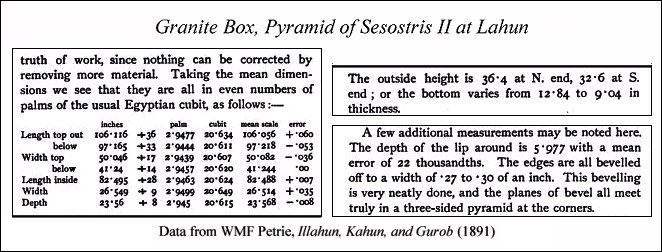


 Luke Piwalker