I am greatly indebted to DUNE at GHMB whose fascinating work on this object got me intrigued with it again. (I am referring to it herein as a “granite box” although the orthodox view is of course that it is a sarcophagus). For readers wanting more background on the pyramid of Sesostris II (Senusret II), Keith Hamilton’s Layman’s Guide to the Illahun pyramid is highly recommended.
I have posted previously about various aspects of the pyramid itself.

Section from WMF Petrie’s plan of the surprisingly elaborate internal structure of the Lahun (Illahun, El-Lahun) pyramid, showing the location of the granite box within the “granite sepulchre” chamber.
I don’t know how much optimism I have that I can solve the riddle of the box’s original design specifications – I’ve become accustomed to having difficulty solving the original proportions of any ancient Egyptian coffers. It’s as if the mathematics involved is so “Royal” as to nearly defy analysis sometimes – as if their original designs may be so brilliant as to nearly defy comprehension.
All the same, I can take some encouragement from various initial observations about the box, and from the idea that the box is not unlike the King’s Chamber in the Great Pyramid – deceptively simply at first glace.

Above: The “sepulchre chamber” containing the granite box. Note how the box is taller toward one end (the North end, to the right in the photo. Below: the sarcophagus chamber in Mycerinus’ pyramid at Giza, which is frequently compared to the Lahun pyramid’s sepulchre chamber on account of the rounded ceilings they have in common .

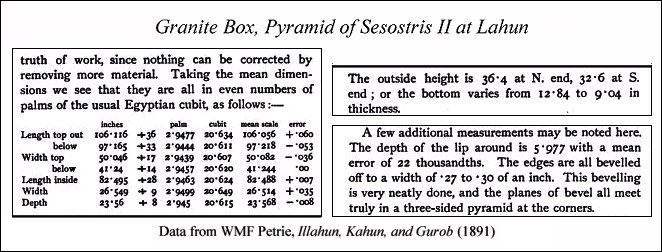
Above: the raw data from WMF Petrie for the dimensions of the Granite box. Below: diagram labelled with Petrie’s data and some extrapolations of the data.

Much of the data seems to simply be in units of the two most likely ancient Egyptian units to encounter, the Royal Cubit and the Remen. However it appears that that they managed include the Megalithic Yard, Megalithic Foot, and quite possibly other units that may be hiding in the unidentified values of 8.843, 0.4980833333, 0.75333333, and 1.07 ft. (It’s worth noting that 1.07 feet is close to the 1.067438159 ft Hashimi Cubit).
The particular suspected expression in Megalithic Feet is something of a surprise. This is something I consider more likely to be encountered in the ancient Americas, where the number may have been favored because of some of it’s astronomical properties. Mathematically, 1.96207628 is ((1 / 1.622311470) / Pi) x 10.
The value of 97.165 inches, labelled here as 6.666666666 Remens, is intriguing. It is likely to be exactly that: 6.66666666 x 1.216733603 = 8.111557353 ft = 16.22311470 / 2 ft. Some doubt remains because it might also be 16.18829140 / 2 = 8.091414570 = 97.12974840 inches.
(6.666666666 Remens is not a rational value in the Inductive Metrology sense, but for now it will do for purposes of discusssion).
We have found the value of 97.12974840 feet at Stonehenge as the inner lintel circle diameter, but only long after finding 80 Remens = 97.33868822 ft as the inner sarsen circle diameter.
16.22311470 comes first, so to speak. I frequently tell people that 1.622311470 and 1.177245771 are two of the most important things to try to build into every pyramid somehow, and the granite box appears to be no exception – note that from the raw data, the outer length (measured without, or below, the lip) divided by the inner length = 97.165 in / 82.495 in = 1.177828959, very likely to mean 1.177245771.
They have seemingly chosen the proportions very carefully so that this hugely important number appears as a ratio in the most straightforward manner possible.
It’s not entirely certain yet which form of the Megalithic Yard they used here. (In my experience, it’s best to start with 2.720174976, followed by 2.719256444, in investigating such matters).
Curiously, I’m not entirely certain which form of the Remen they used for the North end height, either. Normally we expect a certain amount of consistency with a subject when it comes to forms of a particular unit, but I’m seeing some possible schemes that may make the Short Remen out of the height value, whereas the “6.666666666” Remens of the outer length is almost certainly the Long Remen of 1.216733603.
Possibly, if the Remen used for the North end was the Long Remen of 1.216733603 ft, the Megalithic Yard used at the South end was probably 2.720174976 ft; if the Remen used for the North end was the Short Remen of 1.2158542204 ft, the Megalithic Yard used at the South end was probably 2.719256444.
There may be further metrological clues provided by some of the measures appearing to be simple fractions of others.
The 2.21075 figure is somewhat mysterious – not for lacking good candidates, but for lack of a decisive scheme to which the number belongs. Furthermore, it may repeat itself.


One candidate is 2 Indus Feet (2 Long Indus Feet = 2.201849257 ft); another is 2.219055999, and there is also 2.210485321 ft, which is the reciprocal of 1 / 2.210485321 = 4523.893421 / 10^n. One or all of these might be featured here depending on the actual specifics of how the proposed parts work together interactively.
452.3893421 ft is what I have traditionally given as the height of the Great Pyramid from the pavement with the apex section missing. In Royal Cubits, it is 1.622311470^2 x 10^n. That’s one of the ways they seem to have smuggled this number that all pyramids should contain, into the Great Pyramid – in spite of a rather busy agenda for what the design should be able to communicate.
So there is sort of an overview of some initial impressions. At least one more part should follow wherein we can take a closer look at some of what has been proposed. I emphasize the comparison to the King’s Chamber, of seeing something that may be very deceptively simple-looking, because the parts are simple, but how they have been chosen and combined may be nothing short of amazing.
–Luke Piwalker




 Luke Piwalker